


 一键配货
一键配货
化合物详情
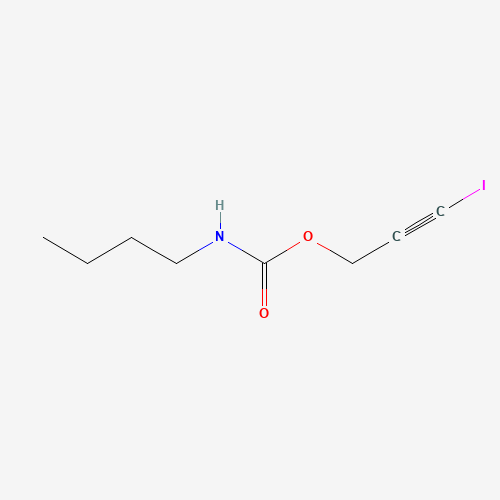
CAS55406-53-6
分子式C8H12INO2
分子量281.09 g/mol g/mol
危化品
Physical Description | 3-iodo-2-propynyl butylcarbamate is an off-white solid.
科学粮草官-词典编辑部,修订于:2026-07-06
Toxicity
ToxicityEPA Ecotoxicity
Pesticide Ecotoxicity Data from EPA: 18
Ecotoxicity Values
LC50 Colinus virginianus (Northern bobwhite, 10 days old) dietary >5620 ppm/8 days
Fate Summary
ATMOSPHERIC FATE: According to a model of gas/particle partitioning of semivolatile organic compounds in the atmosphere(1), 3-iodo-2-propynyl butyl carbamate, which has a vapor pressure of 5.25X10⁻⁵ mm Hg at 30 °C(2), is expected to exist in both the vapor and particulate phases in the ambient atmosphere. Vapor-phase 3-iodo-2-propynyl butylcarbamate is degraded in the atmosphere by reaction with photochemically-produced hydroxyl radicals(SRC); the half-life for this reaction in air is estimated to be 1.5 hours(SRC), calculated from its rate constant of 2.6X10⁻¹¹ cu cm/molecule-sec at 25 °C(SRC) that was derived using a structure estimation method(3). Particulate-phase 3-iodo-2-propynyl butylcarbamate may be removed from the air by wet and dry deposition(SRC).
Soil Adsorption / Mobility
Reported Koc values for 3-iodo-2-propynyl butylcarbamate range from 62-310(1). According to a classification scheme(2), this Koc range suggests that 3-iodo-2-propynyl butylcarbamate is expected to have high to moderate mobility in soil.
Environmental Biodegradation
ANAEROBIC: The half-life of radiolabeled 3-iodo-2-propynyl butylcarbamate was 1.5 hours at 22 °C in a non-sterile, static, anaerobic sediment-water test system compared to 13.3 hours in a sterile, static anaerobic sediment-water test system(1,2).
Environmental Bioconcentration
An estimated BCF of 36 was calculated for 3-iodo-2-propynyl butylcarbamate(SRC), using a water solubility of 156 mg/L(1) and a regression-derived equation(2). According to a classification scheme(3), this BCF suggests the potential for bioconcentration in aquatic organisms is moderate(SRC), provided the compound is not altered physically or chemically once released into the environment(SRP).
Volatilization from Water / Soil
The Henry's Law constant for 3-iodo-2-propynyl butylcarbamate is estimated as 1.2X10⁻⁷ atm-cu m/mole(SRC) derived from its vapor pressure, 5.25X10⁻⁵ mm Hg(1), and water solubility, 156 mg/L(1). This Henry's Law constant indicates that 3-iodo-2-propynyl butylcarbamate is expected to be essentially nonvolatile from moist soil or water surfaces(2). 3-Iodo-2-propynyl butylcarbamate is not expected to volatilize from dry soil surfaces(SRC) based upon its vapor pressure(1).
Environmental Abiotic Degradation
The rate constant for the vapor-phase reaction of 3-iodo-2-propynyl butylcarbamate with photochemically-produced hydroxyl radicals has been estimated as 2.6X10⁻¹¹ cu cm/molecule-sec at 25 °C(SRC) using a structure estimation method(1). This corresponds to an atmospheric half-life of about 1.5 hours at an atmospheric concentration of 5X10+5 hydroxyl radicals per cu cm(1). This substance is expected to undergo hydrolysis based on measured half-lives of 139 days at pH 7 and 0.98 days at pH 9(2). The half-life of 3-iodo-2-propynyl butylcarbamate was 13.3 hours in an aerobic, sterile, static sediment-water system(2,3). The primary hydrolysis metabolite of this substance is propargyl butyl carbamate(2,3).
Ecotoxicity Excerpts
/AQUATIC SPECIES/ The antisapstain chemicals DDAC and IPBC were tested for acute toxicity with juvenile rainbow trout. The 96-hr LC50 estimates were 537 ug DDAC and 67 ug IPBC/L. The two chemicals were also tested as a mixture (10:1) and as the commercial formulation NP-1. The 96-hr LC50 for NP-1 was 581 ug DDAC + IPBC/L and was 494 ug DDAC + IPBC/L for the 10:1 mixture. The two chemicals exhibited mildly antagonistic behavior when present in the mixture or formulation.
Artificial Pollution Sources
3-Iodo-2-propynyl butyl carbamate's production may result in its release to the environment through various waste streams; it's use as a fungicide in paint, adhesives, emulsion, paper coatings, metal cutting fluids, oil recovery drilling fluids, plastics, textiles, inks, canvas, air conditioner and furnace filters, and wood products(1) will result in its direct release to the environment(SRC).
Probable Routes of Human Exposure
The estimated daily exposure for handlers of 3-iodo-2-propynyl butylcarbamate in industrial settings ranges from 0.003-0.11 mg/kg/day for short and intermediate term exposures(1). Estimates range from 0.002-0.005 mg/kg/day for handlers in industrial settings that are chronically exposed. Short and intermediate term estimated daily exposures for handlers of 3-iodo-2-propynyl butylcarbamate in non-industrial settings range from 0.002-0.28 mg/kg/day for homeowners and from 0.09-1.30 mg/kg/day for occupational handlers. Estimated chronic exposures for occupational handlers in non-industrial settings range from 0.0009-0.33 mg/kg/day(1).
Environmental Fate / Exposure Summary
3-Iodo-2-propynyl butyl carbamate's production may result in its release to the environment through various waste streams; it's use as a fungicide in paint, adhesives, emulsion, paper coatings, metal cutting fluids, oil recovery drilling fluids, plastics, textiles, inks, canvas, air conditioner and furnace filters, and wood products will result in its direct release to the environment. If released to air, a vapor pressure of 5.25X10⁻⁵ mm Hg at 30 °C indicates 3-iodo-2-propynyl butylcarbamate will exist in both the vapor and particulate phases in the ambient atmosphere. Vapor-phase 3-iodo-2-propynyl butylcarbamate will be degraded in the atmosphere by reaction with photochemically-produced hydroxyl radicals; the half-life for this reaction in air is estimated to be 1.5 hours. Particulate...
Symptoms
As with organophosphates, the signs and symptoms are based on excessive cholinergic stimulation. Unlike organophosphate poisoning, carbamate poisonings tend to be of shorter duration because the inhibition of nervous tissue acetylcholinesterase is reversible, and carbamates are more rapidly metabolized. Muscle weakness, dizziness, sweating and slight body discomfort are commonly reported early symptoms. Headache, salivation, nausea, vomiting, abdominal pain and diarrhea are often prominent at higher levels of exposure. Contraction of the pupils with blurred vision, incoordination, muscle twitching and slurred speech have been reported. (L795)
Treatment
If the compound has been ingested, rapid gastric lavage should be performed using 5% sodium bicarbonate. For skin contact, the skin should be washed with soap and water. If the compound has entered the eyes, they should be washed with large quantities of isotonic saline or water. In serious cases, atropine and/or pralidoxime should be administered. Anti-cholinergic drugs work to counteract the effects of excess acetylcholine and reactivate AChE. Atropine can be used as an antidote in conjunction with pralidoxime or other pyridinium oximes (such as trimedoxime or obidoxime), though the use of '-oximes' has been found to be of no benefit, or possibly harmful, in at least two meta-analyses. Atropine is a muscarinic antagonist, and thus blocks the action of acetylcholine peripherally.
Health Effects
Acute exposure to cholinesterase inhibitors can cause a cholinergic crisis characterized by severe nausea/vomiting, salivation, sweating, bradycardia, hypotension, collapse, and convulsions. Increasing muscle weakness is a possibility and may result in death if respiratory muscles are involved. Accumulation of ACh at motor nerves causes overstimulation of nicotinic expression at the neuromuscular junction. When this occurs symptoms such as muscle weakness, fatigue, muscle cramps, fasciculation, and paralysis can be seen. When there is an accumulation of ACh at autonomic ganglia this causes overstimulation of nicotinic expression in the sympathetic system. Symptoms associated with this are hypertension, and hypoglycemia. Overstimulation of nicotinic acetylcholine receptors in the central...
Adverse Effects
Skin Sensitizer - An agent that can induce an allergic reaction in the skin.
Exposure Routes
Inhalation (L793); oral (L793); dermal (L793)
Toxicity Summary
3-Iodo-2-propynyl butyl carbamate is a cholinesterase or acetylcholinesterase (AChE) inhibitor. Carbamates form unstable complexes with chlolinesterases by carbamoylation of the active sites of the enzymes. This inhibition is reversible. A cholinesterase inhibitor suppresses the action of acetylcholine esterase. Because of its essential function, chemicals that interfere with the action of acetylcholine esterase are potent neurotoxins, causing excessive salivation and eye-watering in low doses. Headache, salivation, nausea, vomiting, abdominal pain and diarrhea are often prominent at higher levels of exposure. Acetylcholine esterase breaks down the neurotransmitter acetylcholine, which is released at nerve and muscle junctions, in order to allow the muscle or organ to relax. The result...
Human Toxicity Excerpts
/BIOMONITORING/ The preservative iodopropynyl butylcarbamate (IPBC) (0.1% in petrolatum) was tested in 4883 consecutive patients for 18 months between January 1998 and June 1999. ...According to readings at D3, 0.3% were allergic to IPBC, with 14 + and 2 + + reactions. Doubtful or irritant reactions occurred twice as frequently. Patients exposed for 24 hr (n=1814) reacted less frequently (0.1%) than the remaining patients exposed for 48 hr (0.5%). ...More than 80% of the positive reactions displayed a crescendo or plateau time pattern. Furthermore, 18 of 43 doubtful reactions appeared as late as D3 (thus, these could be false negative), whereas the majority of doubtful reactions occurred earlier and displayed a decrescendo pattern (corresponding to a typical irritant pattern).
Carcinogen Classification
No indication of carcinogenicity to humans (not listed by IARC).
Non-Human Toxicity Values
LD50 Rabbit dermal >2000 mg/kg /98% IPBC/ /from table/
Non-Human Toxicity Excerpts
/LABORATORY ANIMALS: Subchronic or Prechronic Exposure/ Troysan Polyphase P-100 (97.5% pure) was dermally administered to Sprague-Dawley Crl:CDBR VAF/Plus rats (10/sex/dose) at 0 (PEG 400=vehicle), 50, 200 and 500 mg/kg/day (with occlusion) for 91 days (6 hr/day, 5 days/wk). Systemic NOEL=50 mg/kg (Male body weight gains were statistically significantly decreased (p<0.05) at 500 mg/kg early in the study but thereafter weight gains were similar to controls. Cumulative body weight gains for males were statistically significantly decreased (p<0.05) over days 1-29 at 500 mg/kg, but thereafter weights were similar to controls. For males, food consumption was intermittently statistically significantly decreased at >200 mg/kg. Dermal NOEL=50 mg/kg (Clinical effects (erythema, edema, eschar, de...
Antidote and Emergency Treatment
Advanced treatment: Consider orotracheal or nasotracheal intubation for airway control in the patient who is unconscious, has severe pulmonary edema, or is in respiratory arrest. Positive pressure ventilation techniques with a bag valve mask device may be beneficial. Monitor cardiac rhythm and treat arrhythmias as necessary ... . Start an IV with D5W /SRP: "To keep open", minimal flow rate/. Use lactated Ringer's if signs of hypovolemia are present. Watch for signs of fluid overload. Consider drug therapy for pulmonary edema ... . For hypotension with signs of hypovolemia, administer fluid cautiously. Watch for signs of fluid overload ... . Treat seizures with diazepam (Valium) ... . Use proparacaine hydrochloride to assist eye irrigation ... . /Poison A and B/









