

 一键配货
一键配货
化合物详情
CAS56038-13-2
分子式C12H19Cl3O8
分子量397.63 g/mol g/mol
危化品
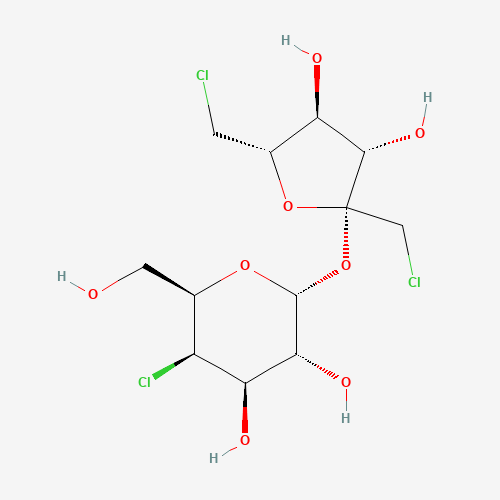
Sucralose is a disaccharide derivative consisting of 4-chloro-4-deoxy-alpha-D-galactopyranose and 1,6-dichloro-1,6-dideoxy-beta-D-fructofuranose units linked by a glycosidic bond. It has a role as a xenobiotic, a sweetening agent and an environmental contaminant. It is an organochlorine compound and a disaccharide derivative.
科学粮草官-词典编辑部,修订于:2026-07-06
Toxicity
ToxicityFate Summary
ATMOSPHERIC FATE: According to a model of gas/particle partitioning of semivolatile organic compounds in the atmosphere(1), sucralose, which has an estimated vapor pressure of 3.2X10⁻¹⁴ mm Hg at 25 °C(SRC), determined from a fragment constant method(2), is expected to exist solely in the particulate phase in the ambient atmosphere. Particulate-phase sucralose may be removed from the air by wet or dry deposition(SRC). Sucralose does not contain chromophores that absorb at wavelengths >290 nm(4), and therefore is not expected to be susceptible to direct photolysis by sunlight(SRC).
Soil Adsorption / Mobility
Using a structure estimation method based on molecular connectivity indices(1), the Koc of sucralose can be estimated to be 10(SRC). According to a classification scheme(2), this estimated Koc value suggests that sucralose is expected to have very high mobility in soil.
Environmental Biodegradation
ANAEROBIC: Sucralose was not mineralized in soil under anaerobic conditions(1).
Environmental Bioconcentration
An estimated BCF of three was calculated in fish for sucralose(SRC), using an estimated log Kow of -1.00(1) and a regression-derived equation(2). According to a classification scheme(3), this BCF suggests the potential for bioconcentration in aquatic organisms is low(SRC).
Volatilization from Water / Soil
The Henry's Law constant for sucralose is estimated as 4.0X10⁻¹⁹ atm-cu m/mole(SRC) using a fragment constant estimation method(1). This Henry's Law constant indicates that sucralose is expected to be essentially nonvolatile from water and moist soil surfaces(2). Sucralose is not expected to volatilize from dry soil surfaces(SRC) based upon an estimated vapor pressure of 3.2X10⁻¹⁴ mm Hg(SRC), determined from a fragment constant method(3).
Environmental Abiotic Degradation
Sucralose is not expected to undergo hydrolysis in the environment due to the lack of functional groups that hydrolyze under environmental conditions(1). Sucralose does not contain chromophores that absorb at wavelengths >290 nm(1), and therefore is not expected to be susceptible to direct photolysis by sunlight(SRC).
Environmental Water Concentrations
SURFACE WATER: A maxium sucralose concentration of 0.6 ug/L was reported in the River Glatt in Zurich, Switzerland, sampled between June and October 2008. It was not detected in eight area lakes(1).
Ecotoxicity Excerpts
/AQUATIC SPECIES/ .../The report presents sucralose/ bioaccumulation studies in the freshwater alga Pseudokirchneriella subcapitata, the crustacean Daphnia magna, and zebrafish (Danio rerio). The freshwater algae and the daphnid tests were performed using a 48-hr static exposure system, whereas the zebrafish test was performed using a 48-hr semi static exposure system followed by 48 hr flow-through of clean water for the depuration phase. All three studies were conducted with two exposure concentrations (10 and 100 mg/L), and the concentrations of sucralose in water and biota were verified by liquid chromatography/mass spectrometry. The studies showed that uptake of sucralose was assumed to achieve a steady state within the first 48 hr, and the bioconcentration factor at the assumed ste...
Effluent Concentrations
[Table#7889]: IkxvY2F0aW9uIiwiU2FtcGxlIERhdGUgKDIwMDgpIiwiVGhyb3VnaHB1dCAoY3UgbS9kYXkpIiwiSW5mbHVlbnQgKHVnL0wpIiwiRWZmbHVlbnQgKHVnL0wpIgoiR29zc2F1IiwiU2VwdGVtYmVyIDMwIiwiMjU2MCIsIjUuOCIsIjYuMiIKIkhvcmdlbiIsIkp1bmUgMTgiLCI5NzAwIiwiMi4yIiwiMi43IgoiTWFlbm5lZG9yZiIsIk1heSA3IiwiMzg1MCIsIjIuOCIsIjIuOSIKIk1laWxlbiIsIkp1bmUgMjMiLCIxMDQwMCIsIjMuNSIsIjQuNSIKIlJlZ2Vuc2RvcmYiLCJTZXB0ZW1iZXIgMTciLCI1NzMwIiwiMy4yIiwiMy4xIgoiUmljaHRlcnN3aWwiLCJKdW5lIDI0IiwiNDE1MCIsIjkuMSIsIjguOCIKIlVzdGVyIiwiU2VwdGVtYmVyIDMwIiwiMTUyNTAiLCI1LjUiLCI1LjIiCiJXYWVkZW5zd2lsIiwiQXByaWwgMjgiLCIxMDE2MCIsIjIuMCIsIjIuMCIKIldldHppa29uIiwiU2VwdGVtYmVyIDMwIiwiNzYxMCIsIjUuMiIsIjUuMiIKIlp1cmljaCIsIlNlcHRlbWJlciAyNCIsIjE1MDEwMCIsIjMuMyIsIjQuMSIK
Artificial Pollution Sources
Sucralose's production and use as a non-nutritive sweetener(1) may result in its release to the environment through various waste streams(SRC).
Probable Routes of Human Exposure
Occupational exposure to sucralose may occur through dermal contact with this compound at workplaces where sucralose is produced or used. Monitoring and use data indicate that the general population may be exposed to sucralose via ingestion of contaminated water and consumer containing sucralose. (SRC)
Environmental Fate / Exposure Summary
Sucralose's production and use as a non-nutritive sweetener may result in its release to the environment through various waste streams. If released to air, an estimated vapor pressure of 3.2X10⁻¹⁴ mm Hg at 25 °C indicates sucralose will exist solely in the particulate phase in the atmosphere. Particulate-phase sucralose will be removed from the atmosphere by wet or dry deposition. Sucralose does not contain chromophores that absorb at wavelengths >290 nm, and therefore is not expected to be susceptible to direct photolysis by sunlight. If released to soil, sucralose is expected to have very high mobility based upon an estimated Koc of 10. Volatilization from moist soil surfaces is not expected to be an important fate process based upon an estimated Henry's Law constant of 4.0X10⁻¹⁹ atm-...
Effect Level
collection=toxvaldb&kind=^EL$
Interactions
/The study/...investigated the ability of zinc sulfate (5, 25, 50 mM) to inhibit the sweetness of 12 chemically diverse sweeteners, which were all intensity matched to 300 mM sucrose [800 mM glucose, 475 mM fructose, 3.25 mM aspartame, 3.5 mM saccharin, 12 mM sodium cyclamate, 14 mM acesulfame-K, 1.04 M sorbitol, 0.629 mM sucralose, 0.375 mM neohesperidin dihydrochalcone (NHDC), 1.5 mM stevioside and 0.0163 mM thaumatin]. Zinc sulfate inhibited the sweetness of most compounds in a concentration dependent manner, peaking with 80% inhibition by 50 mM. Curiously, zinc sulfate never inhibited the sweetness of Na-cyclamate. This suggests that Na-cyclamate may access a sweet taste mechanism that is different from the other sweeteners, which were inhibited uniformly (except thaumatin) at every...
Lethal Dose
collection=toxvaldb&kind=^LD$
Toxicity Summary
Cosmetic Ingredient Review Finding(s): Safe in the present practices of use and concentration. Ingredient, concentration, and use information are available in documents discoverable at https://cir-reports.cir-safety.org
Human Toxicity Excerpts
/CASE REPORTS/ /The study/ report a patient with attacks of migraine consistently triggered by sucralose. She also suffers from menstrually related migraine that had been well-controlled for several months since she switched her contraceptive from fixed estrogen to triphasic contraceptive pills. Some attacks triggered by sucralose were preceded by aura, and she had never experienced migraine with aura before. Withdrawal of the compound was associated with complete resolution of the attacks. Single-blind exposure (vs. sugar) triggered the attacks, after an attack-free period.
Acceptable Daily Intakes
collection=toxvaldb&kind=^ADI$
Non-Human Toxicity Excerpts
/LABORATORY ANIMALS: Subchronic or Prechronic Exposure/ The toxicity of sucralose .../was/ evaluated in acute and subchronic toxicity studies. Acute oral toxicity studies in male and female mice and male rats documented no deaths or treatment-related signs at doses of 16 g/kg for mice and 10 g/kg for rats. Sucralose was administered to male and female rats for 4 and 8 weeks at dietary concentrations of 1.0, 2.5 or 5.0%. Achieved dose ranges (mg/kg/day) for the respective dietary levels were 737-1287, 1865-3218 and 2794-6406. There were no toxicologically significant effects observed at the 1.0% or 2.5% dietary levels. However, decreases in food consumption, body weight gain and selected organ weights and ratios as well as splenic and thymic histopathologic changes occurred in rats admin...
Antidote and Emergency Treatment
/SRP:/ Advanced treatment: Consider orotracheal or nasotracheal intubation for airway control in the patient who is unconscious, has severe pulmonary edema, or is in severe respiratory distress. Positive-pressure ventilation techniques with a bag valve mask device may be beneficial. Consider drug therapy for pulmonary edema ... . Consider administering a beta agonist such as albuterol for severe bronchospasm ... . Monitor cardiac rhythm and treat arrhythmias as necessary ... . Start IV administration of D5W /SRP: "To keep open", minimal flow rate/. Use 0.9% saline (NS) or lactated Ringer's if signs of hypovolemia are present. For hypotension with signs of hypovolemia, administer fluid cautiously. Watch for signs of fluid overload ... . Treat seizures with diazepam or lorazepam ... . Use...
Effects During Pregnancy and Lactation
Relevant published information was not found as of the revision date.