


 一键配货
一键配货
化合物详情
CAS57018-04-9
分子式C9H11Cl2O3PS
分子量301.13 g/mol g/mol
危化品
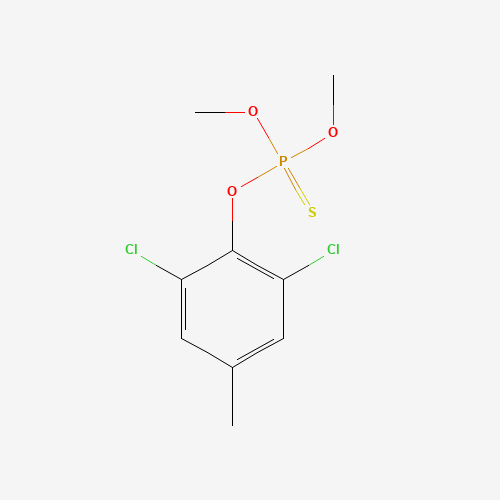
Tolclofos-methyl is an organic thiophosphate that is 2,6-dichloro-4-methylphenol in which the hydrogen of the hydroxy group group has been replaced by a dimethoxyphosphorothioyl group. Tolclofos-methyl is a phospholipid biosynthesis inhibitor and fungicide that is used for controlling soil-borne diseases caused by Typhula incarnata, Corticium rolfsii, Typhula ishikariensis, and Rhizoctonia solani. It has a role as an antifungal agrochemical. It is a dichlorobenzene and an organic thiophosphate.
科学粮草官-词典编辑部,修订于:2026-07-06
Toxicity
ToxicityEPA Ecotoxicity
Pesticide Ecotoxicity Data from EPA: 34
Fate Summary
ATMOSPHERIC FATE: According to a model of gas/particle partitioning of semivolatile organic compounds in the atmosphere(1), tolclofos-methyl, which has a vapor pressure of 4.3X10⁻⁴ mm Hg at 25 °C(2), is expected to exist solely as a vapor in the ambient atmosphere. Vapor-phase tolclofos-methyl is degraded in the atmosphere by reaction with photochemically-produced hydroxyl radicals(SRC); the half-life for this reaction in air is estimated to be 6 hours(SRC), calculated from its rate constant of 6.1X10⁻¹¹ cu cm/molecule-sec at 25 °C(SRC) that was derived using a structure estimation method(3). Tolclofos-methyl does not contain chromophores that absorb at wavelengths >290 nm(4) and, therefore, is not expected to be susceptible to direct photolysis by sunlight(SRC).
Soil Adsorption / Mobility
[Table#8518]: InBIIiwiJSBPcmdhbmljIGNhcmJvbiIsIiUgQ2xheSIsIktkIChtTC9nKSIKIjcuNSIsIjAuMDYiLCIyLjQiLCIyLjAiCiI1LjMiLCIxLjAyIiwiMzkuMCIsIjQ5LjAiCiI1LjgiLCIxLjQ2IiwiMjUuMyIsIjU3LjciCiI1LjUiLCI1LjIxIiwiMTAuOCIsIjI4OS4xIgoiNS44IiwiOC42NSIsIjEuOCIsIjE2Mi42Igo=
Environmental Biodegradation
AEROBIC: Tolclofos-methyl is rapidly biodegraded in the environment(1).
Environmental Bioconcentration
Tolclofos-methyl BCFs measured in guppy (Lebistes reticulatus), killifish (Oryzias latipes), goldfish (Carassius aurapus) and white cloud mountain fish (Tanichthys albonubes) were 828-1383, 714, 283 and 281, respectively(1). According to a classification scheme(2), these BCF values suggest bioconcentration in aquatic organisms is high to very high(SRC).
Volatilization from Water / Soil
The Henry's Law constant for tolclofos-methyl is estimated as 1.5X10⁻⁴ atm-cu m/mole(SRC) derived from its vapor pressure, 4.3X10⁻⁴ mm Hg(1), and water solubility, 1.1 mg/L(2). This Henry's Law constant indicates that tolclofos-methyl is expected to volatilize from water surfaces(3). Based on this Henry's Law constant, the volatilization half-life from a model river (1 m deep, flowing 1 m/sec, wind velocity of 3 m/sec)(3) is estimated as 15 hours(SRC). The volatilization half-life from a model lake (1 m deep, flowing 0.05 m/sec, wind velocity of 0.5 m/sec)(3) is estimated as 10 days(SRC). Tolclofos-methyl's estimated Henry's Law constant indicates that volatilization from moist soil surfaces may occur(SRC). Tolclofos-methyl is not expected to volatilize from dry soil surfaces(SRC) based...
Environmental Abiotic Degradation
The rate constant for the vapor-phase reaction of tolclofos-methyl with photochemically-produced hydroxyl radicals has been estimated as 6.1X10⁻¹¹ cu cm/molecule-sec at 25 °C(SRC) using a structure estimation method(1). This corresponds to an atmospheric half-life of about 6 hours at an atmospheric concentration of 5X10+5 hydroxyl radicals per cu cm(1). Tolclofos-methyl has a reported hydrolysis half-life of 90 days at pH 6.1(2). Tolclofos-methyl does not contain chromophores that absorb at wavelengths >290 nm(3) and, therefore, is not expected to be susceptible to direct photolysis by sunlight(SRC). The compound shows high peristence to photolysis in water and on soil(4). Tolclofos-methyl, applied to soil and exposed to sunlight outdoors from May-June had a degradation half-life of 1-2...
Environmental Water Concentrations
RAIN: Tolclofos-methyl was detected at <0.010-0.012 ug/L in six of eight rainwater samples taken May-Jul 1997 in South Holland, Netherlands(1). Tolclofos-methyl was detected in 1, 20 and 4% of rainwater samples collected 1999, 2000 and 2001 at locations in Flanders, Belgium at respective annual average concentrations of 0.026, 3.8 and 1.0 ng/L(2).
Food Survey Values
[Table#8517]: IkNvbW1vZGl0eSIsIk5vLiBTYW1wbGVkIiwiTm8uIERldGVjdGVkIiwiQ29uY24gKHBwbSkiCiJjZWxlcnkiLCIxMDAiLCI1IiwiMC4wMi0wLjgiCiJlbmRpdmUiLCI3NSIsIjMiLCIwLjAyLTAuMDciCiJsZXR0dWNlIiwiMTEyIiwiMTMiLCIwLjAyLTAuMzMiCiJwYXJzbGV5IiwiODQiLCIxIiwiMC4wMi0wLjE1IgoicmFkaXNoZXMiLCI5MSIsIjMiLCIwLjAyLTAuMTQiCiJsYW1icyBsZXR0dWNlIiwiMTAwIiwiNSIsIjAuMDItMS41Igo=
Milk Concentrations
Tolclofos-methyl was not detected (detection limit 0.002 mg/kg) in 20 milk samples collected from the market in China(1).
Plant Concentrations
The dissipation half-life of tolclofos-methyl from plants was reported as 1.54-2.13 days(1).
Effluent Concentrations
Tolclofos-methyl was detected at 0.003 ug/L in catchment water from a paddy in 1992, monitoring data was collected May-Nov each year from 1990 to 1993(1). Less than 1% of tolclofos-methyl was found in leachate samples collected 3-37 days after standard application to a golf course in Japan(2).
Atmospheric Concentrations
URBAN/SUBURBAN: Tolclofos-methyl was detected at 0.05 ng/cu m in atmospheric samples collected Apr 23-24, 1992 from Kitakyushu City, Japan; it was not detected (detection limit 0.04 ng/cu m) in samples collected Jul 21-22, 1991 in the same city(1).
Fish/Seafood Concentrations
Tolclofos-methyl was not detected (detection limit 5-10 ng/g) in pale chub (Zacco platypus), ayu sweetfish (Plecoglossus altivelis) or dark chub (Zacco temminckii) samples collected Apr 1992-Mar 1993 from seven rivers flowing into Lake Biwa, Japan(1).
Artificial Pollution Sources
Tolclofos methyl's production may result in its release to the environment through various waste streams; its use as a fungicide(1) will result in its direct release to the environment(SRC).
Sediment/Soil Concentrations
SEDIMENT: Tolclofos-methyl was not detected (detection limit 3 ug/kg) in sediment samples collected May-Sep 1999 from the Shin River, Niigata, Japan(1).
Probable Routes of Human Exposure
Occupational exposure to tolclofos-methyl may occur through inhalation and dermal contact with this compound at workplaces where tolclofos-methyl is produced or used. Monitoring data indicate that the general population may be exposed to tolclofos-methyl via ingestion of food containing residual fungicide. (SRC)
Other Environmental Concentrations
Tolclofos-methyl was not detected (detection limit 0.01 mg/kg) in raw wool samples from Uruguay(1).
Environmental Fate / Exposure Summary
Tolclofos-methyl's production may result in its release to the environment through various waste streams; its use as a fungicide will result in its direct release to the environment. If released to air, a vapor pressure of 4.3X10⁻⁴ mm Hg at 25 °C indicates tolclofos-methyl will exist solely as a vapor in the atmosphere. Vapor-phase tolclofos-methyl will be degraded in the atmosphere by reaction with photochemically-produced hydroxyl radicals; the half-life for this reaction in air is estimated to be 6 hours. Tolclofos-methyl does not contain chromophores that absorb at wavelengths >290 nm and, therefore, is not expected to be susceptible to direct photolysis by sunlight. If released to soil, tolclofos-methyl is expected to have low mobility based upon Koc values of 761-1540. Volatilizat...
Effect Level
collection=toxvaldb&kind=^EL$
Lethal Dose
collection=toxvaldb&kind=^LD$
Toxicity Summary
IDENTIFICATION AND USE: Tolclofos-methyl is agricultural fungicide. HUMAN STUDIES: Tolclofos-methyl induced weak responses in vitro in human estrogenicity assays. Negative results were reported for in vitro unscheduled DNA synthesis assay conducted in human carcinoma cells (HeLa). ANIMAL STUDIES: Tolclofos-methyl was minimally irritating to eyes and not irritating on skin when tested in rabbits. It was not a skin sensitizer when tested in guinea pigs. After acute exposure of rats, mice, and dogs to tolclofos-methyl, animals showed decreased spontaneous motor activity, dyspnea, piloerection, urinary incontinence and ataxia. Recovery was complete by day 10. Brain cholinesterase activity was lower 16 days after treatment in dogs given 1000 mg/kg bw than in animals given lower doses. In dog...
Average Daily Intake
Based on a total market basket survey conducted in Belgium from 1991 to 1993, the average daily intake of tolclofos-methyl was calculated to be 0.18 ng/kg/day(1).
Effect Concentration
collection=toxvaldb&kind=^EC$
Human Toxicity Excerpts
/ENDOCRINE MODULATION/ Twenty-four pesticides were tested for interactions with the estrogen receptor (ER) and the androgen receptor (AR) in transactivation assays. Estrogen-like effects on MCF-7 cell proliferation and effects on CYP19 aromatase activity in human placental microsomes were also investigated. Pesticides (endosulfan, methiocarb, methomyl, pirimicarb, propamocarb, deltamethrin, fenpropathrin, dimethoate, chlorpyriphos, dichlorvos, tolchlofos-methyl, vinclozolin, iprodion, fenarimol, prochloraz, fosetyl-aluminum, chlorothalonil, daminozid, paclobutrazol, chlormequat chlorid, and ethephon) were selected according to their frequent use in Danish greenhouses. In addition, the metabolite mercaptodimethur sulfoxide, the herbicide tribenuron-methyl, and the organochlorine dieldrin...
Non-Human Toxicity Values
LD50 Rat (male) sc >5000 mg/kg
Non-Human Toxicity Excerpts
/LABORATORY ANIMALS: Acute Exposure/ Two male and one female New Zealand white rabbits received 0.5 mL of '50% flowable' tolclofos-methyl on 1 sq inch (6.5 sq cm) of clipped dorsal intact or abraded skin for 4 hr under an occlusive dressing. No irritation was observed.
Antidote and Emergency Treatment
/SRP:/ Advanced treatment: Consider orotracheal or nasotracheal intubation for airway control in the patient who is unconscious, has severe pulmonary edema, or is in severe respiratory distress. Positive-pressure ventilation techniques with a bag valve mask device may be beneficial. Consider drug therapy for pulmonary edema ... . Consider administering a beta agonist such as albuterol for severe bronchospasm ... . Monitor cardiac rhythm and treat arrhythmias as necessary ... . Start IV administration of D5W TKO /SRP: "To keep open", minimal flow rate/. Use 0.9% saline (NS) or lactated Ringer's (LR) if signs of hypovolemia are present. For hypotension with signs of hypovolemia, administer fluid cautiously. Watch for signs of fluid overload ... . Treat seizures with diazepam (Valium) or l...









