

 一键配货
一键配货
化合物详情
CAS57837-19-1
分子式C15H21NO4
分子量279.33 g/mol g/mol
危化品
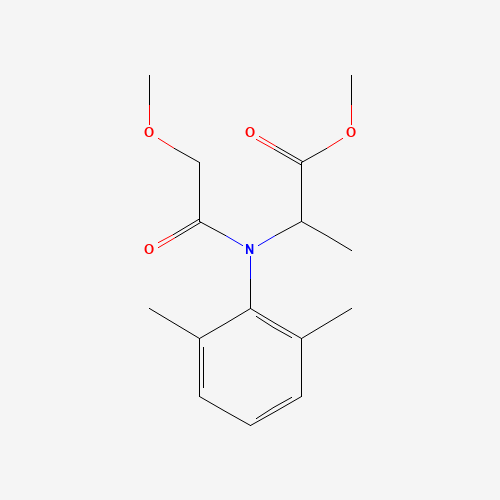
Methyl N-(2,6-dimethylphenyl)-N-(methoxyacetyl)alaninate is an alanine derivative that is methyl alaninate in which one of the hydrogens attached to the nitrogen is substituted by a methoxyacetyl group, while the other is substituted by a 2,6-dimethylphenyl group. It is an alanine derivative, a methyl ester, an ether, a carboxamide and an aromatic amide.
科学粮草官-词典编辑部,修订于:2026-07-06
Toxicity
ToxicityEPA Ecotoxicity
Pesticide Ecotoxicity Data from EPA: 55
Ecotoxicity Values
LC50 Bluegill sunfish 139-150 mg/L /Conditions of bioassay not specified/
Fate Summary
ATMOSPHERIC FATE: According to a model of gas/particle partitioning of semivolatile organic compounds in the atmosphere(1), metalaxyl, which has a vapor pressure of 5.62X10⁻⁶ mm Hg at 25 °C(2), will exist in both the vapor and particulate phases in the ambient atmosphere(SRC). Vapor-phase metalaxyl is degraded in the atmosphere by reaction with photochemically-produced hydroxyl radicals(SRC); the half-life for this reaction in air is estimated to be 14 hours(SRC), calculated from its rate constant of 27X10-12 cu cm/molecule-sec at 25 °C(SRC) that was derived using a structure estimation method(3). Particulate-phase metalaxyl may be removed from the air by wet and dry deposition(SRC). Metalaxyl undergoes photolysis in water(4) and, by analogy, may undergo direct photolysis in the atmosph...
Soil Adsorption / Mobility
Koc values for metalaxyl range from 30 to 284(1,2). According to a classification scheme(3), this range of Koc values suggests that metalaxyl is expected to have very high to moderate mobility in soil(SRC).
Environmental Biodegradation
ANAEROBIC: Degradation of metalaxyl is much slower in anaerobic soils compared to aerobic soils(1).
Environmental Bioconcentration
An estimated BCF of 4 was calculated for metalaxyl(SRC), using log Kow of 1.65(1) and a regression-derived equation(2). According to a classification scheme(3), this BCF suggests the potential for bioconcentration in aquatic organisms is low(SRC).
Volatilization from Water / Soil
The Henry's Law constant for metalaxyl is estimated as 3.0X10⁻⁹ atm-cu m/mole(SRC) derived from its vapor pressure, 5.62X10⁻⁶ mm Hg(1), and water solubility, 8,400 mg/l(1). This Henry's Law constant indicates that metalaxyl is expected to be essentially nonvolatile from moist soil and water surfaces(2). Metalaxyl is not expected to volatilize from dry soil surfaces(SRC) based upon its vapor pressure(1).
Environmental Abiotic Degradation
The rate constant for the vapor-phase reaction of metalaxyl with photochemically-produced hydroxyl radicals has been estimated as 27X10-12 cu cm/molecule-sec at 25 °C(SRC) using a structure estimation method(1). This corresponds to an atmospheric half-life of about 14 hours at an atmospheric concentration of 5X10+5 hydroxyl radicals per cu cm(1). Metalaxyl is resistant to chemical hydrolysis under environmental conditions(2). Under basic conditions, metalaxyl hydrolyzes according to first-order kinetics to metalaxyl acid(2). Half-life of metalaxyl at pH 10 and 25 °C is about 16 days(2). Photolysis of metalaxyl in aqueous solution at 290 nm resulted in 10% substrate transformation in 3 hours(3). Long time (65 hr) irradiation under artificial sunlight in the presence of humic acids result...
Environmental Water Concentrations
RAIN: The median concentration of metalaxyl in rainwater was 14 ng/l (max, 17 ng/l) in Gruze, Switzerland between February and October 1996(1). In Axios River basin, Greece, the mean concentration of metalaxyl was 0.14 ug/l in rainwater for 0.5% of the rain events(2). 40 rainwater samples were collected in Hanover, Germany and near Peine (lower Saxony, Germany) in 1992(3); the mean concentration of metalaxyl in these samples was 0.01 ug/l (range, 0.006-0.48 ug/l)(3); the concentration showed a seasonal dependance reflecting the application periods of metalaxyl(3).
Food Survey Values
The concn of metalaxyl in two samples of wine from Italy were 0.27 and 2.2 mg/kg(1). The mean concn of metalaxyl in endive, lettuce, apples, and strawberries were 0.008 ppm (max, 0.14 ppm; number of positive samples, 1.3%), 0.009 ppm (max, 0.38 ppm; number of positive samples, 0.9%), 0.002 ppm (max, 0.08 ppm; number of positive samples, 0.9%), and 0.009 ppm (max, 0.04 ppm; number of positive samples, 1.4%), respectively(2). The mean concn of metalaxyl in cucumber and tomato from Egyptian markets in 1995 was 0.24 mg/kg (frequency, 1 of 47 samples) and 0.15 mg/kg (frequency, 1 of 62 samples), respectively(3). The mean concn of metalaxyl in cucumber and grapes from Egyptian markets in 1996 was 0.18 mg/kg (frequency, 2 of 94 samples) and 0.20 mg/kg (frequency, 1 of 47 samples), respectively...
Artificial Pollution Sources
Metalaxyl's production may result in its release to the environment through various waste streams; its use as a fungicide(1) results in its direct release to the environment(SRC). In 1982, the annual use of metalaxyl in the US was 370,000 lbs AI/year(2).
Sediment/Soil Concentrations
SEDIMENT: The mean concentration of metalaxyl in sediments from the Sarno river in Italy was 1,560 ng/g dry wt(1).
Probable Routes of Human Exposure
Occupational exposure to metalaxyl may occur through inhalation and dermal contact with this compound at workplaces where metalaxyl is produced or used. Monitoring data indicate that the general population may be exposed to metalaxyl via ingestion of food contaminated with this compound. (SRC)
Environmental Fate / Exposure Summary
Metalaxyl's production may result in its release to the environment through various waste streams; its use as a fungicide results in its direct release to the environment. If released to air, a vapor pressure of 5.62X10⁻⁶ mm Hg at 25 °C indicates metalaxyl will exist in both the vapor and particulate phases in the ambient atmosphere. Vapor-phase metalaxyl will be degraded in the atmosphere by reaction with photochemically-produced hydroxyl radicals; the half-life for this reaction in air is estimated to be 14 hrs. Particulate-phase metalaxyl will be removed from the atmosphere by wet and dry deposition. If released to soil, metalaxyl is expected to have very high to moderate mobility based upon a Koc range from 30 to 284. Volatilization from moist soil surfaces is not expected to be an...
Symptoms
Metalaxyl is mildly irritating to the skin and eyes. Exposure to metalaxyl often results in such nonspecific symptoms as headache, dizziness, weakness, and nausea. Metaxyl poisoning can produce an allergic hypersensitivity dermatitis or asthma with bronchospasm and wheezing with chronic exposure. (T36)
Treatment
Consider gastric lavage, as well was dilution with milk or water after ingestion. Administer charcoal as a slurry following ingestion; however, activated charcoal should not be given to patients ingesting strong acidic or basic caustic chemicals. In case of inhalation, move patient to fresh air. Monitor for respiratory distress. If cough or difficulty breathing develops, evaluate for respiratory tract irritation, bronchitis, or pneumonitis. Administer oxygen and assist ventilation as required. Treat bronchospasm with inhaled beta2 agonist and oral or parenteral corticosteroids. Irrigate exposed eyes with copious amounts of room temperature water for at least 15 minutes. Following dermal exposure, remove contaminated clothing and wash exposed area thoroughly with soap and water. Treat de...
Interactions
Because metalaxyl is used on tobacco, a 90 day smoke inhalation study was conducted. Male & female Fischer 344 rats were exposed to smoke form cigarettes containing 0, 130, 3,900, or 13,000 ppm of metalaxyl for 4 hr/day, 5 days/wk. The max air concn of metalaxyl was 5 ug/L. The concns in test cigarettes were 100-1,000 times avg residue levels & 30-100 times greater than the expected max residue levels. Although the study was limited in its ability to simulate human exposure, the results were adequate to demonstrate toxicological effects from exposures are unlikely beyond that from exposures associated with heavy smoking. The profile of residues in inhalable smoke indicated 30% was metalaxyl, 4% was 2,6-dimethylaniline, & 65% was unidentified material.
Target Organs
Hepatic
Toxicity Data
LD50: 669 mg/kg (Oral, Rat) (L918) LD50: 7120 mg/kg (Oral, hamster) (L918) LD50: >6000 mg/kg (Dermal, Rabbit) (L918)
Health Effects
ARDS/acute lung injury, burns of the esophagus or gastrointestinal tract can result from metalaxyl poisoning. (T36)
Adverse Effects
Occupational hepatotoxin - Secondary hepatotoxins: the potential for toxic effect in the occupational setting is based on cases of poisoning by human ingestion or animal experimentation.
Exposure Routes
Inhalation (L917); oral (L917); dermal (L917); eye contact (L917).
Toxicity Summary
Binds to nAChRs in nervous systems. It also causes endocrine disruption in humans by binding to and inhibiting the estrogen receptor. (T10, A590)
Average Daily Intake
As part of Belgian Total Diet study in 1991-1993, the avg daily intake of metalaxyl was 0.03 mg/kg/day(1).
RAIS Toxicity Values
Oral Chronic Reference Dose Reference: IRIS Current
Carcinogen Classification
No indication of carcinogenicity to humans (not listed by IARC).
Non-Human Toxicity Values
LD50 Rabbit dermal >6000 mg/kg
Non-Human Toxicity Excerpts
/LABORATORY ANIMALS: Subchronic or Prechronic Exposure/ A 6 month study was conducted with beagle dogs fed diets containing 0, 50, 250, or 1,000 ppm of metalaxyl. The diet concns were equivalent to chemical intakes of 0, 1.6, 7.8, & 30.6 mg/kg/day for males, & 0, 1.7, 7.4, & 32.4 mg/kg/day for females, respectively. Exposure to the high dose was associated with an elevation in serum alkaline phosphatase & an incr in liver weight (absolute & relative to brain weight). No clinical signs or findings in hematology, urinalysis, or histopathology were related to treatment. The LOEL was 25 mg/kg/day & the NOEL was 6.3 mg/kg/day.
1 or Cancer Risk Level 1E-06
Fraction of Contaminant Absorbed Dermally from Soil: 0.1
Antidote and Emergency Treatment
Porphyria. Persons affected by porphyria should avoid sunlight, which exacerbates the dermal injury by porphyrins. /Miscellaneous organic fungicides/
Hazard Quotient Level 3 or Cancer Risk Level 1E-04
Fraction of Contaminant Absorbed Dermally from Soil: 0.1
USGS Health-Based Screening Levels for Evaluating Water-Quality
Reference: Smith, C.D. and Nowell, L.H., 2024. Health-Based Screening Levels for evaluating water-quality data (3rd ed.). DOI:10.5066/F71C1TWP