


 一键配货
一键配货
化合物详情
CAS60166-93-0
分子式C17H22I3N3O8
分子量777.08 g/mol
非危品
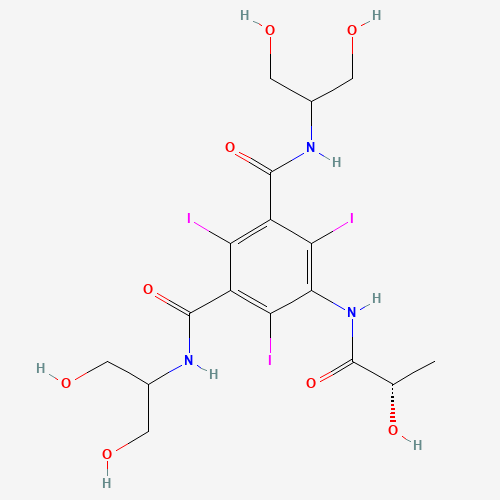
Iopamidol is a benzenedicarboxamide compound having N-substituted carbamoyl groups at the 1- and 3-positions, iodo substituents at the 2-, 4- and 6-positions and a (2S)-2-hydroxypropanamido group at the 5-position. It has a role as a xenobiotic, a radioopaque medium and an environmental contaminant. It is an organoiodine compound, a pentol and a benzenedicarboxamide.
科学粮草官-词典编辑部,修订于:2026-07-06
Toxicity
ToxicityFate Summary
ATMOSPHERIC FATE: According to a model of gas/particle partitioning of semivolatile organic compounds in the atmosphere(1), iopamidol, which has an estimated vapor pressure of 1.3X10⁻³⁰ mm Hg at 25 °C(SRC), determined from a fragment constant method(2), is expected to exist solely in the particulate phase in the ambient atmosphere. Particulate-phase iopamidol may be removed from the air by wet or dry deposition(SRC). Iopamidol contains chromophores that absorb at wavelengths >290 nm(4) and, therefore, may be susceptible to direct photolysis by sunlight(SRC).
Soil Adsorption / Mobility
The Koc of iopamidol is estimated as 10(SRC), using a log Kow of -2.42(1) and a regression-derived equation(2). According to a classification scheme(3), this estimated Koc value suggests that iopamidol is expected to have very high mobility in soil.
Environmental Biodegradation
AEROBIC: Iopamidol exhibited low biotransformation efficiency in a German conventional waster water treatment plant(1), indicating that biodegradation is not an important environmental fate process(SRC).
Environmental Bioconcentration
An estimated BCF of 3 was calculated in fish for iopamidol(SRC), using a log Kow of -2.42(1) and a regression-derived equation(2). According to a classification scheme(3), this BCF suggests the potential for bioconcentration in aquatic organisms is low(SRC).
Volatilization from Water / Soil
The Henry's Law constant for iopamidol is estimated as 1.1X10⁻²⁵ atm-cu m/mole(SRC) using a fragment constant estimation method(1). This Henry's Law constant indicates that iopamidol is expected to be essentially nonvolatile from water surfaces(2). Iopamidol is not expected to volatilize from dry soil surfaces(SRC) based upon an estimated vapor pressure of 1.3X10⁻³⁰ mm Hg(SRC), determined from a fragment constant method(3).
Environmental Abiotic Degradation
Iopamidol is not expected to undergo hydrolysis in the environment due to the lack of functional groups that hydrolyze under environmental conditions(1). Iopamidol contains chromophores that absorb at wavelengths >290 nm(1) and, therefore, may be susceptible to direct photolysis by sunlight(SRC).
Environmental Water Concentrations
SURFACE WATER: Iopamidol concentrations in surface water of the Netherlands between 1996 and 2005 ranged from approximately 10 to 300 ng/L with an outlier at 500 ng/L(1). The median concentration reported in 25 German rivers and creeks monitored from 1997-1998 was 0.49 ug/L; max of 2.8 ug/L, with 24 samples above the detection limit of 0.010 ug/L(2). The compound was reported at median concentrations of 210 upstream of a sewage treatment plant at Ulm/Boefingen and 210 ng/L downstream at Leipheim (maximum of 470 and 520 ug/L, respectively) both located on the River Danube in South Germany, sampling conducted in 2004(3). The compound was detected at a concentration of 0.30 ug/L in groundwater samples from the Rhine River at Koblenz, Germany sampled on November 18, 2009(4).
Effluent Concentrations
Iopamidol was detected at a concentration of approximately 4000 ng/L in an industrial waste water of the Netherlands in 2002. Total riverine discharge was estimated at 8.841 tons/yr in 2002(1). The compound was present at concentrations of 4.2, 11.1, 4, not detected, 4.2, 2.8, 0.6, and 1 ug/L in individual German municipal sewage treatment plants monitored from 1997 to 1998. The plants were associated with a city, 300,000 population equivalents, with 12 hospitals; 3 plants without hospitals, 20,000-40,000 population equivalents; 3 plants without hospitals, rural with >12,000 population equivalents; and one rural plant associated with a hospital. The median concentration reported in 25 German sewage treatment plants monitored from 1997-1998 was 0.66 ug/L; max of 15 ug/L, with 20 samples...
Artificial Pollution Sources
Iopamidol's production and use as a diagnostic contrast agent(1) may result in its release to the environment through various waste streams(SRC).
Probable Routes of Human Exposure
Occupational exposure to iopamidol may occur through dermal contact with this compound at workplaces where iopamidol is produced or used. Monitoring data indicate that the general population may be exposed to iopamidol via ingestion of drinking water. (SRC)
Environmental Fate / Exposure Summary
Iopamidol's production and use as a diagnostic contrast agent may result in its release to the environment through various waste streams. If released to air, an estimated vapor pressure of 1.3X10⁻³⁰ mm Hg at 25 °C indicates iopamidol will exist solely in the particulate phase in the atmosphere. Particulate-phase iopamidol will be removed from the atmosphere by wet or dry deposition. Iopamidol contains chromophores that absorb at wavelengths >290 nm and, therefore, imay be susceptible to direct photolysis by sunlight. If released to soil, iopamidol is expected to have very high mobility based upon an estimated Koc of 10. Iopamidol may not volatilize from dry soil surfaces based upon its vapor pressure. Iopamidol exhibited low biotransformation efficiency in a conventional waster water tr...
Interactions
Renal toxicity has been reported in a few patients with liver dysfunction who were given oral cholecystographic agents followed by intravascular contrast agents. Administration of intravascular agents should therefore be postponed in any patient with a known or suspected hepatic or biliary disorder who has recently received a cholecystographic contrast agent.
Lethal Dose
collection=toxvaldb&kind=^LD$
Human Toxicity Excerpts
/CASE REPORTS/ Iopamidol, a water-soluble contrast agent, has been rarely associated with seizures. /Investigators/ describe a case of generalized tonic-clonic seizure after cervical myelography with iopamidol in a previously healthy young man. In patients presenting with seizures, a history of recent myelography should be considered as an etiology. Iopamidol myelography may be associated with a risk of seizures. Clinicians need to be aware of this complication and inform their patients about such risk.
Non-Human Toxicity Values
LD50 Mouse intravenous 33 g/kg
Non-Human Toxicity Excerpts
/LABORATORY ANIMALS: Acute Exposure/ Contrast-induced nephropathy is a prevalent cause of renal failure, and the mechanisms underlying this injury are not fully understood. /Investigators/ utilized noninvasive functional MRI in order to determine the serial effect of a single administration of iodinated contrast media (CM) on renal hemodynamics and oxygenation. Fifteen rabbits were randomized to receive an intravenous injection of CM (i.e. iopamidol-370; 6 mL kg(-1) body weight) or an equivalent amount of 0.9% saline. Both arterial spin-labeling and blood oxygen level-dependent imaging sequences were performed at 24 hr before and at intervals of 1, 24, 48 and 72 hr after injection to obtain serial renal blood flow (RBF) and relative spin-spin relaxation rate (R(2) *). Results showed tha...
Populations at Special Risk
Contrast media may promote sickling in individuals who are homozygous for sickle cell disease when injected intravenously or intraarterially.
Antidote and Emergency Treatment
/SRP:/ Advanced treatment: Consider orotracheal or nasotracheal intubation for airway control in the patient who is unconscious, has severe pulmonary edema, or is in severe respiratory distress. Positive-pressure ventilation techniques with a bag valve mask device may be beneficial. Consider drug therapy for pulmonary edema ... . Consider administering a beta agonist such as albuterol for severe bronchospasm ... . Monitor cardiac rhythm and treat arrhythmias as necessary ... . Start IV administration of D5W /SRP: "To keep open", minimal flow rate/. Use 0.9% saline (NS) or lactated Ringer's if signs of hypovolemia are present. For hypotension with signs of hypovolemia, administer fluid cautiously. Watch for signs of fluid overload ... . Treat seizures with diazepam or lorazepam ... . Use...
Effects During Pregnancy and Lactation
◉ Effects on Lactation and Breastmilk









