

 一键配货
一键配货
化合物详情
CAS60207-90-1
分子式C15H17Cl2N3O2
分子量342.22 g/mol g/mol
危化品
Physical Description | Yellowish odorless liquid. Non corrosive. Used as a fungicide.
科学粮草官-词典编辑部,修订于:2026-07-06
Toxicity
ToxicityEPA Ecotoxicity
Pesticide Ecotoxicity Data from EPA: 73
Ecotoxicity Values
LD50 Apis mellifera (Honey bee, adult) topical >25 ug/bee[USEPA, Office of Pesticide Programs; Pesticide Ecotoxicity Database (2000) on 1-[
Fate Summary
ATMOSPHERIC FATE: According to a model of gas/particle partitioning of semivolatile organic compounds in the atmosphere(1), propiconazole, which has a vapor pressure of 4.2X10⁻⁷ mm Hg at 25 °C(2), will exist solely in particulate phase in the ambient atmosphere. Particulate-phase propiconazole may be removed from the air by wet and dry deposition(SRC). Propiconazole does not absorb at wavelengths >290 nm(2) and has been shown to be resistant to direct photolysis from sunlight(3).
Soil Adsorption / Mobility
Measured Koc values of propiconazole ranged from 1,200-8,100(SRC). According to a classification scheme(2), these Koc values suggest that propiconazole is expected to have slight to no mobility in soil.
Environmental Biodegradation
AEROBIC: In a laboratory experiment using 3 different types of Norwegian soils, fine sandy loam from Hole, loam from Kroer and highly decomposed organic material from Froland forest, propiconazole had half-lives of 137, 210 and 20 days, respectively(1). Autoclaved soils were used as control and showed decreased amount of degradation. In a separate study, C14-labeled propiconazole was placed in a rice paddy soil lysimeter. Mineralization of propiconazole from the rice paddy soil appeared to proceed slowly with about 5.7-9.8% of the 14C label being converted into carbon dioxide(2).
Environmental Bioconcentration
An estimated BCF of 146 was calculated for propiconazole(SRC), using a log Kow of 3.72 and a regression-derived equation(2). According to a classification scheme(3), this BCF suggests the potential for bioconcentration in aquatic organisms is high(SRC).
Volatilization from Water / Soil
The Henry's Law constant for propiconazole is estimated as 9.1X10⁻¹⁰ atm-cu m/mole(SRC) derived from its vapor pressure, 4.2X10⁻⁷ mm Hg(1), and water solubility, 100 mg/L(1). This Henry's Law constant indicates that propiconazole is expected to be essentially nonvolatile from moist soil and water surfaces(2). Propiconazole is not expected to volatilize from dry soil surfaces(SRC) based upon its vapor pressure(1).
Environmental Abiotic Degradation
No hydrolysis of propiconazole at environmentally relevant pH has been observed(1,3). Propiconazole does not absorb at wavelengths >290 nm(1) and has been shown to be resistant to direct photolysis from direct sunlight(2).
Environmental Water Concentrations
RAIN/SNOW: Propiconazole was detected in the rainfall in Germany at concentrations of less than 30 ng/L to 53 ng/L(1). Propiconazole was identified, not quantified in the rainfall in Norway(2).
Food Survey Values
Propiconazole was detected in celery with a mean concentration of 0.034 ppm(1). Propiconazole was detected in wine with a mean concentration of 0.0009 ppm(1). Propiconazole was detected in must (0.01 mg/L), white wine (0.01 mg/L) and red wine 0.70 mg/L(2). Propiconazole was found in 1/13 apple samples from an Egyptian market with a concentration of 0.39 mg/kg(3).
Ecotoxicity Excerpts
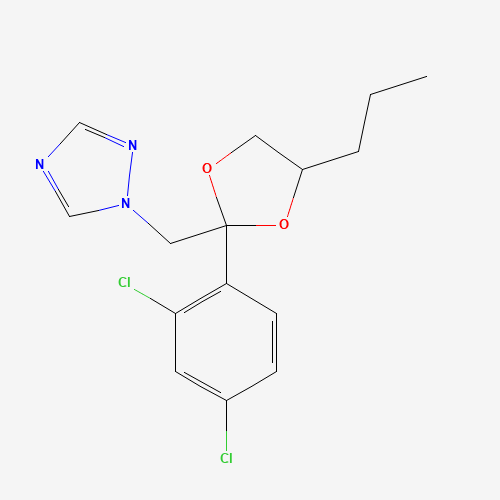
/AQUATIC SPECIES/ The fungicide propiconazole (1-(2-(2,4-dichlorophenyl)-4-propyl-1,3-dioxolan-2-ylmethyl) -1H-1,2,4-triazole) induced the hepatic cytochrome P4501A (CYP1A) activity towards ethoxyresorufin-O-deethylase (EROD), the content of CYP1A protein as quantified by enzyme-linked immunosorbent assay (ELISA) and the glutathione S-transferase (GST) activity towards the three commonly used substrates CDNB(1-chloro-2,4-dinitrobenzene), cumene hydroperoxide (CU) and ethachrynic acid (EA) in brown trout (Salmo trutta) depending on dose and body weight. An exponential dose response relationship existed between propiconazole exposure and CYP1A activity. A 2. order polynomial regression of the propiconazole concentration (square root transformed) on the data for CDNB, EU and CU revealed a...
Effluent Concentrations
Propiconazole was detected in the effluent of an agricultural site in Sweden at a maximum concentration of 2 ug/L(1). Propiconazole was found in the runoff water of 4 out of 5 Costa Rican Banana plantations in concentrations ranging from 24.2-6.1 ug/L(2).
Artificial Pollution Sources
Propiconazole's production may result in its release to the environment through various waste streams; it's use as a fungicide(1,2) will result in its direct release to the environment(SRC).
Sediment/Soil Concentrations
SEDIMENT: Propiconazole was detected in 4 out 4 mobile sediment samples in concentrations ranging from 5-10 ug/kg dry weight(1). The same study showed propiconizole in 3 out of 4 bed sediment samples with concentrations ranging from 20-30 ug/kg dry weight(1).
Probable Routes of Human Exposure
Occupational exposure to propiconazole may occur through dermal contact with this compound at workplaces where propiconazole is produced or used. Monitoring data indicate that the general population may be exposed to propiconazole via ingestion or dermal contact with contaminated food and water. (SRC)
Environmental Fate / Exposure Summary
Propiconazole's production may result in its release to the environment through various waste streams; it's use as a fungicide will result in its direct release to the environment. If released to air, a vapor pressure of 1X10⁻⁶ mm Hg at 25 °C indicates propiconazole will exist in both the vapor and particulate phases in the atmosphere. Vapor-phase propiconazole will be degraded in the atmosphere by reaction with photochemically-produced hydroxyl radicals; the half-life for this reaction in air is estimated to be 5.5 hours. Particulate-phase propiconazole will be removed from the atmosphere by wet or dry deposition. Propiconazole has been reportated to be stable to photolysis. If released to soil, propiconazole has reported soil mobility ranging from moderate to immobile depending on the...
Target Organs
Gastrointestinal
Toxicity Data
LC50 (rat) =1,264 mg/m3/4h
Health Effects
Propiconazole can cause corneal opacity that is reversible with 72 hours. In animal chronic toxicity tests, the benign and malignant liver tumors were found in rats and mice. Propiconazole is categorized as a possible human carcinogen. Propiconazole is also a developmental toxin that caused skeletal deformations in newborn pups.
Adverse Effects
Skin Sensitizer - An agent that can induce an allergic reaction in the skin.
Toxicity Summary
Propiconazole can decrease cholesterol levels that may cause polyploidy and disruption of mitotic cell cycling. It down-regulates the PTEN pathway and up-regulates the WNT-beta-catenin signaling pathway, that would stimulate cell proliferation and may lead to the tumorigenic outcome. (A15329)
Average Daily Intake
The average daily intake of propiconazole for persons in Belgium was calculated as 0.04 mg/kg day(1).
RAIS Toxicity Values
Oral Chronic Reference Dose Reference: OPP
Carcinogen Classification
Not listed by IARC.
Non-Human Toxicity Values
LD50 Mouse oral 1490 mg/kg
Non-Human Toxicity Excerpts
/LABORATORY ANIMALS: Subchronic or Prechronic Exposure/ Groups of RAIf (SPF) rats (10/sex/group) were orally administered 0, 50, 150 and 450 mg propiconazole (purity 91.6%) in 2% carboxymethylcellulose/kg bw for 28 days. All animals were observed daily for mortality and signs of toxicity while body weight and food consumption were recorded weekly. Hematology, clinical chemistry and urinalysis were recorded at the end of the test period on 5 rats/sex. All surviving animals were killed and a complete gross and histopathological examination was performed. Selected organs were weighed. There were no effects on body weight. Food consumption was decreased in high dosed females and these animals showed sedation, dyspnea and ruffled fur during the first week of treatment. One mid and 2 high dos...
1 or Cancer Risk Level 1E-06
Fraction of Contaminant Absorbed Dermally from Soil: 0.1
Antidote and Emergency Treatment
/SRP:/ Advanced treatment: Consider orotracheal or nasotracheal intubation for airway control in the patient who is unconscious, has severe pulmonary edema, or is in severe respiratory distress. Positive-pressure ventilation techniques with a bag valve mask device may be beneficial. Consider drug therapy for pulmonary edema ... . Consider administering a beta agonist such as albuterol for severe bronchospasm ... . Monitor cardiac rhythm and treat arrhythmias as necessary ... . Start IV administration of D5W /SRP: "To keep open", minimal flow rate/. Use 0.9% saline (NS) or lactated Ringer's if signs of hypovolemia are present. For hypotension with signs of hypovolemia, administer fluid cautiously. Watch for signs of fluid overload ... . Treat seizures with diazepam or lorazepam ... . Use...
Hazard Quotient Level 3 or Cancer Risk Level 1E-04
Fraction of Contaminant Absorbed Dermally from Soil: 0.1
USGS Health-Based Screening Levels for Evaluating Water-Quality
Reference: Smith, C.D. and Nowell, L.H., 2024. Health-Based Screening Levels for evaluating water-quality data (3rd ed.). DOI:10.5066/F71C1TWP