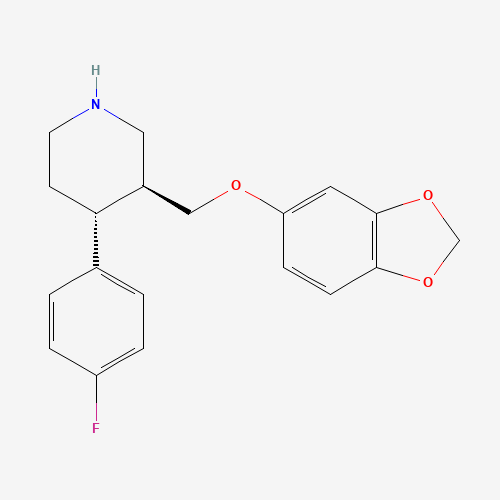
Ecotoxicity Values
LC50; Species: Ceriodaphnia dubia (Water Flea) age <24 hr neonate, 3rd or 4th brood; Conditions: freshwater, static, 24-26 °C, pH 8.1-8.35, hardness 78-93 mg/L CaCO3, alkalinity 64-78 mg/L CaCO3, dissolved oxygen 5.6-6.8 mg/L; Concentration: 580 ug/L for 48 hr /99.86% purity/
Fate Summary
ATMOSPHERIC FATE: According to a model of gas/particle partitioning of semivolatile organic compounds in the atmosphere(1), paroxetine, which has an estimated vapor pressure of 4.8X10⁻⁸ mm Hg at 25 °C(SRC), determined from a fragment constant method(2), is expected to exist solely in the particulate phase in the ambient atmosphere. Particulate-phase paroxetine may be removed from the air by wet and dry deposition(SRC). Photodegradation first order rate constants of 0.29 and 0.27/hr were reported with half-lives of 2.6 and 2.4 hours, respectively(3).
Soil Adsorption / Mobility
Log Koc values of 5.46, 4.04 and 3.91 were measured in loamy sand (6.25% clay, 7.50% silt, 86.25% sand, pH 5.0), sandy loam (7.50% clay, 16.75% silt, 75.75% sand, pH 7.8) and loamy sand soils (5.00% clay, 8.50% silt, 86.50% sand, pH 7.8), respectively(1). These values correspond to Koc values of 2.9X10+5, 1.1X10+4 and 8,128, respectively(SRC). According to a classification scheme(2), these Koc value suggests that paroxetine is expected to be immobile in soil. The pKa of paroxetine is 9.6(3), indicating that this compound will exist almost entirely in the cation form in the environment and cations generally adsorb more strongly to soils containing organic carbon and clay than their neutral counterparts(4). Paroxetine was shown to absorb strongly to sewage treatment plant biosolids, with...
Environmental Bioconcentration
An estimated BCF of 3 was calculated in fish for paroxetine(SRC), using a log Kow of 1.23(1) and a regression-derived equation(2). According to a classification scheme(3), this BCF suggests the potential for bioconcentration in aquatic organisms is low(SRC).
Volatilization from Water / Soil
A pKa of 9.6(1) indicates paroxetine will exist almost entirely in the cation form at pH values of 5 to 9 and, therefore, volatilization from water surfaces is not expected to be an important fate process(SRC). Paroxetine is not expected to volatilize from dry soil surfaces(SRC) based upon an estimated vapor pressure of 4.8X10⁻⁸ mm Hg(SRC), determined from a fragment constant method(2).
Environmental Abiotic Degradation
Paroxetine, present at 321.84 mg/L, degraded 1.65 and 6.95% in deionized water and a pH 9.0 buffer solution, respectively, over 5 days. It is considered hydrolytically stable with a hydrolysis half-life of > 1 year(1). Paroxetine in aqueous solutions stored under dark conditions was found to be stable after 30 days(2). It was reported that paroxetine is completed degraded within 4 days by simulated sunlight in aqueous media(2). Photodegradation first-order rate constants of 0.29 and 0.27/hr were reported with half-lives of 2.6 and 2.4 hours, respectively(1). Photolysis rates of paroxetine hydrochloride at pH 5, 7, and 9 were 15.79, 13.11 and 11.35 hours, respectively(2).
Environmental Water Concentrations
SEAWATER: Paroxetine was not detected in seawater from Tromso Norway(1).
Milk Concentrations
EXPERIMENTAL: The study was carried out to quantify the excretion of the selective serotonin reuptake inhibitor paroxetine in breast milk. In 6 lactating women, the concentrations of paroxetine in breast milk and serum were studied at the times for assumed minimum (24 hours after dose intake) and maximum (4-7 hours after dose intake) drug levels in milk. Moreover, a seventh subject was studied with frequent and regular sampling throughout a dose interval of 24 hours at 2 different dose levels. The mean milk/serum concentration ratios in the first 6 subjects ranged from 0.39 to 1.11 (overall mean +/- SD = 0.69 +/- 0.29), and the mean estimated dose to the infants ranged from 0.7% to 2.9% (overall mean +/- SD = 1.4% +/- 0.79%) of the weight-adjusted maternal dose. Based on area-under-the-...
Ecotoxicity Excerpts
/AQUATIC SPECIES/ ...In the present study, ... the toxicities of five SSRIs (citalopram, fluoxetine, fluvoxamine, paroxetine, and sertraline) as single substances and of citalopram, fluoxetine, and sertraline in binary mixtures /were tested/ in two standardized bioassays. Test organisms were the freshwater algae Pseudokirchneriella subcapitata and the freshwater crustacean Daphnia magna. In algae, test median effect concentrations (EC50s) ranged from 0.027 to 1.6 mg/L, and in daphnids, test EC50s ranged from 0.92 to 20 mg/L, with sertraline being one of the most toxic compounds. ...
Effluent Concentrations
Paroxetine was not detected in 84 samples of wastewater from treatment plants at the Spanish Mediterranean area of Valencia. Sampling occurred in June 2008, January 2009, April 2009, and October 2009; detection limit range = 0.17 to 0.27 ug/L(1). Paroxetine was analyzed for but not detected in effluents from 90 European wastewater treatment plants, sampled in 2010(2). The compound was not detected in sewage from Tromso Norway(3).
Fish/Seafood Concentrations
Paroxetine was analyzed for but not detected (detection limit - 0.015 ng/g)in white sucker brains (Castostomus commersoni) from Boulder Creek, CO and not detected to 0.8 ng/L in Fourmile Creek, IA, sampled in 2005(1).
Artificial Pollution Sources
Paroxtine's production and administration as a human(1) and canine and feline antidepressant(1) may result in its release to the environment through various waste streams(SRC).
Sediment/Soil Concentrations
SEDIMENT: Paroxetine was detected at a concentration range of not detected (detection limit = 0.25 ng/g) to 3.43 ng/g in sediments from Boulder Creek, CO, sampled in 2005(1).
Probable Routes of Human Exposure
Occupational exposure to paroxetine may occur through inhalation and dermal contact with this compound at workplaces where paroxetine is produced or used. Exposure to paroxetine among the general population may be limited to those administered the drug. (SRC)
Environmental Fate / Exposure Summary
Paroxetine's production and administration as an antidepressant may result in its release to the environment through various waste streams. If released to air, an estimated vapor pressure of 4.8X10⁻⁸ mm Hg at 25 °C indicates paroxetine will exist solely in the particulate phase in the atmosphere. Particulate-phase paroxetine will be removed from the atmosphere by wet and dry deposition. Photodegradation first order rate constants of 0.29 and 0.27/hr were reported with half-lives of 2.6 and 2.4 hours, respectively. If released to soil, paroxetine is expected to be immobile based upon a Koc values ranging from 8,128 to 2.9X10+5. The pKa of paroxetine is 9.6, indicating that this compound will exist almost entirely in the cation form in the environment and cations generally adsorb more str...
Symptoms
Coma, dizziness, drowsiness, facial flushing, nausea, sweating, tremor, vomiting
Treatment
Treatment should consist of those general measures employed in the management of overdosage with any drugs effective in the treatment of major depressive disorder. Ensure an adequate airway, oxygenation, and ventilation. Monitor cardiac rhythm and vital signs. General supportive and symptomatic measures are also recommended. Induction of emesis is not recommended. Gastric lavage with a large-bore orogastric tube with appropriate airway protection, if needed, may be indicated if performed soon after ingestion, or in symptomatic patients. Activated charcoal should be administered. Due to the large volume of distribution of this drug, forced diuresis, dialysis, hemoperfusion, and exchange transfusion are unlikely to be of benefit. No specific antidotes for paroxetine are known. (L1712)
Interactions
A 69-year-old white female presented to the emergency department with a history of confusion and paranoia over the past several days. On admission the patient was taking carvedilol 12 mg twice daily, warfarin 2 mg/day, folic acid 1 mg/day, levothyroxine 100 microg/day, pantoprazole 40 mg/day, paroxetine 40 mg/day, and flecainide 100 mg twice daily. Flecainide had been started 2 weeks prior for atrial fibrillation. Laboratory test findings on admission were notable only for a flecainide plasma concentration of 1360 ug/L (reference range 200-1000). A metabolic drug interaction between flecainide and paroxetine, which the patient had been taking for more than 5 years, was considered. Paroxetine was discontinued and the dose of flecainide was reduced to 50 mg twice daily. Her delirium resol...
Toxicity Data
LD50: 500mg/kg (Oral, Mouse) (A308)
Hepatotoxicity
Likelihood score: B (likely but rare cause of clinically apparent liver injury).
Adverse Effects
* Gastrointestinal: Constipation, diarrhea, nausea
Exposure Routes
Paroxetine hydrochloride is slowly, but completely absorbed following oral administration. Paroxetine mesylate salt is also completely absorbed after oral dosing. The oral bioavailability appears to be low due to extensive first-pass metabolism. Paroxetine hydrochloride oral tablets and suspension are reportedly bioequivalent. Absorption of either salt form is not substantially affected by food. Peak concentrations of Brisbelle (mesylate salt) were reached at 6 hours (3 to 8 hours range). Steady state Cmax was 13.10 ng/mL. The steady state AUC (0-last) was 237 hr*ng/mL. Paroxetine mesylate generally follows non-linear pharmacokinetics because CYP2D6, the enzyme that is part responisible for paroxetine metabolism, is readily saturable.
Toxicity Summary
Paroxetine is a potent and highly selective inhibitor of neuronal serotonin reuptake. Paroxetine likely inhibits the reuptake of serotonin at the neuronal membrane, enhances serotonergic neurotransmission by reducing turnover of the neurotransmitter, therefore it prolongs its activity at synaptic receptor sites and potentiates 5-HT in the CNS; paroxetine is more potent than both sertraline and fluoxetine in its ability to inhibit 5-HT reuptake. Compared to the tricyclic antidepressants, SSRIs have dramatically decreased binding to histamine, acetylcholine, and norepinephrine receptors. The mechanism of action for the treatment of vasomotor symptoms is unknown.
Human Toxicity Excerpts
/SIGNS AND SYMPTOMS/ Some neonates exposed to paroxetine and other selective serotonin-reuptake inhibitors (SSRIs) or selective serotonin- and norepinephrine-reuptake inhibitors (SNRIs) late in the third trimester of pregnancy have developed complications that occasionally have been severe and required prolonged hospitalization, respiratory support, enteral nutrition, and other forms of supportive care in special care nurseries. Such complications can arise immediately upon delivery and usually last for several days or up to 2-4 weeks. Clinical findings reported to date in the neonates have included respiratory distress, cyanosis, apnea, seizures, temperature instability or fever, feeding difficulty, dehydration, excessive weight loss, vomiting, hypoglycemia, hypotonia, hypertonia, hype...
Carcinogen Classification
No indication of carcinogenicity to humans (not listed by IARC).
Drug Induced Liver Injury
References: DOI:10.1016/j.drudis.2019.09.022
Non-Human Toxicity Excerpts
/LABORATORY ANIMALS: Developmental or Reproductive Toxicity/ Reproduction studies in rats receiving oral paroxetine dosages of 50 mg/kg daily and in rabbits receiving 6 mg/kg daily during organogenesis have been conducted. These dosages correspond to approximately 9.7 and 2.2 times the maximum recommended human dose for depression, social anxiety disorder, generalized anxiety disorder, and Posttraumatic Stress Disorder (PTSD) and approximately 8.1 and 1.9 times the maximum recommended human dose for obsessive-compulsive disorder on a mg/sq m basis in rats and rabbits, respectively. Although these studies have not revealed evidence of teratogenicity, an increase in pup deaths was observed in rats during the first 4 days of lactation when dosing occurred during the last trimester of gesta...
Populations at Special Risk
The manufacturers of paroxetine state that if a woman becomes pregnant while receiving paroxetine, she should be informed of the potential hazard to the fetus. Unless the potential benefits to the mother justify continuing treatment, consideration should be given to either discontinuing paroxetine therapy or switching to another antidepressant. For women who intend to become pregnant or are in their first trimester of pregnancy, the manufacturer of paroxetine hydrochloride states that paroxetine should only be initiated after consideration of the other available treatment options. The effect of paroxetine on labor and delivery is not known. However, there have been postmarketing reports of premature births in pregnant women who have received paroxetine or other selective serotonin-reupt...
Antidote and Emergency Treatment
Decontamination. Administer activated charcoal orally if conditions are appropriate. Gastric lavage is not necessary after small to moderate ingestions if activated charcoal can be given promptly. /Antidepressants, general (noncyclic)/
Effects During Pregnancy and Lactation
Using paroxetine may raise a person’s levels of the hormone prolactin, which may affect fertility (ability to get partner pregnant). It is not known if paroxetine could increase the chance of birth defects above the background risk. In general, exposures that fathers or sperm donors have are unlikely to increase risks to a pregnancy. For more information, please see the MotherToBaby fact sheet Paternal Exposures at https://mothertobaby.org/fact-sheets/paternal-exposures-pregnancy/.
USGS Health-Based Screening Levels for Evaluating Water-Quality
Reference: Smith, C.D. and Nowell, L.H., 2024. Health-Based Screening Levels for evaluating water-quality data (3rd ed.). DOI:10.5066/F71C1TWP



 一键配货
一键配货