


 一键配货
一键配货
化合物详情
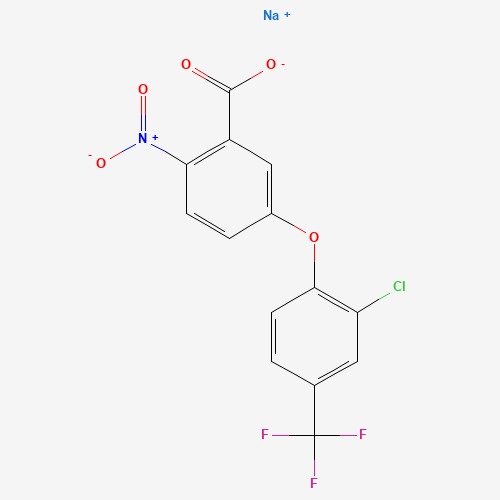
CAS62476-59-9
分子式C14H6ClF3NNaO5
分子量383.64 g/mol
非危品
Acifluorfen Sodium can cause cancer according to The Environmental Protection Agency (EPA).
科学粮草官-词典编辑部,修订于:2026-07-06
Toxicity
ToxicityEPA Ecotoxicity
Pesticide Ecotoxicity Data from EPA: 40
Ecotoxicity Values
LC50; Species: Salmo gairdneri (Fish, estuary, fresh water); 17 mg a.i./L (96 hr) (static)[EPA/Office of Pollution Prevention and Toxics; High Production Volume Information System (HPVIS) on Benzoic acid, 5-
Fate Summary
ATMOSPHERIC FATE: Acifluorfen-sodium dissociates in the environment to acifluorfen(SRC). According to a model of gas/particle partitioning of semivolatile organic compounds in the atmosphere(1), acifluorfen, which has an estimated vapor pressure of 1.5X10⁻⁸ mm Hg at 25 °C(SRC), determined from a fragment constant method(2), will exist in both the vapor and particulate phases in the ambient atmosphere. Vapor-phase acifluorfen is degraded in the atmosphere by reaction with photochemically-produced hydroxyl radicals(SRC); the half-life for this reaction in air is estimated to be 18 days(SRC), calculated from its rate constant of 8.7X10⁻¹³ cu cm/molecule-sec at 25 °C(SRC) that was derived using a structure estimation method(3). Photolysis in water occurs with a half-life of about 2 hours re...
Soil Adsorption / Mobility
The pKa of acifluorfen-sodium is 3.86(4). Acifluorfen-sodium is highly dissociated in moist soil at environmental pH to acifluorfen(1). Adsorption of this anion form is affected by soil type, pH, soil organic carbon content and soil iron content(2). Acifluorfen forms complexes with divalent and trivalent cations(1). Acifluorfen sorption is a nonequilibrium and time-dependent process and therefore mobility in soil is affected by the rate as well as the extent of sorption(1). An adsorption Koc range of 44-684(4,5) (Kd 0.13-1.98) has been reported(4). According to a classification scheme(3), these Koc values suggest that acifluorfen is expected to have very high to low mobility in soil. Acifluorfen is weakly and reversibly adsorbed(6) and therefore accumulation in soil does not occur(5). A...
Environmental Biodegradation
ANAEROBIC: Acifluorfen-sodium dissociates in the environment to acifluorfen(SRC). Acifluorfen degrades under anaerobic conditions; a soil half-life of 30 days and a water half-life of 2.75 days were reported(1). Under anaerobic conditions, acifluorfen degrades to amino acifluorfen which is persistent in soil and may enter surface water via run-off and groundwater by leaching(1).
Environmental Bioconcentration
The pKa of acifluorfen-sodium is 3.86(1) and it dissociates in the environment to acifluorfen(SRC). An estimated BCF of 3 was calculated in fish for acifluorfen(SRC), using a log Kow of 3.70(2) and a regression-derived equation(3). According to a classification scheme(4), this BCF suggests the potential for bioconcentration in aquatic organisms is low(SRC).
Volatilization from Water / Soil
The pKa of acifluorfen-sodium is 3.86(1). Acifluorfen-sodium dissociates in the environment to acifluorfen(SRC). The estimated pKa for acifluorfen is 2.07(2) indicating that it will exist almost entirely in the anion form at pH values of 5 to 9 and therefore volatilization from water surfaces is not expected to be an important fate process(3). The pKa indicates acifluorfen-sodium will exist almost entirely in the anion form at pH values of 5 to 9 and therefore volatilization from water surfaces is not expected to be an important fate process(SRC). Acifluorfen is not expected to volatilize from dry soil surfaces(SRC) based upon an estimated vapor pressure of 1.5X10⁻⁸ mm Hg(SRC), determined from a fragment constant method(4).
Environmental Abiotic Degradation
Photodegradation half-life of about 22 hours.
Environmental Water Concentrations
RAIN/SNOW/FOG: During a sampling period from October 1996 through September 1997, acifluorfen (the active ingredient of acifluorfen-sodium) was detected (detection limit = 0.01 to 0.2 ug/L) in 1 of the 634 (222 rainfall, 124 dry deposition and 228 air) samples collected over four sites within Johnson County, Iowa(1). The sample location/type was not identified. These sites reflect rural (260 acres of farmland 3 miles from Iowa City), urban (central Iowa City), regional (Macbride recreational park 10 miles from both rural and urban settings) conditions, and an Oakdale laboratory control representing the 3 previous sites(1).
Ecotoxicity Excerpts
/OTHER TERRESTRIAL SPECIES/ Non-toxic to bees. /Acifluorfen/
Atmospheric Concentrations
URBAN/SUBURBAN: During a sampling period from October 1996 through September 1997, acifluorfen (the active ingredient of acifluorfen-sodium) was detected (detection limit = 0.1 to 0.2 ug/cu m) in 1 of the 634 (222 rainfall, 124 dry deposition and 228 air) samples collected over four sites within Johnson County, Iowa(1). The sample location/type was not identified. These sites reflect rural (260 acres of farmland 3 miles from Iowa City), urban (central Iowa City), regional (Macbride recreational park 10 miles from both rural and urban settings) conditions, and Oakdale laboratory control representing the 3 previous sites(1).
Artificial Pollution Sources
Acifluorfen-sodium's production may result in its release to the environment through various waste streams; it's use as a herbicide(1) will result in its direct release to the environment(SRC).
Probable Routes of Human Exposure
NIOSH (NOES Survey 1981-1983) has statistically estimated that 3,018 workers (359 of these are female) are potentially exposed to the active ingredient of acifluorfen-sodium, acifluorfen, in the US(1). The NOES Survey does not include farm workers. Occupational exposure to acifluorfen-sodium may occur through inhalation and dermal contact with this compound at workplaces where acifluorfen-sodium is produced or used(SRC). Use data indicate that the general population may be exposed to acifluorfen-sodium via dermal contact with consumer products containing this compound(SRC).
Environmental Fate / Exposure Summary
Acifluorfen-sodium's production may result in its release to the environment through various waste streams; it's use as a herbicide will result in its direct release to the environment. Acifluorfen-sodium dissociates in the environment to acifluorfen. If acifluorfen is released to air, an estimated vapor pressure of 1.5X10⁻⁸ mm Hg at 1.5X10⁻⁸ °C indicates acifluorfen will exist in both the vapor and particulate phases in the atmosphere. Vapor-phase acifluorfen will be degraded in the atmosphere by reaction with photochemically-produced hydroxyl radicals; the half-life for this reaction in air is estimated to be 18 days. Particulate-phase acifluorfen will be removed from the atmosphere by wet or dry deposition. If released to soil, acifluorfen-sodium has a pKa of 3.86 indicating it will...
Target Organs
Urinary
Toxicity Data
LC50 (rat) > 6,900 mg/m3/4h
Adverse Effects
Occupational hepatotoxin - Secondary hepatotoxins: the potential for toxic effect in the occupational setting is based on cases of poisoning by human ingestion or animal experimentation.
RAIS Toxicity Values
Oral Chronic Reference Dose Reference: IRIS Current
Human Toxicity Excerpts
/SIGNS AND SYMPTOMS/ DANGER: corrosive. Causes irreversible eye damage. Harmful if swallowed or absorbed through the skin...Prolonged or frequently repeated skin contact may cause allergic reactions in some individuals. /Storm Herbicide and Ultra Blazer/
Carcinogen Classification
Not listed by IARC.
Non-Human Toxicity Values
LD50 Mouse male oral 2,050 mg/kg, and for female 1,370 mg/kg /Acifluorfen/
Non-Human Toxicity Excerpts
/LABORATORY ANIMALS: Subchronic or Prechronic Exposure/ New Zealand white rabbits, 20 animals per dose per sex, were exposed to Tackle 2S by dermal application (occlusive) at 92, 277 and 923 mg/kg bw (at day 4 highest dose was reduced to 4.62 mg/kg bw) 5 days a week for 21 days (Vehicle: NaOH solution (not specified) pH 7.5-7.6, total volume applied: 1mL, 3mL, 10mL (5mL after day 4)). CLINICAL OBSERVATIONS AND MORTALITY - Mortality and time to death (day): at 923 mg/kg bw 19/20 died ore were sacrificed before day 8, one male survived until sacrifice; at 92 mg/kg bw 1 male (8); at 277 mg/kg bw 1 male (13); controls one male and one female (21) - Clinical signs: at highest dose ataxia, decreased activity, nasal discharge, respiratory distress and salivation was seen in both sexes, males s...
1 or Cancer Risk Level 1E-06
Fraction of Contaminant Absorbed Dermally from Soil: 0.1
Antidote and Emergency Treatment
If swallowed call a poison control center or doctor immediately for treatment advice. Have person sip a glass of water if able to swallow. Do not induce vomiting unless told to do so by a poison control center or doctor. Do not give anything by mouth to an unconscious person. If inhaled move person to fresh air. If person is not breathing, call 911 or an ambulance, then give artificial respiration ... Call a poison control center or doctor for further treatment advice. Note to Physician: Probable mucosal damage may contraindicate the use of gastric lavage. /Storm Herbicide and Ultra Blazer Herbicide/
Hazard Quotient Level 3 or Cancer Risk Level 1E-04
Fraction of Contaminant Absorbed Dermally from Soil: 0.1
USGS Health-Based Screening Levels for Evaluating Water-Quality
Reference: Smith, C.D. and Nowell, L.H., 2024. Health-Based Screening Levels for evaluating water-quality data (3rd ed.). DOI:10.5066/F71C1TWP









