


 一键配货
一键配货
化合物详情
CAS62571-86-2
分子式C9H15NO3S
分子量217.29 g/mol g/mol
危化品
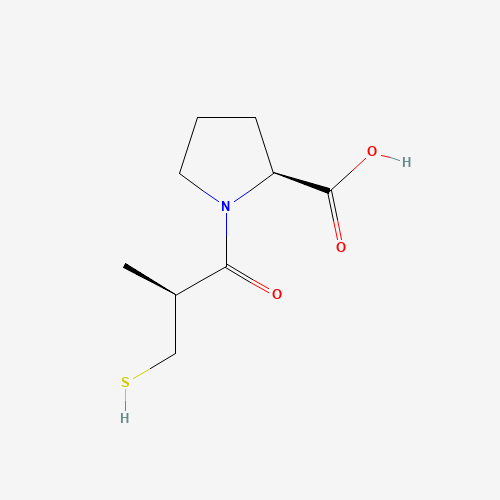
Captopril is a L-proline derivative in which L-proline is substituted on nitrogen with a (2S)-2-methyl-3-sulfanylpropanoyl group. It is used as an anti-hypertensive ACE inhibitor drug. It has a role as an EC 3.4.15.1 (peptidyl-dipeptidase A) inhibitor and an antihypertensive agent. It is a pyrrolidinemonocarboxylic acid, a N-acylpyrrolidine, an alkanethiol and a L-proline derivative.
科学粮草官-词典编辑部,修订于:2026-07-06
Toxicity
ToxicityEcotoxicity Values
EC50; Species: Lemna minor (Duckweed) 3-4 frond; Conditions: freshwater, static, pH 5.5-8.0; Concentration: >200000 ug/L for 7 days; Effect: population, decreased population growth rate
Fate Summary
ATMOSPHERIC FATE: According to a model of gas/particle partitioning of semivolatile organic compounds in the atmosphere(1), captopril, which has an estimated vapor pressure of 7.3X10⁻⁶ mm Hg at 25 °C(SRC), determined from a fragment constant method(2), will exist in both the vapor and particulate phases in the ambient atmosphere. Vapor-phase captopril is degraded in the atmosphere by reaction with photochemically-produced hydroxyl radicals(SRC); the half-life for this reaction in air is estimated to be 4 hrs(SRC), calculated from its rate constant of 8.8X10⁻¹¹ cu cm/molecule-sec at 25 °C(SRC) that was derived using a structure estimation method(3). Particulate-phase captopril may be removed from the air by wet and dry deposition(SRC). Captopril contains chromophores that absorb at wavel...
Soil Adsorption / Mobility
Using a structure estimation method based on molecular connectivity indices(1), the Koc of captopril can be estimated to be 10(SRC). According to a classification scheme(2), this estimated Koc value suggests that captopril is expected to have very high mobility in soil. The pKa values of captopril are 3.7 and 9.8(3), indicating that this compound will exist almost entirely in the anion form in the environment and anions generally do not adsorb more strongly to soils containing organic carbon and clay than their neutral counterparts(4).
Environmental Biodegradation
AEROBIC: Captopril was completely biodegraded and mineralized under the conditions of the modified Zahn-Wellens test (OECD 302 B). Biodegradation was observed to a lesser extent in the Manometric Respiratory Test (OECD 301 F). Captopril was not biodegraded in the Closed Bottle test (OECD 301 D)(1).
Environmental Bioconcentration
An estimated BCF of 3 was calculated in fish for captopril(SRC), using a log Kow of 0.34(1) and a regression-derived equation(2). According to a classification scheme(2), this BCF suggests the potential for bioconcentration in aquatic organisms is low(SRC).
Volatilization from Water / Soil
The pKa values of 3.7 an d9.8(1) indicate captopril will exist almost entirelyin the anion form at pH values of 5 to 9 and, therefore, volatilization from water surfaces is not expected to be an important fate process(SRC). Captopril is not expected to volatilize from dry soil surfaces(SRC) based upon an estimated vapor pressure of 7.3X10⁻⁶ mm Hg(SRC), determined from a fragment constant method(2).
Environmental Abiotic Degradation
The rate constant for the vapor-phase reaction of captopril with photochemically-produced hydroxyl radicals has been estimated as 8.8X10⁻¹¹ cu cm/molecule-sec at 25 °C(SRC) using a structure estimation method(1). This corresponds to an atmospheric half-life of about 4 hours at an atmospheric concentration of 5X10+5 hydroxyl radicals per cu cm(1). Captopril is expected to undergo hydrolysis in the environment due to the presence of functional groups that hydrolyze under environmental conditions(2). Captopril contains chromophores that absorb at wavelengths >290 nm(2) and, therefore, may be susceptible to direct photolysis by sunlight(SRC).
Milk Concentrations
/MILK/ Concentrations of captopril in human milk are approximately one percent of those in maternal blood.
Ecotoxicity Excerpts
/AQUATIC SPECIES/ ... The present study aimed to evaluate the sublethal effects induced by three different concentrations of captopril, on C. carpio), by determination of activity of the antioxidant enzymes superoxide dismutase (SOD), catalase (CAT) and glutathione peroxidase (GPx), as well as indicators of cellular oxidation: hydroperoxide content (HPC), lipid peroxidation (LPX) and protein carbonyl content (PCC). Specimens were exposed for 12, 24, 48, 72 and 96 hr to three different captopril concentrations: 1 ug/L, 1 mg/L and 100 mg/L (the first one has been detected environmentally, the other two have been associated with diverse toxic effects in aquatic species), and brain, gill, liver, kidney and blood samples were evaluated. Significant increases in HPC and LPX were observed main...
Artificial Pollution Sources
Captopril's production and administration as a human and veterinary antihypertensive(1) may result in its release to the environment through various waste streams(SRC).
Probable Routes of Human Exposure
Occupational exposure to captopril may occur through inhalation and dermal contact with this compound at workplaces where captopril is produced or used. The general public is not likely to be exposed to captopril unless by direct medical treatment. (SRC)
Environmental Fate / Exposure Summary
Captopril's production and administration as a human and veterinary antihypertensive may result in its release to the environment through various waste streams. If released to air, an estimated vapor pressure of 7.3X10⁻⁶ mm Hg at 25 °C indicates captopril will exist in both the vapor and particulate phases in the atmosphere. Vapor-phase captopril will be degraded in the atmosphere by reaction with photochemically-produced hydroxyl radicals; the half-life for this reaction in air is estimated to be 4 hrs. Particulate-phase captopril will be removed from the atmosphere by wet and dry deposition. Captopril contains chromophores that absorb at wavelengths >290 nm and, therefore, may be susceptible to direct photolysis by sunlight. If released to soil, captopril is expected to have very high...
Interactions
Initiation of captopril therapy has been associated with unexplained hypoglycemia in several diabetic patients whose diabetes had been controlled with insulin or oral antidiabetic agents. Testing in these patients indicated that captopril may increase insulin sensitivity; the mechanism of this effect is not known. The risk of precipitating hypoglycemia should be considered when captopril therapy is initiated in diabetic patients.
Hepatotoxicity
Likelihood score: B (likely but rare cause of clinically apparent liver injury).
Adverse Effects
Drug-Laboratory interaction: Captopril may cause a false-positive urine test for acetone in patients with diabetes.
Toxicity Summary
Acute captopril overdose presents with profound hypotension, acute kidney injury, central hypoperfusion, and altered mental status. Management is primarily supportive. Maintenance of hemodynamics with IV fluids and vasopressors is required. The literature review suggests the role of dialysis in acute overdose. Case reports also describe the role of naloxone in the reversal of ACE inhibitor toxicity, including captopril. The proposed mechanism is the impact of ACE inhibitors on the endogenous opioid systems, leading to the accumulation of enkephalin and its reversal by naloxone.
Human Toxicity Excerpts
/CASE REPORTS/ A 57 year old male with mild impairment of renal function secondary to diabetic glomerulosclerosis developed acute renal failure (creatinine 32.4 mg/dL) associated with a generalized desquamative skin rash and peripheral eosinophilia shortly after initiation of antihypertensive therapy with captopril. An acute interstitial nephritis was demonstrated on renal biopsy, and improvement was temporally related to initiation of therapy with prednisone. A review of the literature revealed 5 similar cases in whom acute deterioration of renal function occurred following initiation of captopril and in whom there were features of a hypersensitivity reaction, including skin rash, fever, eosinophilia, azotemia, eosinophiluria, and a Coombs positive hemolytic anemia. Renal biopsy, where...
Drug Induced Liver Injury
References: DOI:10.1016/j.drudis.2019.09.022
Non-Human Toxicity Values
LD50 Rat iv 554 mg/kg
Non-Human Toxicity Excerpts
/LABORATORY ANIMALS: Developmental or Reproductive Toxicity/ Reproduction studies in hamsters and rats using large doses of captopril have not revealed evidence of teratogenic effects. However, the drug was embryocidal and was associated with a low incidence of craniofacial malformations in rabbits when given at dosaes 2-70 times the maximum human dosage, probably as a result of the marked decrease in blood pressure caused by the drug in this species. Reduction in neonatal survival occurred in the offspring of rats receiving captopril dosages 400 times the usual human dosage continuously during gestation and lactation, and an increased incidence of stillbirths has reportedly occurred in ewes.
Populations at Special Risk
Captopril may cause serious adverse effects (e.g., neutropenia) and must be used under close supervision, particularly in patients with renal impairment (especially those with collagen vascular disease).
Antidote and Emergency Treatment
Treatment and supportive measures: Monitor blood pressure and heart rate for 6 hours after ingestion. If symptomatic or significant hypotension develops, observe for at least 24 hours. 1. If hypotension occurs, treat it with supine positioning and IV fluids. Vasopressors are rarely necessary. 2. Treat angioedema with usual measures (eg, diphenhydramine, corticosteroids) and discontinue the ACE inhibitors. Switching to an AR blocker may not be appropriate as angioedema has also been reported with these agents. 3. Treat hyperkalemia if it occurs. /Angiotensin blockers and ACE inhibitors/
Effects During Pregnancy and Lactation
In one report, 1 woman out of 12 subjects was unable to produce enough milk for the study while taking captopril 100 mg 3 times daily even though she had been successfully breastfeeding for 6 months. It is not known if this decrease was an effect of captopril.









