


 一键配货
一键配货
化合物详情
CAS64359-81-5
分子式C11H17Cl2NOS
分子量282.23 g/mol
非危品
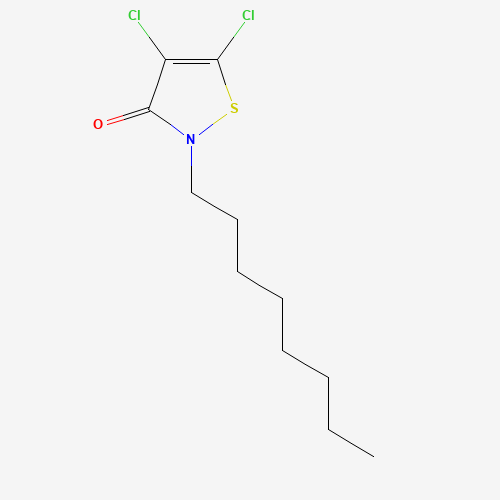
4,5-dichloro-2-n-octyl-3(2H)-isothiazolone is a 1,2-thiazole that is 1,2-thiazol-3(2H)-one substituted by chloro groups at positions 4 and 5 and an octyl group at position 2. It is used as a fungicide. It has a role as a fungicide, a xenobiotic and an environmental contaminant. It is an organochlorine compound and a member of 1,2-thiazoles.
科学粮草官-词典编辑部,修订于:2026-07-06
Toxicity
ToxicityEPA Ecotoxicity
Pesticide Ecotoxicity Data from EPA: 55
Ecotoxicity Values
EC50; Species: Chlorella fusca var. vacuolata (Green Algae) strain 211-15; Conditions: saltwater, static; Concentration: 314 nM for 24 hr (95% confidence interval: 286-342 nM); Effect: decreased population growth rate /99.6% purity/
Fate Summary
ATMOSPHERIC FATE: According to a model of gas/particle partitioning of semivolatile organic compounds in the atmosphere(1), 4,5-dichloro-2-octyl-3-isothiazolone, which has a vapor pressure of 7.4X10⁻⁶ mm Hg at 25 °C(2), in the ambient atmosphere. Vapor-phase 4,5-dichloro-2-octyl-3-isothiazolone is degraded in the atmosphere by reaction with photochemically-produced hydroxyl radicals(SRC); the half-life for this reaction in air is estimated to be 13 hrs(SRC), calculated from its rate constant of 3.0X10⁻¹¹ cu cm/molecule-sec at 25 °C(SRC) that was derived using a structure estimation method(3). Particulate-phase 4,5-dichloro-2-octyl-3-isothiazolone may be removed from the air by wet and dry deposition(SRC). 4,5-Dichloro-2-octyl-3-isothiazolone absorbs UV light weakly at wavelengths >290 n...
Soil Adsorption / Mobility
Using a structure estimation method based on molecular connectivity indices(1), the Koc of 4,5-dichloro-2-octyl-3-isothiazolone can be estimated to be 2300(SRC). According to a classification scheme(2), this estimated Koc value suggests that 4,5-dichloro-2-octyl-3-isothiazolone is expected to have slight mobility in soil(SRC). 4,5-Dichloro-2-octyl-3-isothiazolone and its metabolites have been reported as being essentially immobile in sediment(3).
Environmental Biodegradation
ANAEROBIC: 4,5-dichloro-2-octyl-3-isothiazolone, present at 0.05 and 1 ppm, exhibited a half-life of less than one hour when incubated in seawater and sediment in a one-year microcosm study(1).
Environmental Bioconcentration
A BCF of 13 was reported using bluegill sunfish (Lepomis macrochirus) which were exposed for 49 days. It is reported to be metabolized rapidly in fish(1,2). According to a classification scheme(3), this BCF suggests bioconcentration in aquatic organisms is low(SRC).
Volatilization from Water / Soil
The Henry's Law constant for 4,5-dichloro-2-octyl-3-isothiazolone is estimated as 2.0X10⁻⁷ atm-cu m/mole(SRC) derived from its vapor pressure, 7.4X10⁻⁶ mm Hg(1), and water solubility, 14 mg/L(2). This Henry's Law constant indicates that 4,5-dichloro-2-octyl-3-isothiazolone is expected to volatilize slowly from water and moist soil surfaces(2). Based on this Henry's Law constant, the volatilization half-life from a model river (1 m deep, flowing 1 m/sec, wind velocity of 3 m/sec)(3) is estimated as 310 days hours(SRC). The volatilization half-life from a model lake (1 m deep, flowing 0.05 m/sec, wind velocity of 0.5 m/sec)(3) is estimated as 2300 days(SRC). 4,5-Dichloro-2-octyl-3-isothiazolone is not expected to volatilize from dry soil surfaces(SRC) based upon its vapor pressure(1).
Environmental Abiotic Degradation
[Table#8560]: IkFxdWF0aWMgbWVkaWEiLCJOYXR1cmFsIHNvbGFyIGlycmFkaWF0aW9uIGhhbGYtbGlmZSAoaHJzKSIsIlN5bnRoZXRpYyBzb2xhciBpcnJhZGlhdGlvbiBoYWxmLWxpZmUgKGhycykiCiJEaXN0aWxsZWQgd2F0ZXIiLCI0MzMiLCIxNCIKIlNlYSB3YXRlciIsIjMxNSIsIjEwIgoiUml2ZXIgd2F0ZXIiLCIxNTQiLCI4IgoiTGFrZSB3YXRlciIsIjEzMSIsIjYiCg==
Environmental Water Concentrations
SEAWATER: 4,5-Dichloro-2-octyl-3-isothiazolone was introduced to the aquatic environment as a result of leaching from two painted Danish Navy ships 8 days after being moored in Korser Harbor, Denmark. The ship was moved to the harbor five weeks after painting. A second ship had been painted 6 months earlier. Compound concentrations in the immediate vicinity of the ships ranged from 30 to 79 ng/L(1). The compound has been reported present in Spanish seawater at concentrations as high as 3700 ng/L(2).
Ecotoxicity Excerpts
/AQUATIC SPECIES/ ...In the present study, affinity pull-down assays were used to identify target proteins for 4,5-dichloro-2-n-octyl-4-isothiazolin-3-one (DCOIT), a costal pollutant of emerging concern, in various tissues (e.g., brain, liver, plasma, and gonad) from marine medaka (Oryzias melastigma) and zebrafish (Danio rerio). Pull-down results showed that, in male and female brains from medaka and zebrafish, DCOIT had a consistently high affinity for G protein alpha subunits (Ga), suggesting the targeted effects of DCOIT on signaling transduction from G protein-coupled receptors (GPCRs) and an extrapolatable mode of action in teleost brains. Validation using recombinant proteins and molecular docking analysis confirmed that binding of DCOIT to Ga protein competitively inhibited its...
Effluent Concentrations
The emission sources of biocidal active substances in households have been under discussion since these substances have been detected frequently in municipal wastewater and receiving surface water bodies. Therefore, the goal of this study was to investigate the products responsible for the emission of these substances to wastewater. We analysed the wastewater of two streets for a set of biocidal active substances. Time-proportional sampling was conducted for one week of each season during one year in each street. The 14 substances analysed with liquid chromatography coupled with tandem mass spectrometry were 1,2-benzisothiazol-3(2H)-one (BIT), C12-benzalkonium chloride, carbendazim, 5-chloro-2-methyl-2H-isothiazol-3-one (CMIT), dichlorooctylisothiazolinone (DCOIT), N,N-diethyl-meta-tolu...
Artificial Pollution Sources
4,5-Dichloro-2-octyl-3-isothiazolone's production and use in adhesives, coatings, fuels, metal working fluids (MUP only), resin emulsions, paints and various other specialty industrial products (as a preservative)(1) may result in its release to the environment through various waste streams; its use in microbiocide in pulp/paper mills, cooling water systems, oil field operations (MUP only), industrial process waters and air washers systems(1), as a marine antifoulant paint(1,2), in industrial process water, in ornamental fountains, in industrial caulkings, paints and pressure treated lumber(1) will result in its direct release to the environment(SRC).
Sediment/Soil Concentrations
SEDIMENT: Antifouling paint particles (APPs) are generated during periodical maintenance of boat hulls. Chemical composition and toxicity (either chronic or acute) of APPs found in the sediment was evaluated using the epibenthic copepod Nitokra sp. The APPs analyzed showed the presence of high levels of metals such as Cu (234,247 ug/g), Zn (112,404 ug/g) and the booster biocide DCOIT (0.13 ug/g). ... This study was the first assessment of toxicity associated with the presence of APPs in sediment to benthic organisms, and it calls attention to the need of improving regulations in boatyards and marina areas.
Probable Routes of Human Exposure
Occupational exposure to 4,5-dichloro-2-octyl-3-isothiazolone may occur through inhalation and dermal contact with this compound at workplaces where 4,5-dichloro-2-octyl-3-isothiazolone is produced or used. Use data indicate that the general population may be exposed to 4,5-dichloro-2-octyl-3-isothiazolone via dermal contact when using consumer products containing this compound. (SRC)
Other Environmental Concentrations
Biocides are included in organic building facade coatings as protection against biological attack by algae and fungi but have the potential to enter the environment via leaching into runoff from wind driven rain. The following field study correlates wind driven rain to runoff and measured the release of several commonly used organic biocides (terbutryn, Irgarol 1051, diuron, isoproturon, OIT, DCOIT) in organic facade coatings from four coating systems. During one year of exposure of a west oriented model house facade in the Zurich, Switzerland area, an average of 62.7 L/sq m, or 6.3% of annual precipitation came off the four facade panels installed as runoff. The ISO method for calculating wind driven rain loads is adapted to predict runoff and can be used in the calculation of emission...
Environmental Fate / Exposure Summary
4,5-Dichloro-2-octyl-3-isothiazolone's production and use in adhesives, coatings, fuels, metal working fluids, resin emulsions, paints and various other specialty industrial products (as a preservative) may result in its release to the environment through various waste streams; its use in microbiocide in pulp/paper mills, cooling water systems, oil field operations (MUP only), industrial process waters and air washers systems, as a marine antifoulant paint, in industrial process water, in ornamental fountains, in industrial caulkings, paints and pressure treated lumber will result in its direct release to the environment. If released to air, a vapor pressure of 7.4X10⁻⁶ mm Hg at 25 °C indicates 4,5-dichloro-2-octyl-3-isothiazolone will exist in both the vapor and particulate phases in t...
Effect Level
collection=toxvaldb&kind=^EL$
Interactions
The toxicity of three antifoulants (Sea-Nine, Irgarol, and TBT) was determined individually and in mixtures in two tests with microalgae. Effects on periphyton community photosynthesis and reproduction of the unicellular green algae Scenedesmus vacuolatus were investigated. The tested antifoulants were highly toxic in both tests. Observed mixture toxicities were compared with predictions derived from two concepts: Independent Action (IA), assumed to be more relevant for the tested mixtures that were composed of dissimilarly acting substances, and Concentration Addition (CA), regarded as a reasonable worst-case approach in predictive mixture hazard assessment. Despite the corresponding mechanistic basis, IA failed to provide accurate predictions of the observed mixture toxicities. Result...
Toxicity Summary
IDENTIFICATION AND USE: 4,5-Dichloro-2-octyl-3-isothiazolone (DCOIT) is a solid. It is used as a marine antifoulant. HUMAN STUDIES: An outbreak of occupational contact dermatitis occurred due to the biocide DCOIT. Eight of 19 persons, six females, 20 to 63 years old, employed in a Japanese textile finishing factory developed edematous reddish eruptions on their forearms, upper arms, face, or neck. The subjects have been sensitized to DCOIT without apparent cross sensitization to DCOIT. ANIMAL STUDIES: In dogs decreased body weight and food consumption, hematologic and clinical chemistry parameter changes observed at 1500 ppm. After inhalation in rats at concentrations of 0.02, 0.63, and 6.72 mg/cu m for 6 hours per day, 5 days per week, for thirteen weeks, treatment-related microscopic...
RAIS Toxicity Values
Oral Chronic Reference Dose Reference: OPP
Human Toxicity Excerpts
/CASE REPORTS/ An outbreak of occupational contact dermatitis due to the biocide Kathon-930 was described. Eight of 19 persons, six females, 20 to 63 years old, employed in a Japanese textile finishing factory developed edematous reddish eruptions on their forearms, upper arms, face, or neck between 24 July and 8 August 1991. Two patients worked in the textile finishing unit. The other six worked in the drying and inspection unit. All eight wore protective gloves; however, they wore short sleeved shirts and used no protective equipment on their upper arms or forearms. The patients reported that on 2 July a new biocide consisting of 30% Kathon-930 in xylene was added to the finishing agent. Open patch testing was performed with Kathon-930 and closed patch testing was performed with Katho...
Reference and Risk Values
collection=toxvaldb&kind=^RRV$
Non-Human Toxicity Excerpts
/LABORATORY ANIMALS: Developmental or Reproductive Toxicity/ ... In the /two-generation reproduction/ study, DCOIT (100.3% a.i.) was administered via diet to male and female Crl:CDBR rats at dose levels of 0, 200, 800, or 3200 ppm (equivalent to 0, 16-20, 62-88, and 235 mg/kg/day in males during premating and 0, 18-21, 67-93, and 259 mg/kg/day in females during premating). Significant offspring mortality at 3200 ppm caused an insufficient number of pups available to produce a second generation; consequently, all surviving 3200-ppm offspring were euthanized prior to sexual maturation. An additional treatment group of 400 ppm (equivalent to 30-39 mg/kg/day in males during premating and 33-41 mg/kg/day in females during premating) and a concurrent control group were initiated. P1 and P2 ma...
Antidote and Emergency Treatment
/SRP:/ Advanced treatment: Consider orotracheal or nasotracheal intubation for airway control in the patient who is unconscious, has severe pulmonary edema, or is in severe respiratory distress. Positive-pressure ventilation techniques with a bag valve mask device may be beneficial. Consider drug therapy for pulmonary edema ... . Consider administering a beta agonist such as albuterol for severe bronchospasm ... . Monitor cardiac rhythm and treat arrhythmias as necessary ... . Start IV administration of D5W TKO /SRP: "To keep open", minimal flow rate/. Use 0.9% saline (NS) or lactated Ringer's (LR) if signs of hypovolemia are present. For hypotension with signs of hypovolemia, administer fluid cautiously. Watch for signs of fluid overload ... . Treat seizures with diazepam (Valium) or l...









