


 一键配货
一键配货
化合物详情
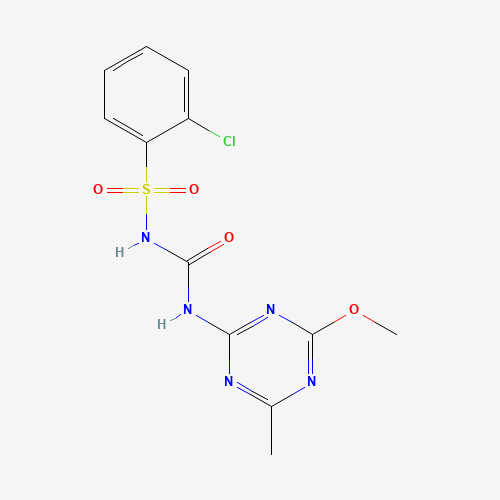
CAS64902-72-3
分子式C12H12ClN5O4S
分子量357.77 g/mol g/mol
危化品
Physical Description | Chlorsulfuron appears as colorless crystals. Non corrosive. Insoluble in water. Used as an herbicide.
科学粮草官-词典编辑部,修订于:2026-07-06
Toxicity
ToxicityEPA Ecotoxicity
Pesticide Ecotoxicity Data from EPA: 50
Ecotoxicity Values
LD50; Species: Apis mellifera (Honey bee) adult; topical >25 ug/bee for 48 hr /98.2% purity/[USEPA, Office of Pesticide Programs; Pesticide Ecotoxicity Database (2000) on 2-Chloro-N-[
Fate Summary
ATMOSPHERIC FATE: According to a model of gas/particle partitioning of semivolatile organic compounds in the atmosphere(1), chlorsulfuron, which has a vapor pressure of 2.25X10⁻¹¹ mm Hg at 25 °C(2), is expected to exist solely in the particulate phase in the ambient atmosphere. Particulate-phase chlorsulfuron may be removed from the air by wet and dry deposition(SRC). Chlorsulfuron is unlikely to undergo direct photolysis in the atmosphere(3).
Soil Adsorption / Mobility
Leaching of the herbicides chlorsulfuron and metsulfuron methyl was studied using field lysimeters containing either undisturbed soil monoliths or packed soil. Three soil types were represented, two sandy soils and one clay soil. Each herbicide was applied at two rates, 4 and 8 g ai/ha, representing normal and double doses of the compound for spring cereals. All lysimeters received supplementary watering in addition to natural rainfall. With the exception of a single sample that had a chlorsulfuron concentration (14 ng/L) just above the detection limit, neither compound was detectable in leachate from lysimeters receiving the normal dose of the herbicides. For both herbicides at double dose, levels above the minimum detectable were found in selected lysimeters, reaching 43 and 21 ng/L d...
Environmental Biodegradation
AEROBIC: The half-life of chlorsulfuron in non-sterile soils was 5 and 15 days at 30 °C compared to the half-life of 21 and 28 days in the sterile soils(1). Microbial breakdown accounted for 79% of the total initial degradation in a silt loam soil (pH 5.9, organic matter 5%), 50% in a sandy loam soil (pH 6.5, organic matter 1%) and 91% in a silt loam soil (pH 8.0, organic matter 5%)(1). Microbial breakdown accounted for only 25% of total loss in a silty clay loam soil (pH 5.6, organic matter 2.4%)(2).
Environmental Bioconcentration
An estimated BCF of 3 was calculated in fish for chlorsulfuron(SRC), using a log Kow of -1.34(1) and a regression-derived equation(2). According to a classification scheme(3), this BCF suggests the potential for bioconcentration in aquatic organisms is low. The BCF of chlorsulfuron in unicellular green algae was measured as 8, 36 and 53 at pH 6, 5.3 and 5.0, respectively(4).
Volatilization from Water / Soil
A pKa of 3.4(1) indicates chlorsulfuron will exist almost entirely in the anion form at pH values of 5 to 9 and, therefore, volatilization from water surfaces is not expected to be an important fate process(SRC). Chlorsulfuron is not expected to volatilize from dry soil surfaces(SRC) based upon a vapor pressure of 2.25X10⁻¹¹ mm Hg(1).
Environmental Abiotic Degradation
The chemical hydrolysis of chlorsulfuron both in aqueous solution and in moist soil was faster at lower pH and higher temperature(1-2). The rate of hydrolysis in soil is more than 6 times faster at pH 5.7 than at a pH 7.5(1). The half-life in soil at 30 °C increased from 3 weeks at pH 5.9 to 4 weeks at pH 6.5(2). At 20 °C, hydrolysis half-lives for aqueous chlorsulfuron were 4 weeks at pH 5.7 and 8 weeks at pH 7.0(3). The half-life of chlorsulfuron in aqueous solution on irradiation with artificial sunlamp is 1 month(4). A dry film of chlorsulfuron on a glass plate underwent 15% decomposition in 1 month upon irradiation with artificial sunlight(4). Chlorsulfuron is unlikely to undergo direct photolysis in the atmosphere(5).
Environmental Water Concentrations
GROUND WATER: Chlorsulfuron was not detected in 25 samples of groundwater collected in various parts of the Midwestern US in 1998(1). Chlorsulfuron was detected at 25-48 ng/L in groundwater of the Abruzzi Region of Central Italy(2).
Milk Concentrations
Chlorsulfuron was not detected (detection limit 0.6 ug/kg) in 100 raw milk, 30 full-fat milk, 20 half-skimmed milk and 20 skimmed milk samples(1). Raw milk was provided by a local farm and all other milk samples were obtained from local supermarkets in Shenyang, China(1).
Ecotoxicity Excerpts
/AQUATIC SPECIES/ Research has been conducted on the effect of chlorsulfuron on non-target plants but little information is available on its effects on aquatic macrophytes. Potamogeton pectinatus (sago pondweed) is an ecologically important submerged aquatic macrophyte found in freshwater bodies. Many species of wildlife use this plant as a food source. The objective of this study was to measure the phytotoxic effects of chlorsulfuron on sago pondweed. P. pectinatus plants were exposed to chlorsulfuron at 0, 0.25, 0.50, 1.0, or 2.0 ppb, in an environmental growth chamber. Plants exposed to 0.25 ppb chlorsulfuron showed a reduction in length (76%), number of leaves (50%), and number of stems (50%), compared to control plants. A reduction (47%) was also observed in the length of stems pro...
Artificial Pollution Sources
Chlorsulfuron's production may result in its release to the environment through various waste streams; it's use as an herbicide(1) will result in its direct release to the environment(SRC).
Probable Routes of Human Exposure
Occupational exposure to chlorsulfuron may occur through inhalation of dust or mists and dermal contact with this compound at workplaces where chlorsulfuron is produced or used. Monitoring data indicate that the general population is not likely to be exposed to chlorsulfuron. (SRC)
Environmental Fate / Exposure Summary
Chlorsulfuron's production may result in its release to the environment through various waste streams; it's use as an herbicide will result in its direct release to the environment. If released to air, a vapor pressure of 2.25X10⁻¹¹ mm Hg at 25 °C indicates chlorsulfuron will exist solely in the particulate phase in the atmosphere. Particulate-phase chlorsulfuron will be removed from the atmosphere by wet and dry deposition. Chlorsulfuron is unlikely to undergo direct photolysis in the atmosphere. If released to soil, chlorsulfuron is expected to have very high to high mobility based upon a Koc values of 6.3-154. The pKa of chlorsulfuron is 3.4, indicating that this compound will exist almost entirely in anion form in the environment and anions generally do not adsorb more strongly to s...
Interactions
Pea (Pisum sativum L. cv Alaska) root tips were excised and cultured aseptically in White's medium. Cultures were treated immediately or after a 24 hour equilibration time with 28 nanomolar chlorsulfuron plus isoleucine and valine (each 0.1 millimolar), isoleucine and valine, or untreated. The percentage of mitotic figures in untreated control roots sampled immediately after excision showed a transitory drop and recovery within 24 hours (an excision effect). In chlorsulfuron-treated roots, the percentage of mitotic figures did not recover. In roots treated with chlorsulfuron plus isoleucine and valine, a complete recovery did occur. If roots were treated with chlorsulfuron 24 hours after excision, the percentage of mitotic figures was reduced to near 0 by 8 hours. In roots treated with...
Toxicity Data
LC50 (rat) > 5,900 mg/m3/4h
Toxicity Summary
IDENTIFICATION AND USE: Chlorsulfuron is a white crystalline solid. It is a selective preemergence or early postemergence herbicide used at low rates. HUMAN STUDIES: There are no data available. ANIMAL STUDIES: In 2 yr feeding trials, rats receiving 100 mg/kg diet and mice receiving 500 mg/kg diet showed no ill-effects. Developmental studies in rats demonstrated reduced maternal body weights and food consumption at 1500 mg/kg/day and decreased fetal body weights at 1500 mg/kg/day. There were no teratogenic effects. Chlorsulfuron tested negative for mutagenicity in Salmonella typhimurium bacterial strains TA98, TA100, TA1535, TA1537 treated for 48 hours with chlorsulfuron at 0, 0.001, 0.005, 0.01, 0.05, 0.1 or 0.5 ug/plate with or without metabolic activation. ECOTOXICITY STUDIES: Chlors...
RAIS Toxicity Values
Oral Chronic Reference Dose Reference: OPP
Carcinogen Classification
No indication of carcinogenicity to humans (not listed by IARC).
Non-Human Toxicity Values
LC50 Rat inhaltion >5900 mg/cu m/4 hr
Non-Human Toxicity Excerpts
/LABORATORY ANIMALS: Developmental or Reproductive Toxicity/ ...NOAEL = 75 mg/kg/day /and/ LOAEL = 200 mg/kg/day /were/ from the rabbit developmental toxicity study ... /of/ short-term /(1-28 days)/ dermal and inhalation exposure. Endpoint /was the/ maternal toxicity, based on decreased body weight/ body-weight gain ... /From table/
1 or Cancer Risk Level 1E-06
Fraction of Contaminant Absorbed Dermally from Soil: 0.1
Antidote and Emergency Treatment
/SRP:/ Advanced treatment: Consider orotracheal or nasotracheal intubation for airway control in the patient who is unconscious, has severe pulmonary edema, or is in severe respiratory distress. Positive-pressure ventilation techniques with a bag valve mask device may be beneficial. Consider drug therapy for pulmonary edema ... . Consider administering a beta agonist such as albuterol for severe bronchospasm ... . Monitor cardiac rhythm and treat arrhythmias as necessary ... . Start IV administration of D5W TKO /SRP: "To keep open", minimal flow rate/. Use 0.9% saline (NS) or lactated Ringer's (LR) if signs of hypovolemia are present. For hypotension with signs of hypovolemia, administer fluid cautiously. Watch for signs of fluid overload ... . Treat seizures with diazepam or lorazepam...
Hazard Quotient Level 3 or Cancer Risk Level 1E-04
Fraction of Contaminant Absorbed Dermally from Soil: 0.1
USGS Health-Based Screening Levels for Evaluating Water-Quality
Reference: Smith, C.D. and Nowell, L.H., 2024. Health-Based Screening Levels for evaluating water-quality data (3rd ed.). DOI:10.5066/F71C1TWP









