


 一键配货
一键配货
化合物详情
CAS65277-42-1
分子式C26H28Cl2N4O4
分子量531.43 g/mol g/mol
危化品
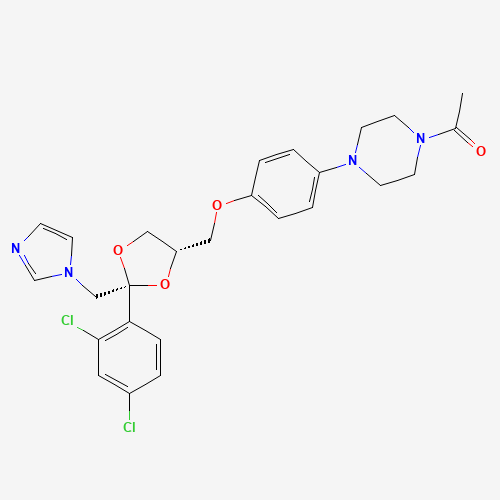
(2S,4R)-ketoconazole is a cis-1-acetyl-4-(4-{[2-(2,4-dichlorophenyl)-2-(1H-imidazol-1-ylmethyl)-1,3-dioxolan-4-yl]methoxy}phenyl)piperazine which dioxolane moiety has (2S,4R)-configuration. It is an enantiomer of a (2R,4S)-ketoconazole.
科学粮草官-词典编辑部,修订于:2026-07-06
Toxicity
ToxicityEcotoxicity Values
EC50; Species: Daphnia magna (Water Flea) age <24 hr neonate; Conditions: freshwater, static, 20 °C; Concentration: 1510 ug/L for 48 hr (95% confidence interval: 1160-1910 ug/L); Effect: intoxication, immobilization /100% purity/
Fate Summary
ATMOSPHERIC FATE: According to a model of gas/particle partitioning of semivolatile organic compounds in the atmosphere(1), ketoconazole, which has an estimated vapor pressure of 6.4X10⁻¹⁴ mm Hg at 25 °C(SRC), determined from a fragment constant method(2), is expected to exist solely in the particulate phase in the ambient atmosphere. Particulate-phase ketoconazole may be removed from the air by wet and dry deposition(SRC). Ketoconazole contains chromophores that absorb at wavelengths >290 nm(3) and, therefore, may be susceptible to direct photolysis by sunlight(SRC).
Soil Adsorption / Mobility
The Koc of ketoconazole is estimated as 3,000(SRC), using a log Kow of 4.34(1) and a regression-derived equation(2). According to a classification scheme(3), this estimated Koc value suggests that ketoconazole is expected to have slight mobility in soil. The estimated pKa value of 3.96(4) indicates that this compound will exist partially in the cation form in the environment and cations generally adsorb more strongly to soils containing organic carbon and clay than their neutral counterparts(5). Ketoconazole adsorption isotherms (Kd) of 9.7X10+3 L/kg and 8.5X10+3 L/kg were measured in primary sludge and long-age secondary sludge, respectively. Sludge was obtained from 2 wastewater treatment plants that were representative of plants utilized in industrialized countries(6).
Environmental Biodegradation
AEROBIC: Residue of azole antifungals in the environment is of concern due to the environmental risks and persistence. Distribution, behavior, and fate of frequently used azole antifungal pharmaceuticals were investigated in wastewater at two sewage treatment plants (STPs) in China. Fluconazole, clotrimazole, econazole, ketoconazole, and miconazole were constantly detected at 1-1834 ng/L in the wastewater. The latter four were also ubiquitously detected in sewage sludge. Fluconazole passed through treatment in the STPs and largely remained in the final effluent. On the contrary, biotransformation and sorption to sludge occurred to the other azoles. Ketoconazole was more readily bio-transformed, whereas clotrimazole, econazole, and miconazole were more likely to be adsorbed onto and pers...
Environmental Bioconcentration
An estimated BCF of 340 was calculated in fish for ketoconazole(SRC), using a log Kow of 4.34(1) and a regression-derived equation(2). According to a classification scheme(3), this BCF suggests the potential for bioconcentration in aquatic organisms is high(SRC).
Volatilization from Water / Soil
The Henry's Law constant for ketoconazole is estimated as 5.6X10⁻²⁰ atm-cu m/mole(SRC) using a fragment constant estimation method(1). This Henry's Law constant indicates that ketoconazole is expected to be essentially nonvolatile from water and moist soil surfaces(2). Ketoconazole is not expected to volatilize from dry soil surfaces(SRC) based upon an estimated vapor pressure of 6.4X10⁻¹⁴ mm Hg(SRC), determined from a fragment constant method(3).
Environmental Abiotic Degradation
Ketoconazole is not expected to undergo hydrolysis in the environment due to the lack of functional groups that hydrolyze under environmental conditions(1). Ketoconazole contains chromophores that absorb at wavelengths >290 nm(1) and, therefore, may be susceptible to direct photolysis by sunlight(SRC).
Environmental Water Concentrations
While data specific to ketoconazole were not located(SRC, 2014), the literature suggests that some pharmaceutically active compounds originating from human and veterinary therapy are not eliminated completely in municipal sewage treatment plants and are, therefore, discharged into receiving waters(1). Wastewater treatment processes often were not designed to remove them from the effluent(2). Selected organic waste compounds may be degrading to new and more persistent compounds that may be released instead of or in addition to the parent compound(2).
Milk Concentrations
EXPERIMENTAL: Infant exposure to ketoconazole in human milk was calculated to be 0.4% on average (maximum 1.4%) of those expected from therapeutic doses given directly to infants. ...
Ecotoxicity Excerpts
/AQUATIC SPECIES/ Ketoconazole (KTC) is a model pharmaceutical representing imidazole and triazole pesticides, which inhibit fungal growth through blocking a cytochrome P450 (CYP)-mediated step in ergosterol biosynthesis. Several of these fungicides have been shown to be reversible inhibitors of CYPs in vertebrates (primarily mammals), including CYP isoforms involved in the pathway that converts cholesterol to active sex steroids. In these studies, we assessed the effects of KTC on aspects of steroidogenesis and reproductive function in the fathead minnow (Pimephales promelas). Exposure of spawning adults to the fungicide for 21 days significantly decreased egg production at a water concentration as low as 25 ug/L. Despite evidence of reduced ex vivo testosterone production by gonads fr...
ICSC Environmental Data
The substance is very toxic to aquatic organisms. It is strongly advised not to let the chemical enter into the environment.
Artificial Pollution Sources
Ketoconazole's production and administration as an antifungal agent(1) may result in its release to the environment through various waste streams(SRC).
Probable Routes of Human Exposure
NIOSH (NOES Survey 1981-1983) has statistically estimated that 1,045 workers (620 of these were female) were potentially exposed to ketoconazole in the US(1). Occupational exposure to ketoconazole may occur through inhalation and dermal contact with this compound at workplaces where ketoconazole is produced or used. Exposure to ketoconazole among the general population may be limited to those administered the drug(SRC).
Environmental Fate / Exposure Summary
Ketoconazole's production and administration as an antifungal agent may result in its release to the environment through various waste streams. If released to air, an estimated vapor pressure of 6.4X10⁻¹⁴ mm Hg at 25 °C indicates ketoconazole will exist solely in the particulate phase in the atmosphere. Particulate-phase ketoconazole will be removed from the atmosphere by wet and dry deposition. Ketoconazole contains chromophores that absorb at wavelengths >290 nm and, therefore, may be susceptible to direct photolysis by sunlight. If released to soil, ketoconazole is expected to have slight mobility based upon an estimated Koc of 3,000. An estimated pKa of 3.96 indicates that this compound will exist partially in the cation form in the environment and cations generally adsorb more stro...
Symptoms
Side effects of the potential hepatotoxicity of Ketoconazole include abdominal pain or tenderness, clay-colored stools, dark urine, decreased appetite, fever, headache, itching, loss of appetite, nausea and vomiting, skin rash, swelling of the feet or lower legs, unusual tiredness or weakness, and yellow eyes or skin. (L1536)
Treatment
In the event of accidental overdosage, supportive measures, including gastric lavage with sodium bicarbonate, should be employed. (L1712)
Interactions
Concomitant use of mefloquine (single 500-mg dose) and ketoconazole (400 mg once daily for 10 days) in healthy adults increased the mean peak plasma concentration and AUC of mefloquine by 64 and 79%, respectively, and increased the mean elimination half-life of mefloquine from 322 hours to 448 hours. Because of the risk of a potentially fatal prolongation of the corrected QT (QTc) interval, the manufacturer of mefloquine states that ketoconazole should not be used concomitantly with mefloquine or within 15 weeks after the last mefloquine dose.
Toxicity Data
Hepatotoxicity, LD<sub>50</sub>=86 mg/kg (orally in rat) LD50: 44 mg/kg (Intravenous, Mouse) (T66) LD50: 702 mg/kg (Oral, Mouse) (T66)
Health Effects
Ketoconazole can cause liver problems. (L1536)
Hepatotoxicity
Likelihood score: A (well established cause cause of clinically apparent liver injury).
Adverse Effects
Hypersensitivity reactions have also been reported, such as anaphylaxis and urticaria. High-dose ketoconazole has been shown to cause an increase in long bone fragility and lead to fracture. Other side effects include alcohol intolerance, decreased platelet count, epistaxis, fatigue, hot flash, hyperlipidemia, insomnia, myalgia, nervousness, paresthesia, and peripheral edema. Topical ketoconazole can cause dermatological reactions, including pruritis, stinging, and dryness at the application site. There are also reports of dry hair, dry scalp, and oily hair when using ketoconazole-containing shampoo. Less common adverse effects include abnormal hair texture, alopecia, angioedema, contact dermatitis, eye irritation, headache, hypersensitivity reaction, impetigo, and pyogenic granuloma.
Exposure Routes
Oral (L1908); topical (L1908)
Toxicity Summary
Ketoconazole interacts with 14-α demethylase, a cytochrome P-450 enzyme necessary for the conversion of lanosterol to ergosterol. This results in inhibition of ergosterol synthesis and increased fungal cellular permeability. Other mechanisms may involve the inhibition of endogenous respiration, interaction with membrane phospholipids, inhibition of yeast transformation to mycelial forms, inhibition of purine uptake, and impairment of triglyceride and/or phospholipid biosynthesis. Ketoconazole can also inhibit the synthesis of thromboxane and sterols such as aldosterone, cortisol, and testosterone. (A1990, A1991, A1992, A1993)
Human Toxicity Excerpts
/SIGNS AND SYMPTOMS/ Concomitant use of dofetilide and ketoconazole is contraindicated. Concomitant use of the drugs may increase dofetilide plasma concentrations and lead to QTc interval prolongation, sometimes resulting in serious life-threatening ventricular tachyarrhythmias such as torsades de pointes.
Carcinogen Classification
No indication of carcinogenicity to humans (not listed by IARC).
Drug Induced Liver Injury
References: DOI:10.1016/j.drudis.2019.09.022
Non-Human Toxicity Values
LD50 Dog oral 178 mg/kg
Non-Human Toxicity Excerpts
/LABORATORY ANIMALS: Chronic Exposure or Carcinogenicity/ In the Wistar rat (200 males, 200 females), oral administration of 0,5, 20 and 80 mg/kg/day of ketoconazole in the diet for 24 months did not affect the mortality rate as compared to controls. At necropsy the following dose-related effects were seen: a brownish aspect of the salivary glands and the abdominal fat in medium and high-dosed animals and broken legs in one high-dosed male, 2 medium-dosed females and 10 high-dosed females. These findings have been identified in the 18 month rat toxicity study. The overall incidence of and type of tumors was not significantly different between treated and control groups, except for high-dosed female rats who had a decrease of the overall tumor rate.
Populations at Special Risk
The use of Nizoral Tablets is contraindicated in patients with acute or chronic liver disease.
Antidote and Emergency Treatment
In the event of acute accidental overdose, treatment consists of supportive and symptomatic measures. Within the first hour after ingestion, activated charcoal may be administered.
Effects During Pregnancy and Lactation
Relevant published information was not found as of the revision date.
USGS Health-Based Screening Levels for Evaluating Water-Quality
Reference: Smith, C.D. and Nowell, L.H., 2024. Health-Based Screening Levels for evaluating water-quality data (3rd ed.). DOI:10.5066/F71C1TWP









