


 一键配货
一键配货
化合物详情
CAS66215-27-8
分子式C6H10N6
分子量166.18 g/mol g/mol
危化品
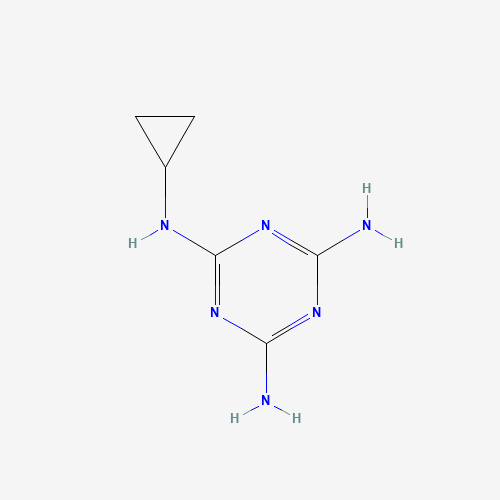
Cyromazine is a triamino-1,3,5-triazine. It has a role as a triazine insecticide and a mouse metabolite.
科学粮草官-词典编辑部,修订于:2026-07-06
Toxicity
ToxicityEPA Ecotoxicity
Pesticide Ecotoxicity Data from EPA: 15
Ecotoxicity Values
LC50; Species: Colinus virginianus (Northern bobwhite) dietary >5620 ppm for 8 days
Fate Summary
ATMOSPHERIC FATE: According to a model of gas/particle partitioning of semivolatile organic compounds in the atmosphere(1), cyromazine, which has a measured solid vapor pressure of 3.36X10⁻⁹ mm Hg at 25 °C(2), that corresponds to a super-cooled vapor pressure of 3.2X10⁻⁷ mm Hg(3), will exist in both the vapor and particulate phases in the ambient atmosphere. Vapor-phase cyromazine is degraded in the atmosphere by reaction with photochemically-produced hydroxyl radicals(SRC); the half-life for this reaction in air is estimated to be 12.7 days(SRC), calculated from its rate constant of 1.26X10⁻¹² cu cm/molecule-sec at 25 °C(SRC) that was derived using a structure estimation method(4). Particulate-phase cyromazine will be removed from the atmosphere by wet or dry deposition(SRC).
Soil Adsorption / Mobility
Based upon a variety of measured Koc values in different soils (range of 81 to 1,800), cyromazine has a recommended Koc of 765(1). According to a classification scheme(2), this recommended Koc value suggests that cyromazine is expected to have low mobility in soil. Cyromazine has also been reported to have moderate mobility in soil(3), which would correspond to the lower Koc values measured in some soils(SRC). An agricultural runoff study(4) found that cyromazine (applied to soil via chicken manure) was present in runoff waters with concentrations increasing as rainfall rates increased. Anilines (aromatic amines) are expected to bind strongly to humus or organic matter in soils due to the high reactivity of the aromatic amino group(5,6), suggesting that mobility may be much lower than p...
Environmental Biodegradation
Numerous studies conducted (laboratory and field) demonstrate the cyromazine is degraded by biological mechanisms(1); no rates or additional data were available(SRC).
Environmental Bioconcentration
An estimated BCF of 3 was calculated in fish for cyromazine(SRC), using an experimental log Kow of -0.06(1) and a regression-derived equation(2). According to a classification scheme(3), this BCF suggests the potential for bioconcentration in aquatic organisms is low(SRC).
Volatilization from Water / Soil
The Henry's Law constant for cyromazine is estimated as 5.65X10⁻¹⁴ atm-cu m/mole(SRC) derived from its vapor pressure, 3.36X10⁻⁹ mm Hg(1), and water solubility, 13,000 mg/L(2). This Henry's Law constant indicates that cyromazine is expected to be essentially nonvolatile from water surfaces(2). Cyromazine is not expected to volatilize from dry soil surfaces(SRC) based upon its vapor pressure of 3.36X10⁻⁹ mm Hg at 25 °C(1).
Environmental Abiotic Degradation
The rate constant for the vapor-phase reaction of cyromazine with photochemically-produced hydroxyl radicals has been estimated as 1.26X10⁻¹² cu cm/molecule-sec at 25 °C(SRC) using a structure estimation method(1). This corresponds to an atmospheric half-life of about 12.7 days at an atmospheric concentration of 5X10+5 hydroxyl radicals per cu cm(1). Cyromazine is not expected to undergo hydrolysis in the environment due to the lack of functional groups that hydrolyze under environmental conditions(2). Cyromazine is reported to be stable to aqueous hydrolysis for 28 days at up to 70 °C(3). Cyromazine is stable in aqueous solution exposed to sunlight(4). A photolysis rate constant of 0.0116 per day has been reported for cyromazine on soil surfaces exposed to artificial light(4); this cor...
Ecotoxicity Excerpts
/PLANTS/ There are no aquatic or terrestrial plant toxicity data available for cyromazine. However, risks to plants are presumed to be minimal given the mode of action.
Artificial Pollution Sources
Cyromazine's production may result in its release to the environment through various waste streams; its use as an insect growth regulator(1) will result in its direct release to the environment(SRC).
Probable Routes of Human Exposure
Occupational exposure to cyromazine may occur through inhalation and dermal contact with this compound at workplaces where cyromazine is produced or used. (SRC)
Environmental Fate / Exposure Summary
Cyromazine's production may result in its release to the environment through various waste streams; its use as an insect growth regulator will result in its direct release to the environment. If released to air, a measured solid-phase vapor pressure of 3.36X10⁻⁹ mm Hg at 25 °C, that corresponds to a super-cooled vapor pressure of 3.2X10⁻⁷ mm Hg, indicates cyromazine will exist in both the vapor and particulate phases in the atmosphere. Vapor-phase cyromazine will be degraded in the atmosphere by reaction with photochemically-produced hydroxyl radicals; the half-life for this reaction in air is estimated to be 12.7 days. Particulate-phase cyromazine will be removed from the atmosphere by wet or dry deposition. If released to soil, cyromazine is expected to have low mobility based upon a...
Target Organs
Hematologic
Toxicity Data
LC50 (rat) > 3,600 mg/m3/4H
Adverse Effects
ACGIH Carcinogen - Not Classifiable.
RAIS Toxicity Values
Oral Chronic Reference Dose Reference: OPP
Human Toxicity Excerpts
/OTHER TOXICITY INFORMATION/ EPA has concluded that only residues of the parent compound cyromazine need to be regulated and used for risk assessment and is proposing that melamine, a metabolite of cyromazine, be removed from the tolerance expression as a residue of toxicological concern. ... EPA has reassessed the weight-of-the evidence for both cyromazine and melamine with particular reference to their carcinogenic potential. Cyromazine is classified as a group ``E'' carcinogen (no evidence of carcinogenicity) with an chronic RfD of 0.0075 mg/kg/day with an uncertainty factor (UF) of 100 using a no observed adverse effect level (NOAEL) of 0.75 mg/kg/day and a lowest observed adverse effect level (LOAEL) of 7.5 mg/kg/day. ... Melamine produced bladder tumors only in the male rat urinar...
Carcinogen Classification
No indication of carcinogenicity to humans (not listed by IARC).
Non-Human Toxicity Values
LD50 Rat percutaneous >3100 mg/kg
Non-Human Toxicity Excerpts
/LABORATORY ANIMALS: Subchronic or Prechronic Exposure/ Groups of 20 weanling Charles River CD rats/sex/dose were given diet containing 0, 30, 300, 1000 or 3000 ppm cyromazine (96.3% pure) for 90 days. Additionally groups of 5 rats/sex/dose were given diet containing 0 or 3000 ppm cyromazine for 90 days followed by control diet for a 4 week recovery period. No treatment-related changes were noted in behavior, appearance, hematological parameters, clinical biochemistry or urinalysis. Mean body weight was about 5-10% lower than controls in the 3000 ppm group and up to 4% lower in the 1000 ppm group. In the recovery period males approached control weights but the female weights were 5-6% lower than the controls. Food consumption expressed as g/kg bw/day was reduced in both sexes at 3000 pp...
1 or Cancer Risk Level 1E-06
Fraction of Contaminant Absorbed Dermally from Soil: 0.1
Antidote and Emergency Treatment
Skin decontamination. Dermal contamination should be washed off with soap and water. Flush contamination from the eyes with copious amounts of water. If irritation persists, specialized medical care should be obtained. /Substituted benzenes/
Hazard Quotient Level 3 or Cancer Risk Level 1E-04
Fraction of Contaminant Absorbed Dermally from Soil: 0.1









