


 一键配货
一键配货
化合物详情
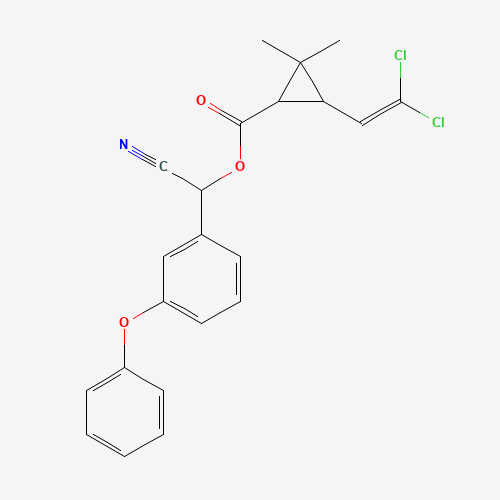
CAS67375-30-8
分子式C22H19Cl2NO3
分子量416.3 g/mol
非危品
(1R)-cis-(alphaS)-cypermethrin is a cyclopropanecarboxylate ester. It is an enantiomer of a (1S)-cis-(alphaR)-cypermethrin.
科学粮草官-词典编辑部,修订于:2026-07-06
Toxicity
ToxicityEPA Ecotoxicity
Pesticide Ecotoxicity Data from EPA: 31
Ecotoxicity Values
LD50 Bee 0.059 ug/bee (24 hr)
Fate Summary
ATMOSPHERIC FATE: According to a model of gas/particle partitioning of semivolatile organic compounds in the atmosphere(1), alphacypermethrin, which has a vapor pressure of 1.73X10⁻⁷ mm Hg at 20 °C(2), is expected to exist solely as a vapor will exist in both the vapor and particulate phases in the ambient atmosphere(SRC). Vapor-phase alphacypermethrin is degraded in the atmosphere by reaction with photochemically-produced hydroxyl radicals(SRC); the half-life for this reaction in air is estimated to be 18 hours(SRC), calculated from its rate constant of 2.14X10⁻¹¹ cu cm/molecule-sec at 25 °C(SRC) determined using a structure estimation method(3). Vapor-phase alphacypermethrin is degraded in the atmosphere by reaction with photochemically-produced ozone(SRC); the half-life for this reac...
Soil Adsorption / Mobility
The Koc of alphacypermethrin is estimated as 142,000(SRC), using a measured log Kow of 6.94(1) and a regression-derived equation(2). According to a classification scheme(3), this estimated Koc value suggests that alphacypermethrin is expected to be immobile mobility in soil(SRC).
Environmental Biodegradation
AEROBIC: The pyrethroid class of insecticides is readily degraded by environmental microorganisms(1,2); based upon its structure, alphacypermethrin is also expected to readily biodegrade(1,2). Aerobic batch enrichment cultures, with permethrin-containing effluent and soil samples, and sewage sludge, were able to transform alphacypermethrin at concn of 50 mg/l in the presence of Tween 80(0.05% vol/vol) with a half-life of 7 to 14 days(3). Alphacypermethrin did not degrade in the sterile control after 28 days(3).
Environmental Bioconcentration
An estimated BCF of 990 was calculated for alphacypermethrin(SRC), using a log Kow of 6.94(1) and a regression-derived equation(2). According to a classification scheme(3), this BCF suggests the potential for bioconcentration in aquatic organisms is high(SRC). However, bioconcentration studies on compounds which are structurally similar suggest that bioconcentration may be lower than that indicated by the regression-derived equations due to the ability of aquatic organisms to readily metabolize this class of compounds(4).
Volatilization from Water / Soil
The Henry's Law constant for alphacypermethrin is estimated as 9.5X10⁻⁶ atm-cu m/mole(SRC) based upon its vapor pressure, 1.73X10⁻⁷ mm Hg(1), and water solubility, 0.01 mg/l(1). This Henry's Law constant indicates that alphacypermethrin is expected to volatilize from water surfaces(2). Based on this Henry's Law constant, the volatilization half-life from a model river (1 m deep, flowing 1 m/sec, wind velocity of 3 m/sec)(2) is estimated as 8 days(SRC). The volatilization half-life from a model lake (1 m deep, flowing 0.05 m/sec, wind velocity of 0.5 m/sec)(2) is estimated as 65 days(SRC). However, volatilization from water surfaces is expected to be attenuated by adsorption to suspended solids and sediment in the water column(SRC). The estimated volatilization half-life from a model pon...
Environmental Abiotic Degradation
The rate constant for the vapor-phase reaction of alphacypermethrin with photochemically-produced hydroxyl radicals has been estimated as 2.14X10⁻¹¹ cu cm/molecule-sec at 25 °C(SRC) using a structure estimation method(1). This corresponds to an atmospheric half-life of about 18 hours at an atmospheric concentration of 5X10+5 hydroxyl radicals per cu cm(1). A base-catalyzed second-order hydrolysis rate constant of 6.12 l/mole-sec(SRC) was estimated using a structure estimation method(2); this corresponds to half-lives of 36 and 4 years at pH values of 7 and 8, respectively(2). Pyrethrins, such as alphacypermethrin, undergo rapid photodecomposition in the environment(3).
Artificial Pollution Sources
Alphacypermethrin's former(2) production and use as an insecticide and as a component of cypermethrin(1) resulted in its direct release to the environment(SRC).
Probable Routes of Human Exposure
Occupational exposure to alphacypermethrin may have occurred through inhalation and dermal contact with this compound at workplaces where alphacypermethrin was produced or used. The general population may have been exposed to alphacypermethrin via dermal contact with insecticides containing alphacypermethrin. (SRC)
Environmental Fate / Exposure Summary
Alphacypermethrin's former production and use as an insecticide and as a component of cypermethrin resulted in its direct release to the environment. If released to air, a vapor pressure of 1.73X10⁻⁷ mm Hg at 20 °C indicates alphacypermethrin will exist in both the vapor and particulate phases in the ambient atmosphere. Vapor-phase alphacypermethrin will be degraded in the atmosphere by reaction with photochemically-produced hydroxyl radicals and ozone; the half-life for these reactions in air are estimated to be 18 hours and 49 days, respectively. Particulate-phase alphacypermethrin will be removed from the atmosphere by wet and dry deposition. If released to soil, alphacypermethrin is expected to have no mobility based upon an estimated Koc of 142,000. Volatilization from moist soil s...
Effect Level
collection=toxvaldb&kind=^EL$
Interactions
At dietary level of 1000 ppm pyrethrins & 10000 ppm piperonyl butoxide ... /enlargement, margination, & cytoplasmic inclusions in liver cells of rats/ were well developed in only 8 days, but ... were not maximal. Changes were proportional to dosage & similar to those produced by DDT. Effects of the 2 ... were additive. /Pyrethrins/
Lethal Dose
collection=toxvaldb&kind=^LD$
Toxicity Data
LC50 (rat) > 400 mg/m3/4h
Adverse Effects
Occupational hepatotoxin - Secondary hepatotoxins: the potential for toxic effect in the occupational setting is based on cases of poisoning by human ingestion or animal experimentation.
Toxicity Summary
IDENTIFICATION: Alpha-cypermethrin is a highly active pyrethroid insecticide, effective against a wide range of pests encountered in agriculture and animal husbandry. It is supplied as emulsifiable concentrate, ultra-low-volume formulation, suspension concentrate and in mixtures with other insecticides. The technical product is a crystalline powder with good solubility in acetone, cyclohexanone and xylene, but its solubility in water is low. It is stable under acidic and neutral conditions. HUMAN EXPOSURE: Exposure of the general population to alpha-cypermethrin is negligible, provided its use follows good agricultural practice. With good work practices, hygiene measures, and safety precautions, the use of alpha-cypermethrin is unlikely to present a hazard to those occupationally expose...
RAIS Toxicity Values
Oral Acute Reference Dose Reference: OPP
Human Toxicity Excerpts
The clinical manifestations of inhalation exposure to pyrethrins can be local or systemic. Localized reactors confined to the upper respiratory tract include rhinitis, sneezing, scratchy throat, oral mucosal edema, and even laryngeal mucosal edema. Localized reaction of the lower respiratory tract include cough, shortness of breath, wheezing, and chest pain. An asthmalike reaction occurs with acute exposures in sensitized patients. Hypersensitivity pneumonitis characterized by chest pain, cough, dyspnea, & bronchospasm may occur in an individual chronically exposed. /Pyrethrum and synthetic pyrethroids/
Acceptable Daily Intakes
collection=toxvaldb&kind=^ADI$
Non-Human Toxicity Values
LD50 Rabbit percutaneous >2000 mg tech./kg
Reference and Risk Values
collection=toxvaldb&kind=^RRV$
Non-Human Toxicity Excerpts
Synthetic pyrethroids are neuropoisons acting on the axons in the peripheral and central nervous systems by interacting with sodium channels in mammals and/or insects. A single dose produces toxic signs in mammals, such as tremors, hyperexcitability, salivation, choreoathetosis, and paralysis. ... At near-lethal dose levels, synthetic pyrethroids cause transient changes in the nervous system, such as axonal swelling and/or breaks and myelin degeneration in sciatic nerves. They are not considered to cause delayed neurotoxicity of the kind induced by some organophosphorus compounds. /Synthetic prethroids/
Antidote and Emergency Treatment
Skin decontamination. Wash skin promptly with soap and water ... . If irritant or paresthetic effects occur, obtain treatment by a physician. Because volatilization of pyrethroids apparently accounts for paresthesia affecting the face, strenuous measures should be taken (ventilation, protective face mask and hood) to avoid vapor contact with the face and eyes. Vitamin E oil preparations (dL-alpha tocopheryl acetate) are uniquely effective in preventing and stopping the paresthetic reaction. They are safe for application to the skin under field conditions. Corn oil is somewhat effective, but possible side effects with continuing use make it less suitable. Vaseline is less effective than corn oil. Zinc oxide actually worsens the reaction. /Pyrethroids/









