


 一键配货
一键配货
化合物详情
CAS67485-29-4
分子式C25H24F6N4
分子量494.48 g/mol
非危品
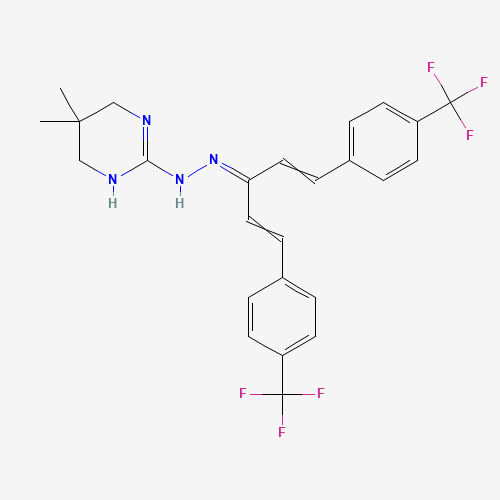
Physical Description | Hydramethylnon appears as odorless yellow crystals. Insoluble in water. Used as an insecticide.
科学粮草官-词典编辑部,修订于:2026-07-06
Toxicity
ToxicityEPA Ecotoxicity
Pesticide Ecotoxicity Data from EPA: 46
Ecotoxicity Values
LC50 Colinus virginianus (Northern bobwhite, age 14 days) diet 1136 ppm for 8 days (95% confidence interval: 908-1420 ppm)[USEPA, Office of Pesticide Programs; Pesticide Ecotoxicity Database (2000) on Tetrahydro-5,5-dimethyl-2(1H)-pyrimidio[3-[4-Trifluoromethyl)phenyl]-1-[2-
Fate Summary
ATMOSPHERIC FATE: According to a model of gas/particle partitioning of semivolatile organic compounds in the atmosphere(1), hydramethylnon, which has a vapor pressure of 2.03X10⁻⁸ mm Hg at 25 °C(2), will exist in both the vapor and particulate phases in the ambient atmosphere. Vapor-phase hydramethylnon is degraded in the atmosphere by reaction with photochemically-produced hydroxyl radicals(SRC); the half-life for this reaction in air is estimated to be 3 hrs(SRC), calculated from its rate constant of 1.35X10⁻¹⁰ cu cm/molecule-sec at 25 °C(SRC) that was derived using a structure estimation method(3). Particulate-phase hydramethylnon may be removed from the air by wet or dry deposition(SRC). Hydramethylnon is rapidly degraded in sunlight by photolysis, with a half-life of approximately...
Soil Adsorption / Mobility
Koc values of hydramethylnon have been reported as ranging from 3,300 to 8,677 using loamy sand, sandy loam, loam and silt loam soils, with reported Kds of 1,039-1,782 mL/g(1). According to a classification scheme(2), these Koc values suggest that hydramethylnon is expected to be slightly mobile to immobile in soil.
Environmental Biodegradation
ANAEROBIC: The half-life for anaerobic aquatic metabolism ranges from 445 to 552 days(1).
Environmental Bioconcentration
Reported bioconcentration factors are 1,300 in whole fish, 780 in fillet, and 1,900 in viscera(1). According to a classification scheme(2), this BCF suggests that bioconcentration in aquatic organisms is very high, provided the compound is not metabolized by the organism(SRC).
Volatilization from Water / Soil
The Henry's Law constant for hydramethylnon is estimated as 2.2X10⁻⁶ atm-cu m/mole(SRC) derived from its vapor pressure, 2.03X10⁻⁸ mm Hg(1), and water solubility, 6.0X10⁻³ mg/L(1). This Henry's Law constant indicates that hydramethylnon is expected to be essentially nonvolatile from water surfaces(2). Hydramethylnon is not expected to volatilize from dry soil surfaces(SRC) based upon its vapor pressure(1).
Environmental Abiotic Degradation
Hydramethylnon is rapidly degraded in sunlight by photolysis, with a half-life of approximately 1 hour; formulated bait decomposes rapidly in daylight(1). Photodegradation of C14-labeled hydramethylnon at benzylic and pyrimidine-2 positions was carried out separately under borosilicate-filtered xenon arc lamps (to simulate natural sunlight) at 27 °C as a suspension in distilled water. The half-life of hydramethylnon was calculated to be 42 minutes. Photoproducts of benzylic C14-labeled hydramethylnon include 1,5-bis(alpha, alpha, alpha-trifluoro-p-tolyl)-1,4-pentadien-3-one; alpha, alpha, alpha-trifluoro-p-toluic acid; and p-(trifluoromethyl)cinnamic acid. The photoproduct from both benzylic and pyrimidine-2 C14-labeled hydramethylnon was determined to be 6,7,8,9-tetrahydro-7,7-dimethyl...
Food Survey Values
Negligible residues of hydramethylnon were found in radishes, barley, and french beans planted three months after treatment of the soil(1).
Milk Concentrations
EXPERIMENTAL: No residues of hydramethylnon were detectable in the milk of goats after being exposed to 0.2 mg/kg hydramethylnon in the daily diet for 8 days(1). No residues were found in the milk of cows after being exposed to 0.05 mg/kg hydramethylnon for 21 consecutive days(1).
Ecotoxicity Excerpts
/OTHER TERRESTRIAL SPECIES/ A honey bee acute contact study using the technical grade active ingredient was required for hydramethylnon because its outdoor use may result in honey bee exposure. The LD50 of 68.0 g/bee using 96.8% a.i. demonstrated that hydramethylnon is practically non-toxic to bees on an acute contact basis.
Plant Concentrations
Residues of hydramethylnon in grass four months after treatment were <0.01 ppm(1).
Animal Concentrations
No residues of hydramethylnon were detectable in tissues of goats after being exposed to 0.2 mg/kg hydramethylnon in the daily diet for 8 days(1). No residues were found in tissues of cows after being exposed to 0.05 mg/kg hydramethylnon for 21 consecutive days(1).
Artificial Pollution Sources
Hydramethylnon's production may result in its release to the environment through various waste streams; its use as an insecticide(1) will result in its direct release to the environment(SRC).
Probable Routes of Human Exposure
Occupational exposure to hydramethylnon may occur through inhalation and dermal contact with this compound at workplaces where hydramethylnon is produced or used. (SRC)
Environmental Fate / Exposure Summary
Hydramethylnon's production may result in its release to the environment through various waste streams; its use as an insecticide will result in its direct release to the environment. If released to air, a vapor pressure of 2.03X10⁻⁸ mm Hg at 25 °C indicates hydramethylnon will exist in both the vapor and particulate phases in the atmosphere. Vapor-phase hydramethylnon will be degraded in the atmosphere by reaction with photochemically-produced hydroxyl radicals; the half-life for this reaction in air is estimated to be 3 hrs. Particulate-phase hydramethylnon will be removed from the atmosphere by wet or dry deposition. Hydramethylnon is rapidly degraded in sunlight by photolysis, with a half-life of approximately 1 hour. If released to soil, hydramethylnon is expected to have very slig...
Target Organs
Hepatic
Toxicity Data
LC50 (rat) > 5,000 mg/m3/4h
RAIS Toxicity Values
Oral Chronic Reference Dose Reference: OPP
Non-Human Toxicity Values
LC50 Rat inhalation >5,000 g/cu m/4 hr
Non-Human Toxicity Excerpts
/LABORATORY ANIMALS: Acute Exposure/ ... Ten CD rats/group of initial body weight of 85 g were dosed by gavage with 0 or 800 mg/kg of hydramethylnon (91.6% purity) in corn oil vehicle. Treated males had diarrhea and decreased food consumption during the first 24 hr, followed by rapid recovery. During the 5th week after dosing, these males were mated to untreated females. Males were then sacrificed, and combined testes weights were recorded (there was no dose effect). Males were not further evaluated. There were no differences in parameters evaluated in females: time to impregnation, numbers of viable pups or dead pups, or resorption incidence. ... /91.6% purity/
1 or Cancer Risk Level 1E-06
Fraction of Contaminant Absorbed Dermally from Soil: 0.1
Evidence for Carcinogenicity
The /EPA Pesticides/ Cancer Peer Review Committee determined that hydramethylnon should be classified as a Group C carcinogen, a possible human carcinogen, and recommended that, for the purpose of risk characterization, the Reference Dose approach should be used for quantification of human risk.
Antidote and Emergency Treatment
... There was no advantage to treatment with universal antidote of charcoal:magnesium oxide:tannic acid (2:1:1), nor was magnesium oxide:tannic acid (1:1) of any value. ...
Hazard Quotient Level 3 or Cancer Risk Level 1E-04
Fraction of Contaminant Absorbed Dermally from Soil: 0.1









