

 一键配货
一键配货
化合物详情
CAS68157-60-8
分子式C12H10ClN3O
分子量247.68 g/mol g/mol
危化品
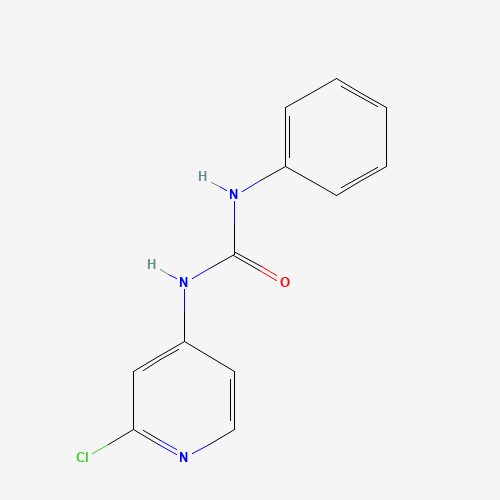
Forchlorfenuron is a member of the class of phenylureas that is urea substituted by a phenyl group and a 2-chloropyridin-4-yl group at positions 1 and 3 respectively. It is a plant growth regulator widely used in agriculture for improving fruit quality and fruit size. It has a role as a plant growth regulator. It is a member of phenylureas and a monochloropyridine.
科学粮草官-词典编辑部,修订于:2026-07-06
Toxicity
ToxicityEPA Ecotoxicity
Pesticide Ecotoxicity Data from EPA: 29
Ecotoxicity Values
LC50; Species: Oncorhynchus mykiss (Rainbow trout); Concentration: >9.2 ppm (acute) /Conditions of bioassay not specified in source examined/
Fate Summary
ATMOSPHERIC FATE: According to a model of gas/particle partitioning of semivolatile organic compounds in the atmosphere(1), forchlorfenuron, which has a vapor pressure of 3.45X10⁻¹⁰ mm Hg at 25 °C(2) is expected to exist solely in the particulate phase. Particulate-phase forchlorfenuron may be removed from the air by wet or dry deposition(SRC).
Soil Adsorption / Mobility
A Koc range of 852-3320 (mean of 1763) was reported for four soils(1). According to a classification scheme(2), this Koc range suggests that forchlorfenuron is expected to have low to slight mobility in soil. Forchlorfenuron was considered to be moderately mobile to essentially immobile in soils with Freundlich Kads values of 2-20(3). Adsorption-desorption studies using three Indian soils classified forchlorfenuron as a chemical in the low to medium leaching category(4).
Environmental Biodegradation
ANAEROBIC: A half-life of 226 days for fenchlorfenuron incubated in anaerobic (nitrogen) flooded sandy loam soil was based on extractable residues. The parent compound appeared to be relatively stable in the water and soil phases from 60 to 90 days post treatment (anaerobic incubation days 30-60). Degradates were not detected in the soil or water phases(1).
Environmental Bioconcentration
Forchlorfenuron accumulation was studied in bluegill sunfish that were exposed to non-radiolabeled and uniformly phenyl ring-labeled [14C]-forchlorfenuron at a nominal concentration of 0.10 mg/L under flow-through aquarium conditions; Maximum bioconcentration factor (BCF) was 7.2x for the whole fish tissue samples(1). According to a classification scheme(2), this BCF suggests the potential for bioconcentration in aquatic organisms is low(SRC).
Volatilization from Water / Soil
The Henry's Law constant for forchlorfenuron is 2.86X10⁻¹² atm-cu m/mole(1). This Henry's Law constant indicates that forchlorfenuron is expected to be essentially nonvolatile from water surfaces(2). Forchlorfenuron's Henry's Law constant indicates that volatilization from moist soil surfaces is not expected to occur(SRC). Forchlorfenuron is not expected to volatilize from dry soil surfaces(SRC) based upon a vapor pressure of 3.45X10⁻¹⁰ mm Hg(3).
Environmental Abiotic Degradation
The rate constant for the vapor-phase reaction of forchlorfenuron with photochemically-produced hydroxyl radicals has been estimated as 4.8X10⁻¹¹ cu cm/molecule-sec at 25 °C(SRC) using a structure estimation method(1). This corresponds to an atmospheric half-life of about 8 hours at an atmospheric concentration of 5X10+5 hydroxyl radicals per cu cm(1). Forchlorfenuron, at a nominal concentration of 30 ppm, was stable to hydrolysis in pH 5, 7 and 9 aqueous buffer solutions incubated at 25 °C for up to 30 days(2). Forchlorfenuron, at a concentration of 6.7 ug/mL, was photolytically stable in pH5 aqueous buffer solution that was continuously irradiated with a xenon arc lamp and maintained at 25 °C for up to 30 days(2). In the sensitized irradiated solutions, the photolytic half-life was 5...
Artificial Pollution Sources
Forchlorfenuron's production may result in its release to the environment through various waste streams; its use as a plant growth regulator(1) will result in its direct release to the environment(SRC).
Probable Routes of Human Exposure
Workers may be exposed to forchlorfenuron during mixing, loading, application, and post application activities. Handlers may be exposed to forchlorfenuron during mixing, loading, and application activities associated with agricultural crops. Based on the proposed use patterns, short- and intermediate-term dermal and inhalation exposure are expected to occur(1).
Environmental Fate / Exposure Summary
Forchlorfenuron's production may result in its release to the environment through various waste streams; its use as a plant growth regulator will result in its direct release to the environment. If released to air, a vapor pressure of 3.45X10⁻¹⁰ mm Hg at 25 °C indicates forchlorfenuron will exist solely in the particulate phase in the atmosphere. Particulate-phase forchlorfenuron will be removed from the atmosphere by wet or dry deposition. If released to soil, forchlorfenuron is expected to have low to slight mobility based upon a Koc range of 852-3320. Volatilization from moist soil surfaces is not expected to be an important fate process based upon a Henry's Law constant of 2.86X10⁻¹² atm-cu m/mole. Forchlorfenuron is not expected to volatilize from dry soil surfaces based upon its v...
Effect Level
collection=toxvaldb&kind=^EL$
Lethal Dose
collection=toxvaldb&kind=^LD$
Effect Concentration
collection=toxvaldb&kind=^EC$
RAIS Toxicity Values
Oral Chronic Reference Dose Reference: OPP
Carcinogen Classification
No indication of carcinogenicity to humans (not listed by IARC).
Non-Human Toxicity Values
LD50 Rabbit dermal >2000 mg/kg bw
Reference and Risk Values
collection=toxvaldb&kind=^RRV$
Non-Human Toxicity Excerpts
/LABORATORY ANIMALS: Subchronic or Prechronic Exposure/ One male and one female Beagle dog/dose were offered feed containing each of the following concentrations of CN-11-3183 (/forchlorfenuron/ purity: 98.9%): 0, 150, 500, 2500, 7500 ppm. Food containing the test article was offered for 2 hours/day for 10 days, followed by a 5 day interval when feed without test article was mistakenly used, followed again by a 42 day interval of daily compound presentation in the feed. Weekly samples of feed were analyzed chemically to ensure that proper dosage levels were maintained. No animals died during the study and there were no abnormal clinical signs. Similarly, necropsy at study termination revealed no abnormalities common to the different dosage levels. Despite the use of only one male and on...
Antidote and Emergency Treatment
/SRP:/ Advanced treatment: Consider orotracheal or nasotracheal intubation for airway control in the patient who is unconscious, has severe pulmonary edema, or is in severe respiratory distress. Positive-pressure ventilation techniques with a bag valve mask device may be beneficial. Consider drug therapy for pulmonary edema ... . Consider administering a beta agonist such as albuterol for severe bronchospasm ... . Monitor cardiac rhythm and treat arrhythmias as necessary ... . Start IV administration of D5W /SRP: "To keep open", minimal flow rate/. Use 0.9% saline (NS) or lactated Ringer's if signs of hypovolemia are present. For hypotension with signs of hypovolemia, administer fluid cautiously. Watch for signs of fluid overload ... . Treat seizures with diazepam or lorazepam ... . Use...