


 一键配货
一键配货
化合物详情
CAS69377-81-7
分子式C7H5Cl2FN2O3
分子量255.03 g/mol
非危品
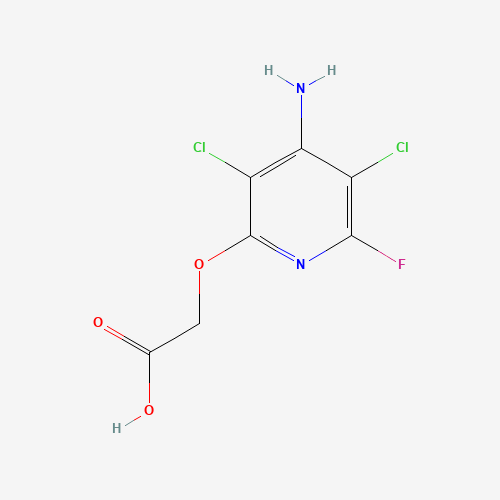
Fluroxypyr is an aminopyridine that is pyridin-4-amine substituted by chloro groups at positions 3 and 5, a fluoro group at position 6 and a carboxymethoxy group at position 2. It has a role as a herbicide, a xenobiotic and an environmental contaminant. It is a monocarboxylic acid, an aromatic ether, an organochlorine compound, an organofluorine compound and an aminopyridine.
科学粮草官-词典编辑部,修订于:2026-07-06
Toxicity
ToxicityEPA Ecotoxicity
Pesticide Ecotoxicity Data from EPA: 52
Ecotoxicity Values
LD50 Honeybee (Apis mellifera) contact > 25ug a.i./bee for 48 hr /Fluroxypyr acid (technical grade) (98.3% a.i.)/
Fate Summary
ATMOSPHERIC FATE: According to a model of gas/particle partitioning of semivolatile organic compounds in the atmosphere(1), fluroxypyr, which has a vapor pressure of 3.75X10⁻⁷ mm Hg at 25 °C(2), will exist in both the vapor and particulate phases in the ambient atmosphere. Vapor-phase fluroxypyr is degraded in the atmosphere by reaction with photochemically-produced hydroxyl radicals(SRC); the half-life for this reaction in air is estimated to be 13 hours(SRC), calculated from its rate constant of 2.88X10⁻¹¹ cu cm/molecule-sec at 25 °C(SRC) that was derived using a structure estimation method(3). Particulate-phase fluroxypyr may be removed from the air by wet or dry deposition(SRC). The results of one study that measured direct photolysis of fluroxypyr in aqueous solution by sunlight (h...
Soil Adsorption / Mobility
Lysimeter and field studies have demonstrated that leaching may not be an important fate process for fluroxypyr in the soil environment(1-3); although fluroxypyr may be mobile in soil(2,3), degradation via microbial metabolism may attenuate the importance of leaching(SRC).
Environmental Biodegradation
ANAEROBIC: In sediment/soil solutions, under anaerobic conditions, 4-amino-3,5-dichloro-6-fluoropyrid-2-ol, 4-amino-3-chloro-6-fluoropyrid-2-ol, 4-amino-5-chloro-6-fluoropyrid-2-ol, and carbon dioxide were formed. Degradation half-lives of 0.5-2 weeks were observed(1).
Environmental Bioconcentration
An estimated BCF of 3.2 was calculated in fish for fluroxypyr(SRC), using a log Kow of 2.20(1) and a regression-derived equation(2). According to a classification scheme(3), this BCF suggests the potential for bioconcentration in aquatic organisms is low.
Volatilization from Water / Soil
The Henry's Law constant for fluroxypyr is estimated as 1.72X10⁻¹¹ atm-cu m/mole(SRC) derived from its vapor pressure, 3.75X10⁻⁷ mm Hg(1), and water solubility, 7300 mg/L(1). This Henry's Law constant indicates that fluroxypyr is expected to be essentially nonvolatile from water surfaces(2). Fluroxypyr is not expected to volatilize from dry soil surfaces(SRC) based upon a vapor pressure of 3.75X10⁻⁷ mm Hg(1).
Environmental Abiotic Degradation
The rate constant for the vapor-phase reaction of fluroxypyr with photochemically-produced hydroxyl radicals has been estimated as 2.88X10⁻¹¹ cu cm/molecule-sec at 25 °C(SRC) using a structure estimation method(1). This corresponds to an atmospheric half-life of about 13 hours at an atmospheric concentration of 5X10+5 hydroxyl radicals per cu cm(1). Fluroxypyr is not expected to undergo hydrolysis in the environment due to the lack of functional groups that hydrolyze under environmental conditions(2). Fluroxypyr is reported to be stable in acidic media and have a half-life of 185 days in water at pH9 and 20 °C(3). A photolysis degradation study using deionized water solutions in vials exposed to sunlight for 35 days (and dark controls) determined a fluroxypyr photolysis half-life of one...
Ecotoxicity Excerpts
/BIRDS and MAMMALS/ Northern Bobwhite Quail (Colinus virginianus), 11-days-old at test initiation, 10 birds/dose group, were fed Fluroxypyr MHE ( Dowco 433 ester): Dietary levels of 658, 988, 1481, 2222, 3333, or 5000 ppm for 5 days with a 5 day post-treatment period. Average body weights: about 20 g/bird. Average food consumption: about 3 g/bird. Food consumption factor: about 0.15. One mortality occurred at doses of 988, 1481, and 2222 ppm, and two mortalities occurred at 3333 ppm; no mortality at 5000 ppm. No dose-related effects on general bird health, bodyweight, or food consumption; and no abnormalities were found at post-mortem examination. /Fluroxypyr-1-methylheptyl ester/ /From table/
Plant Concentrations
In a study to determine C-14 uptake in rotational crops 1, 4 and 12 months after application of the formulation, fluroxypyr dissipated too rapidly to be taken up by most of the rotational crops. Wheat plants absorbed only small quantities through the roots, and these residues were not deposited in the grain, but in the straw/chaff fraction, which is recycled back to the field(1).
Artificial Pollution Sources
Fluoxypyr's production may result in its release to the environment through various waste streams; its use as a herbicide to control broadleaf weeds(1) will result in its direct release to the environment(SRC).
Probable Routes of Human Exposure
The U.S. Environmental Protection Agency (EPA) has performed aggregate risk assessment analyses on fluroxypyr to determine the public's safety with respect to combined dietary and nondietary exposures. Acute (short-term) and chronic (long-term) aggregate risk calculations were determined. The EPA has concluded with reasonable certainty that "no harm will result to the general population and to infants and children from aggregate exposure to fluroxypyr and its residues."
Environmental Fate / Exposure Summary
Fluroxypyr's production may result in its release to the environment through various waste streams; its use as a herbicide to control broadleaf weeds will result in its direct release to the environment. Fluroxypyr will be formed in the environment through use of meptyl fluroxypyr herbicide which hydrolyzes rapidly in the environment to form fluroxypyr. If released to air, a vapor pressure of 3.75X10⁻⁷ mm Hg at 25 °C indicates fluroxypyr will exist in both the vapor and particulate phases in the atmosphere. Vapor-phase fluroxypyr will be degraded in the atmosphere by reaction with photochemically-produced hydroxyl radicals; the half-life for this reaction in air is estimated to be 13 hours. Particulate-phase fluroxypyr will be removed from the atmosphere by wet or dry deposition. Photol...
Toxicity Data
LC50 (rat) > 6,200 mg/m3
RAIS Toxicity Values
Oral Chronic Reference Dose Reference: OPP
Carcinogen Classification
No indication of carcinogenicity to humans (not listed by IARC).
Non-Human Toxicity Values
LD50 Rat, female, Fischer 344 oral 3162 mg/kg /Fluroxypyr-1-methylheptyl ester/
Non-Human Toxicity Excerpts
/LABORATORY ANIMALS: Acute Exposure/ Rabbits (New Zealand, 2.3-3.1 kg, 5/sex/group) received XRM-5316 (25.6% fluroxypyr MHE) dermally. Dose: 2000 mg XRM/kg bw applied to shaved back; test material held in contact with skin by gauze dressing and non-irritating tape. 24-hour exposure period, after which the skin was washed with mild soap and water. 2 week observation period; body weights recorded on Days 1, 2, 8, and 15. Results: No mortality; clinical signs observed at application site included burn, edema, erythema, and scaling in all rabbits of each gender. /Fluroxypyr-1-methylheptyl ester/
Evidence for Carcinogenicity
Cancer Classification: Not Likely to be Carcinogenic to Humans
Antidote and Emergency Treatment
/SRP:/ Advanced treatment: Consider orotracheal or nasotracheal intubation for airway control in the patient who is unconscious, has severe pulmonary edema, or is in severe respiratory distress. Positive-pressure ventilation techniques with a bag valve mask device may be beneficial. Consider drug therapy for pulmonary edema ... . Consider administering a beta agonist such as albuterol for severe bronchospasm ... . Monitor cardiac rhythm and treat arrhythmias as necessary ... . Start IV administration of D5W /SRP: "To keep open", minimal flow rate/. Use 0.9% saline (NS) or lactated Ringer's if signs of hypovolemia are present. For hypotension with signs of hypovolemia, administer fluid cautiously. Watch for signs of fluid overload ... . Treat seizures with diazepam or lorazepam ... . Use...









