


 一键配货
一键配货
化合物详情
CAS70356-09-1
分子式C20H22O3
分子量310.39 g/mol g/mol
危化品
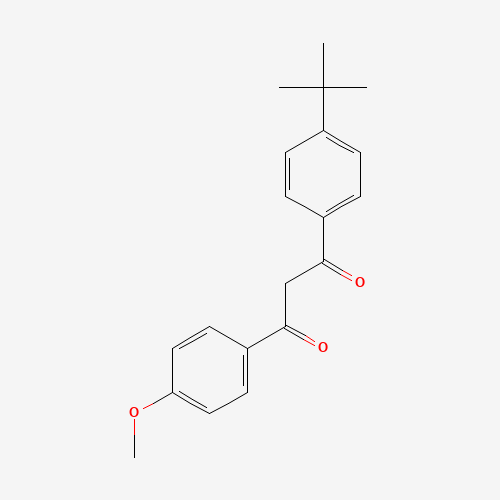
Avobenzone is a member of dihydrochalcones.
科学粮草官-词典编辑部,修订于:2026-07-06
Toxicity
ToxicityFate Summary
ATMOSPHERIC FATE: According to a model of gas/particle partitioning of semivolatile organic compounds in the atmosphere(1), avobenzone, which has an estimated vapor pressure of 1.4X10⁻⁶ mm Hg at 25 °C(SRC), determined from a fragment constant method(2), will exist in both the vapor and particulate phases in the ambient atmosphere. Vapor-phase avobenzone is degraded in the atmosphere by reaction with photochemically-produced hydroxyl radicals(SRC); the half-life for this reaction in air is estimated to be 15 hours(SRC), calculated from its rate constant of 2.5X10⁻¹¹ cu cm/molecule-sec at 25 °C(SRC) that was derived using a structure estimation method(2). Particulate-phase avobenzone may be removed from the air by wet and dry deposition(SRC). Avobenzone absorbs UV light strongly at wavele...
Soil Adsorption / Mobility
Using a structure estimation method based on molecular connectivity indices(1), the Koc of avobenzone can be estimated to be 1980(SRC). According to a classification scheme(2), this estimated Koc value suggests that avobenzone is expected to have low mobility in soil.
Environmental Biodegradation
Biological treatment of gray water containing an influent average avobenzone concentration of 3.5 ug/L reduced the average concentration to 0.48 ug/L under aerobic treatment, 1.27 ug/L under anaerobic treatment, and 0.2 ug/L with combined aerobic and anaerobic treatment(1).
Environmental Bioconcentration
An estimated BCF of 113 was calculated for avobenzone in fish(SRC), using an estimated log Kow of 4.51(1) and a regression-derived equation(1). According to a classification scheme(2), this BCF suggests the potential for bioconcentration in aquatic organisms is high(SRC), provided the compound is not metabolized by the organism(SRC).
Volatilization from Water / Soil
The Henry's Law constant for avobenzone is estimated as 2X10⁻¹⁰ atm-cu m/mole(SRC) using a fragment constant estimation method(1). This Henry's Law constant indicates that avobenzone is expected to be essentially nonvolatile from water surfaces(2). Avobenzene's Henry's Law constant indicates that volatilization from moist soil surfaces is not expected to occur(SRC). Avobenzone is not expected to volatilize from dry soil surfaces(SRC) based upon an estimated vapor pressure of 1.4X10⁻⁶ mm Hg(SRC), determined from a fragment constant method(1).
Environmental Abiotic Degradation
The rate constant for the vapor-phase reaction of avobenzone with photochemically-produced hydroxyl radicals has been estimated as 2.5X10⁻¹¹ cu cm/molecule-sec at 25 °C(SRC) using a structure estimation method(1). This corresponds to an atmospheric half-life of about 15 hours at an atmospheric concentration of 5X10+5 hydroxyl radicals per cu cm(1). Avobenzone is not expected to undergo hydrolysis in the environment due to the lack of hydrolyzable functional groups(2). Avobenzone absorbs UV light strongly at wavelengths >290 nm(3) and therefore may be susceptible to direct photolysis by sunlight(SRC). Avobenzone is highly degraded by UV light and normal day light and it will be drastically reduced over time during the course of normal use(4); control degradation studies have shown that 1...
Environmental Water Concentrations
SURFACE WATER: In surface seawater samples collected from Folly Beach, South Carolina in the summer of 2010, sulisobenzone was not detected in any samples from four sites (detection limit 1 ng/L) while other UV filter compounds (avobenzone, octocrylene, octinoxate, and padimate-O) were detected at concentrations ranging from 10 to 2013 ng/L(1).
Effluent Concentrations
Avobenzone has been detected in sewage treatment water works as part of an EPA monitoring study identifying pharmaceuticals and personal care products in the environment(1). Gray water (any washwater that has been used in the home, except water from toilets) collected from 32 homes in the Netherlands contained an average avobenzone concentration of 3.5 ug/L with a range of 0.3 to 17.4 ug/L(2).
Artificial Pollution Sources
Avobenzone's production and use as an ultraviolet absorber in sunscreen products and cosmetics(1,2) may result in its release to the environment through various waste streams(SRC).
Probable Routes of Human Exposure
Occupational exposure to avobenzone may occur through dermal contact with this compound at workplaces where avobenzone is produced or used. The general population may be exposed to avobenzone via dermal contact with this compound in consumer products, such as sunscreens and cosmetics, containing avobenzone. (SRC)
Environmental Fate / Exposure Summary
Avobenzone's production and use as an ultraviolet absorber in sunscreen products and cosmetics may result in its release to the environment through various waste streams. If released to air, an estimated vapor pressure of 1.4X10⁻⁶ mm Hg at 25 °C indicates avobenzone will exist in both the vapor and particulate phases in the atmosphere. Vapor-phase avobenzone will be degraded in the atmosphere by reaction with photochemically-produced hydroxyl radicals; the half-life for this reaction in air is estimated to be 15 hours. Particulate-phase avobenzone will be removed from the atmosphere by wet and dry deposition. Avobenzone absorbs UV light strongly at wavelengths >290 nm and therefore may be susceptible to direct photolysis by sunlight. Avobenzone has been shown to photolyze rapidly when a...
Interactions
Diminish the penetration of ultraviolet (UV) light through the epidermis by absorbing UV radiation within a specific wavelength range. The amount and wavelength of UV radiation absorbed are affected by the molecular structure of the sunscreen agent. /Sunscreen agents, topical/
Adverse Effects
Skin Sensitizer - An agent that can induce an allergic reaction in the skin.
Toxicity Summary
A 2025 publication by authors in the U.S. and U.K. reviewed the toxicity and human exposure data for avobenzone as currently used in over-the-counter sunscreen formulations. The information included results from in vitro, animal toxicity, and human studies. The authors concluded that avobenzone is unlikely to pose a risk to human health when used in sunscreen products at concentrations up to the permitted 3% maximum usage levels in the U.S. and Canada. The authors noted that avobenzone has been classified by U.S. FDA as a category I UV filter, and following OTC reform legislation in 2020, its classification has been under review by the FDA.
Human Toxicity Excerpts
A 2025 review by authors in the U.S. and U.K. noted indications of photoallergy in clinical case studies; however, postmarket surveillance data has been reviewed by regulatory bodies and safety experts around the world and 4.5% to 5%mavobenzone does not have irritation, sensitization, photoirritation, or photoallergenic potential.
Non-Human Toxicity Values
A 2025 review by authors in the U.S. and U.K. noted that avobenzone has a suitable safety profile with no clear markers of toxicity or endpoints of concern. This includes information from in vitro studies,in vivo toxicity studies in animal models and human clinical studies. For example, acute toxicity studies indicate that avobenzone has minimal toxicity, and it has not shown any in vitro or in vivo indication of genotoxicity. Also, the authors noted that while there are no formal two-year carcinogenicity studies for avobenzone, other results support that carcinogenicity in humans is unlikely.
Populations at Special Risk
Because the absorptive characteristics of skin of children younger than 6 months of age may differ from those of adults and because the immaturity of metabolic and excretory pathways of these children may limit their ability to eliminate any percutaneously absorbed sunscreen agent, sunscreen products should be used in children younger than 6 months of age only as directed by a clinician. It is possible that the characteristics of geriatric skin also differ from those of skin in younger adults, but these characteristics and the need for special considerations regarding use of sunscreen preparations in this age group are poorly understood. /Sunscreens/
Antidote and Emergency Treatment
/SRP:/ Advanced treatment: Consider orotracheal or nasotracheal intubation for airway control in the patient who is unconscious, has severe pulmonary edema, or is in severe respiratory distress. Positive-pressure ventilation techniques with a bag valve mask device may be beneficial. Consider drug therapy for pulmonary edema ... . Consider administering a beta agonist such as albuterol for severe bronchospasm ... . Monitor cardiac rhythm and treat arrhythmias as necessary ... . Start IV administration of D5W /SRP: "To keep open", minimal flow rate/. Use 0.9% saline (NS) or lactated Ringer's if signs of hypovolemia are present. For hypotension with signs of hypovolemia, administer fluid cautiously. Watch for signs of fluid overload ... . Treat seizures with diazepam or lorazepam ... . Use...









