


 一键配货
一键配货
化合物详情
CAS71963-77-4
分子式C16H26O5
分子量298.38 g/mol g/mol
危化品
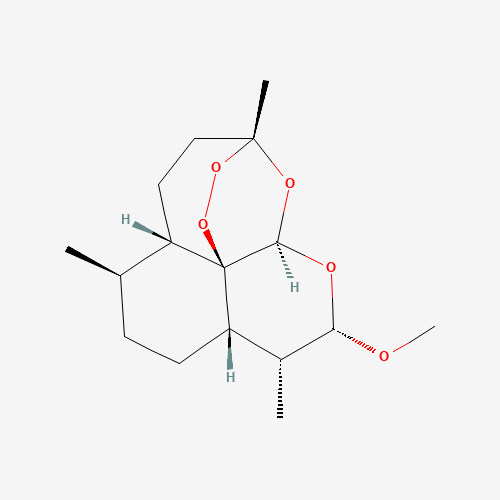
Artemether is an artemisinin derivative that is artemisinin in which the lactone has been converted to the corresponding lactol methyl ether. It is used in combination with lumefantrine as an antimalarial for the treatment of multi-drug resistant strains of falciparum malaria. It has a role as an antimalarial. It is an organic peroxide, a sesquiterpenoid, a cyclic acetal, an artemisinin derivative and a semisynthetic derivative.
科学粮草官-词典编辑部,修订于:2026-07-06
Toxicity
ToxicityEnvironmental Biodegradation
According to an index that ranks medicinal chemicals persistence, bioaccumulation, and toxicity (PBT) potential, artemether has a PBT of 7 on an index ranging from 0 (the lowest PBT) to 9 (the highest potential PBT)(1).
Environmental Bioconcentration
According to an index that ranks medicinal chemicals persistence, bioaccumulation, and toxicity (PBT) potential, artemether has a PBT of 7 on an index ranging from 0 (the lowest PBT) to 9 (the highest potential PBT)(1).
Environmental Water Concentrations
While data specific to artemether were not located(SRC, 2006), the literature suggests that some pharmaceutically active compounds originating from human and veterinary therapy are not eliminated completely in municipal sewage treatment plants and are therefore discharged into receiving waters(1). Wastewater treatment processes often were not designed to remove them from the effluent(2). Selected organic waste compounds may be degrading to new and more persistent compounds that may be released instead of or in addition to the parent compound(2). Studies have indicated that several polar pharmaceutically active compounds can leach through subsoils(1).
Interactions
There has been some concern that antipyretics might attenuate the host defense against malaria, as their use is associated with delayed parasite clearance. However, this appears to result from delaying cytoadherence, which is likely to be beneficial. There is no reason to withhold antipyretics in malaria. ...Paracetamol (acetaminophen) and ibuprofen are the preferred options for reducing fever.
Lethal Dose
collection=toxvaldb&kind=^LD$
Exposure Routes
A 2025 systematic review states that Artemether's routes of administration include oral, intramuscular, and rectal.
Toxicity Summary
A 2025 systematic review notes that Artemether and Arteether have a more neurotoxic profile than Artesunate. Artemether induced substantial and frequently irreversible neurotoxic injury in a mouse model in contrast to Artesunate's lower incidence of neurotoxic effects which were reversible.
Human Toxicity Excerpts
/EPIDEMIOLOGY STUDIES/ A recent report from Mozambique described a small but significant and irreversible hearing loss in patients exposed to artemether-lumefantrine. To explore this issue, we conducted a case-control study using tympanometry, audiometry and auditory brain-stem responses. We assessed 68 subjects who had been treated with artemether-lumefantrine within the previous five years and 68 age- and sex-matched controls living in the malarious region along the Thailand-Myanmar border. There were no differences in the test results between cases and controls. There was no neurophysiologic evidence of auditory brainstem toxicity that could be attributed to artemether-lumefantrine in this study population.
Drug Induced Liver Injury
References: DOI:10.1016/j.drudis.2019.09.022
Non-Human Toxicity Excerpts
/GENOTOXICITY/ Dihydroartemisinin administered orally to rats at 100 mg/kg for 5, 10, or 15 doses was not mutagenic and did not produce chromosome aberrations in bone marrow or testicular cells. /Dihydroartemisinin/
Antidote and Emergency Treatment
Advanced treatment: Consider orotracheal or nasotracheal intubation for airway control in the patient who is unconscious, has severe pulmonary edema, or is in severe respiratory distress. Positive-pressure ventilation techniques with a bag valve mask device may be beneficial. Consider drug therapy for pulmonary edema ... . Consider administering a beta agonist such as albuterol for severe bronchospasm ... . Monitor cardiac rhythm and treat arrhythmias as necessary ... . Start IV administration of D5W /SRP: "To keep open", minimal flow rate/. Use 0.9% saline (NS) or lactated Ringer's if signs of hypovolemia are present. For hypotension with signs of hypovolemia, administer fluid cautiously. Watch for signs of fluid overload ... . Treat seizures with diazepam or lorazepam ... . Use propar...









