


 一键配货
一键配货
化合物详情
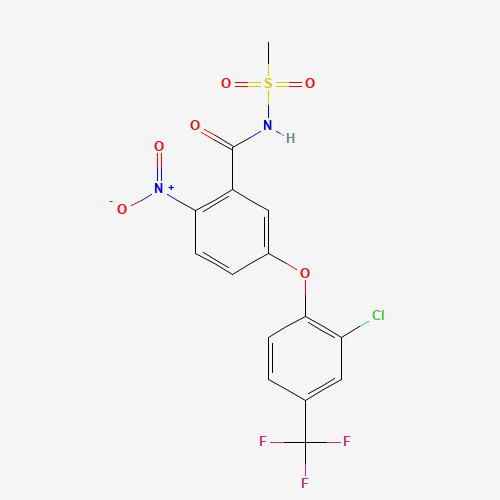
CAS72178-02-0
分子式C15H10ClF3N2O6S
分子量438.76 g/mol
非危品
Physical Description | Fomesafen is a white crystalline solid. Used as an herbicide.
科学粮草官-词典编辑部,修订于:2026-07-06
Toxicity
ToxicityEPA Ecotoxicity
Pesticide Ecotoxicity Data from EPA: 7
Ecotoxicity Values
LD50; Species: Apis mellifera (Honey Bee, worker) topical >100 ug/bee for 48 hr
Fate Summary
ATMOSPHERIC FATE: According to a model of gas/particle partitioning of semivolatile organic compounds in the atmosphere(1), fomesafen, which has a vapor pressure of <3.0X10⁻⁸ mm Hg at 20 °C(2), is expected to exist solely in the particulate phase in the ambient atmosphere. Particulate-phase fomesafen may be removed from the air by wet or dry deposition(SRC). Fomesafen contains chromophores that absorb at wavelengths >290 nm(3) and therefore may be susceptible to direct photolysis by sunlight(SRC).
Soil Adsorption / Mobility
Kom values of 86 and 700 were determined for fomesafen in Drummer silt loam and Norfolk sandy loam, respectively(1). These values correspond to Koc values of 150 and 1200, respectively(2). Koc values of 34 to 164(3) and 60(4) were also reported. According to a classification scheme(5), these Koc values suggest that fomesafen is expected to have very high to low mobility in soil(SRC). Sorption of fomesafen by both soils increased as pH decreased: on the Drummer soil sorption increased from 14% at pH 6.3 to 42% at pH 4.7 and 95% at pH 2.0; on the Norfolk soil, fomesafen sorption increased from 5% at pH 5.3 to 15% at pH 4.0 and 55% at pH 2.0(1). The pKa of fomesafen is 2.83(3), indicating that this compound will exist almost entirely in anion form in the environment (pH 5 to 9) and anions...
Environmental Biodegradation
ANAEROBIC: In soil, fomesafen is rapidly decomposed under anaerobic conditions, with a half-life of <3 weeks(1).
Environmental Bioconcentration
A measured BCF of 6 was reported for fomesafen in bluegill (Lepomis macrochirus) which were exposed over a 28 day period(1). According to a classification scheme(2), this BCF suggests the potential for bioconcentration in aquatic organisms is low(SRC).
Volatilization from Water / Soil
A pKa of 2.83(1) indicates fomesafen will exist almost entirely in the anion form at pH values of 5 to 9 and therefore volatilization from water and moist soil surfaces is not expected to be an important fate process(SRC). Fomesafen is not expected to volatilize from dry soil surfaces(SRC) based upon a vapor pressure of <3.0X10⁻⁸ mm Hg(1).
Environmental Abiotic Degradation
Fomesafen is not expected to undergo hydrolysis in the environment due to the lack of functional groups that hydrolyze under environmental conditions(1). Fomesafen will photodecompose readily under relatively low intensities of sunlight(2). Fomesafen contains chromophores that absorb at wavelengths >290 nm(3) and therefore may be susceptible to direct photolysis by sunlight(SRC).
Ecotoxicity Excerpts
/AQUATIC SPECIES/ Ecotoxicological effects of the diphenyl ether herbicide fomesafen, applied alone or in combination with the adjuvant Agral 90 (mixture of polyethoxylated derivatives of nonylphenol), were assessed on planktonic communities in 18-cu m outdoor mesocosms during a nine-month study. Four mesocosms were treated with fomesafen only (nominal concentration: 40 ug/L), four were treated with the mixture fomesafen-Agral 90 (nominal concentration: 40 ug/L and 90 ug/L, respectively), and four were kept as the controls. Five treatments were performed every three weeks from April 18, 2000. Mean (+/- standard error [SE]) values of fomesafen concentration in water of 62.5 (+/-5.3) and 19.4 (+/-7.6) ug/L were measured at the end of the treatment period in fomesafen- and mixture-treated...
Artificial Pollution Sources
Fomesafen's production may result in its release to the environment through various waste streams; its use as a herbicide(1) will result in its direct release to the environment(SRC).
Probable Routes of Human Exposure
Occupational exposure to fomesafen may occur through inhalation of spray mists or aerosols and dermal contact with this herbicide during or after its application or at workplaces where fomesafen is produced. (SRC)
Environmental Fate / Exposure Summary
Fomesafen's production may result in its release to the environment through various waste streams; its use as a herbicide will result in its direct release to the environment. If released to air, a vapor pressure of <3.0X10⁻⁸ mm Hg at 20 °C indicates fomesafen will exist solely in the particulate phase in the atmosphere. Particulate-phase fomesafen will be removed from the atmosphere by wet or dry deposition. Fomesafen contains chromophores that absorb at wavelengths >290 nm and therefore may be susceptible to direct photolysis by sunlight. If released to soil, fomesafen is expected to have very high to low mobility based upon Koc values of 34 to 1200, depending on soil type. The pKa of fomesafen is 2.83, indicating that this compound will exist almost entirely in anion form in the envi...
Cancer Sites
Hepatic
Interactions
Field studies were conducted to determine rhizomatous johnsongrass and barnyardgrass control with clethodim, quizalofop-P-ethyl, fluazifop-P, sethoxydim, fenoxaprop-ethyl, and quizalofop-P-tefuryl applied alone and with lactofen, imazaquin, chlorimuron, and fomesafen. Graminicides applied alone controlled johnsongrass and barnyardgrass 83 to 99%. Of the graminicides evaluated, clethodium was the most antagonistic of the broadleaf herbicides toward the activity of graminicides. Clethodim mixed with imazaquin reduced johnsongrass control as much as 64% and mixed with chlorimuron reduced barnyardgrass control as much as 52%. Quizalofop-P-tefuryl was least affected by broadleaf herbicides and fomesafen was least antagonistic in mixtures with graminicides.
RAIS Toxicity Values
Oral Slope Factor Reference: IRIS Archive
Human Toxicity Excerpts
/GENOTOXICITY/ In an in vitro mammalian cell cytogenetics assay (Chromosomal aberrations), human lymphocytes (obtained from 1 male donor) in culture were exposed to fomesafen (97.5% ai) in dimethyl sulfoxide (DMSO) at concentrations of 0, 10, 100, and 1000 ug/ml in the absence and presence of metabolic activation for 3 hours and harvested 26 hours after the beginning of treatment. One-hundred cells (duplicate slides) were evaluated for metaphases with structural aberrations. The S9-fraction was obtained from Aroclor 1254 induced male Sprague Dawley rat liver. Fomesafen was tested up to a cytotoxic concentration for this assay. Cytotoxicity was observed at 1000 ug/ml with and without S-9 mix. No statistically or biologically significant increases in chromosomal damage were observed at an...
Non-Human Toxicity Values
LC50 Rat (male) inhalation 4.97 mg/L /4 hr
Non-Human Toxicity Excerpts
/LABORATORY ANIMALS: Subchronic or Prechronic Exposure/ In this subchronic toxicity study, Fomesafen (97.5% ai) was administered in the diet for 90 days to 20 Alderley Park rats/sex/dose at doses of 0, 1, 5, 100 or 1000 ppm (equivalent to 0, 0.1, 0.5, 10 and 100 mg/kg/day). Animals were observed daily for clinical signs of toxicity. Body weights and food consumption were determined initially and at 2-week intervals, thereafter. Hematology, clinical chemistry and urinalysis were conducted. At termination, animals were necropsied, organs weighed and representative tissues examined microscopically. Election microscopy was conducted on selected tissues. No mortality occurred. Animals in the 1000 ppm group gained less weight than the controls. Plasma alkaline phosphatase, alanine transaminas...
1 or Cancer Risk Level 1E-06
Fraction of Contaminant Absorbed Dermally from Soil: 0.1
Antidote and Emergency Treatment
/SRP:/ Advanced treatment: Consider orotracheal or nasotracheal intubation for airway control in the patient who is unconscious, has severe pulmonary edema, or is in severe respiratory distress. Positive-pressure ventilation techniques with a bag valve mask device may be beneficial. Consider drug therapy for pulmonary edema ... . Consider administering a beta agonist such as albuterol for severe bronchospasm ... . Monitor cardiac rhythm and treat arrhythmias as necessary ... . Start IV administration of D5W /SRP: "To keep open", minimal flow rate/. Use 0.9% saline (NS) or lactated Ringer's if signs of hypovolemia are present. For hypotension with signs of hypovolemia, administer fluid cautiously. Watch for signs of fluid overload ... . Treat seizures with diazepam or lorazepam ... . Use...
Hazard Quotient Level 3 or Cancer Risk Level 1E-04
Fraction of Contaminant Absorbed Dermally from Soil: 0.1
USGS Health-Based Screening Levels for Evaluating Water-Quality
Reference: Smith, C.D. and Nowell, L.H., 2024. Health-Based Screening Levels for evaluating water-quality data (3rd ed.). DOI:10.5066/F71C1TWP









