


 一键配货
一键配货
化合物详情
CAS74222-97-2
分子式C15H16N4O5S
分子量364.4 g/mol g/mol
危化品
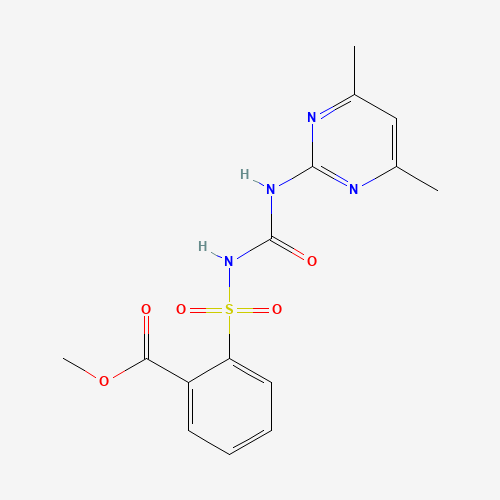
Sulfometuron methyl is a benzoate ester that is the methyl ester of 2-{[(4,6-dimethylpyrimidin-2-yl)carbamoyl]sulfamoyl}benzoic acid. It has a role as an EC 2.2.1.6 (acetolactate synthase) inhibitor and a herbicide. It is a benzoate ester, a member of pyrimidines and a N-sulfonylurea. It is functionally related to a sulfometuron.
科学粮草官-词典编辑部,修订于:2026-07-06
Toxicity
ToxicityEPA Ecotoxicity
Pesticide Ecotoxicity Data from EPA: 34
Ecotoxicity Values
LD50; Species: Apis mellifera (Honey bee) topical, general >100 ug/bee
Fate Summary
ATMOSPHERIC FATE: According to a model of gas/particle partitioning of semivolatile organic compounds in the atmosphere(1), sulfometuron methyl, which has a vapor pressure of 5.48X10⁻¹⁶ mm Hg at 25 °C(2), is expected to exist solely in the particulate phase in the ambient atmosphere. Particulate-phase sulfometuron methyl may be removed from the air by wet or dry deposition(SRC). (14C)Sulfometuron methyl was completely degraded to 14-C02 under aquatic photolysis conditions(2) and therefore is expected to be susceptible to direct photolysis by sunlight(SRC). The compound has been shown to photolyze completely under aquatic photolysis conditions with half-lives from 22-37 days(3).
Soil Adsorption / Mobility
The Kd for sulfometuron methyl sorption to soils of 0-20 cm depths ranged from 0.04 to 0.6. Sorption of sulfometuron methyl on soil from depths 65-95 cm was less than in the surface soils. It appears that once this herbicide leaches past the top 10 cm of these soils, retardation of the herbicide would be slight(1).
Environmental Biodegradation
AEROBIC: Sulfometuron readily biodegrades in aerobic soil. The half-life was reported to be 12-25 days (2-4 weeks) in various soil conditions(1,2). In native sediments at neutral pH, microbial degradation of sulfometuron methyl was prevalent. Pseudo-first-order dissipation rate constants between 1.27X10⁻² days-1 and 3.95X10⁻² days-1 were determined from a stream and pond near Athens, Georgia(3), corresponding to half-lives of 54 and 17 days, respectively(SRC). (14C)Sulfometuron methyl degraded in aerobic soils under laboratory and field conditions at a rate dependent upon soil pH and moisture content. Saccharin was the major degradation product under sterile conditions, but in the presence of a viable soil microbial population, metabolism of the phenyl ring of [phenyl-14C]sulfometuron m...
Environmental Bioconcentration
An estimated BCF of 99 was calculated for sulfometuron methyl using an estimated log Kow of 1.2(1) and a regression-derived equation(2). According to a classification scheme(3), this BCF suggests the potential for bioconcentration in aquatic organisms is moderate(SRC). (14C)Sulfometuron methyl has a low partition ratio (0.31) between n-octanol and 0.01 M phosphate buffer, pH 7.0. It does not accumulate in fish tissue when fish are exposed to 0.01 ppm or 1.0 ppm (14C)-sulfometuron methyl in their environment(4).
Volatilization from Water / Soil
The Henry's Law constant for sulfometuron methyl is estimated as 5.2X10⁻¹⁴ atm-cu m/mole(SRC) using a fragment constant estimation method(1). This Henry's Law constant indicates that sulfometuron methyl is expected to be essentially nonvolatile from water surfaces(2). The Henry's Law constant for sulfometuron methyl indicates that volatilization from moist soil surfaces is not expected(SRC). Sulfometuron methyl is not expected to volatilize from dry soil surfaces(SRC) based upon a vapor pressure of 5.48X10⁻¹⁶ mm Hg(3).
Environmental Abiotic Degradation
Abiotic and microbially-mediated hydrolysis/degradation are the major routes of transformation of sulfometuron methyl in water, soil, and sediment; hydrolysis appears to be a function of pH and temperature, with the rate being much more rapid under acidic conditions(1). (phenyl-14C)Sulfometuron methyl was found to be stable in water at pH 7 or 9, but hydrolyzes readily to (14C)methyl 2-(aminosulfonyl)benzoate and (14C)1,2-benzisothiazol-3-one, 2,3-dihydro 1,1-dioxide (saccharin), at pH 5.0(2). The half-life of sulfometuron-methyl maintained at pH 5 is 18 days(3); at 35 °C, reported half-lives at pH 5, 6, 7, and 8 were 1.8, 6, 15, and 20 days, respectively; at 45 °C, half-lives at pH 5 and 7 were 2.1 and 33 days, respectively(1). Using distilled water maintained at room temperature and a...
Environmental Water Concentrations
SURFACE WATER: Surface water samples were collected from 44 midwestern locations during the summer of 1997, and analyzed for herbicide residues of 15 chemicals including sulfometuron methyl and concluded that all samples were below the level of detection(1). In the Midwestern United States, 212 water samples were collected from 75 surface-water sites in 1998. These samples were analyzed by the USGS for 16 sulfonylurea, sulfonamide, and imidazolinone herbicides. In surface water streams, 2 samples were detected above the established method reporting limit of <0.01 ug/L; the maximum was 0.018 ug/L(2).
Milk Concentrations
EXPERIMENTAL: Sulfometuron methyl was rapidly metabolized and excreted by goats, a representative ruminant animal ... Less than 1% was excreted in milk ... The major metabolite in milk was also (hydroxymethyl)-pyrimidine sulfometuron methyl (HM-SM). Less than 10% (<0.01 ppm) of total (14)C labeled residues in milk was the parent herbicide, indicating that sulfometuron methyl accumulation in milk was below detectable limits of 0.03 ppm.
Artificial Pollution Sources
Sulfometuron methyl's production may result in its release to the environment through various waste streams; its use as an herbicide to manage annual and perennial broadleaf weeds and grasses in non-agricultural sites(1) will result in its direct release to the environment(SRC).
Probable Routes of Human Exposure
From 1993 to 2005 The American Association of Poison Control Center (AAPCC) reported poisoning incident data on sulfometuron methyl. A total of 40 incidents were reported for sulfometuron. Six of the incidents resulted in moderate effects as reported by AAPCC (3 occurring in a residential environment, 1 in a public area and 2 in the workplace) and 18 of the incidents resulted in minor effects (9 occurring in a residential environment, 6 in a public area and 3 in the workplace). There were no deaths and no major incidents related to sulfometuron exposure. The remaining 16 of the 40 AAPCC incidents were either not followed (15, with minimal to no effects expected from the exposure incident) or, were determined to have resulted in no effects (1 incident)(1).
Environmental Fate / Exposure Summary
Sulfometuron methyl's production may result in its release to the environment through various waste streams; its use as an herbicide to manage annual and perennial broadleaf weeds and grasses in non-agricultural sites will result in its direct release to the environment. If released to air, a vapor pressure of 5.48X10⁻¹⁶ mm Hg at 25 °C indicates sulfometuron methyl will exist solely in the particulate phase in the atmosphere. Particulate-phase sulfometuron methyl will be removed from the atmosphere by wet or dry deposition. (14C)Sulfometuron methyl was completely photolyzed to 14-C02 under aquatic photolysis conditions and therefore is expected to be susceptible to direct photolysis by sunlight. If released to soil, sulfometuron methyl is expected to have high mobility based upon a an e...
Toxicity Data
LC50 (rat) = >11,000 mg/m3/4H [ACGIH]
Adverse Effects
ACGIH Carcinogen - Not Classifiable.
RAIS Toxicity Values
Oral Chronic Reference Dose Reference: OPP
Human Toxicity Excerpts
/SURVEILLANCE/ There are 4 reported incidents in the IDS since 2000. The incidents are associated with a variety of symptoms including abdominal pain, diarrhea, tremors, joint pain, edema, hives, welts, hair loss, fingernail loss, jaundice, eye irritation, welts, respiratory irritation, weakness, and a fast pulse.
Non-Human Toxicity Values
LC50 Rat inhalation > 5 ppm over 4 hrs
Non-Human Toxicity Excerpts
/LABORATORY ANIMALS: Developmental or Reproductive Toxicity/ In a developmental toxicity study Sulfometuron-methyl (100% a.i.; Batch# not provided) in 0.5% aqueous methylcellulose was administered via oral gavage at a dose volume of 4 mL/kg to 17 artificially inseminated New Zealand White rabbits/dose group at doses of 0, 30, 100, or 300 mg/kg/day from gestation days (GD) 6-18. On GD 29, all does were euthanized, and the uterus was removed via cesarean section and its contents examined. Fetuses were examined for external, visceral, and skeletal malformations and variations. There were no mortalities and no treatment-related clinical signs or macroscopic findings. During the treatment interval (GD 6-18), decreased maternal body weight gains of 44% were observed at the HDT (300 mg/kg/day)...
Evidence for Carcinogenicity
A4: Not classifiable as a human carcinogen.
Antidote and Emergency Treatment
/SRP:/ Advanced treatment: Consider orotracheal or nasotracheal intubation for airway control in the patient who is unconscious, has severe pulmonary edema, or is in severe respiratory distress. Positive-pressure ventilation techniques with a bag valve mask device may be beneficial. Consider drug therapy for pulmonary edema ... . Consider administering a beta agonist such as albuterol for severe bronchospasm ... . Monitor cardiac rhythm and treat arrhythmias as necessary ... . Start IV administration of D5W /SRP: "To keep open", minimal flow rate/. Use 0.9% saline (NS) or lactated Ringer's if signs of hypovolemia are present. For hypotension with signs of hypovolemia, administer fluid cautiously. Watch for signs of fluid overload ... . Treat seizures with diazepam or lorazepam ... . Use...
USGS Health-Based Screening Levels for Evaluating Water-Quality
Reference: Smith, C.D. and Nowell, L.H., 2024. Health-Based Screening Levels for evaluating water-quality data (3rd ed.). DOI:10.5066/F71C1TWP









