


 一键配货
一键配货
化合物详情
CAS74223-64-6
分子式C14H15N5O6S
分子量381.36 g/mol
非危品
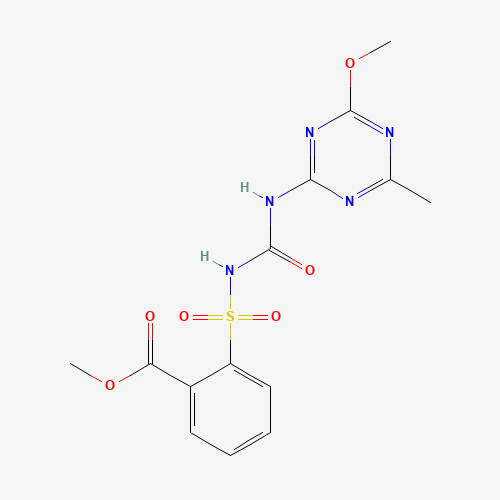
Metsulfuron methyl is a N-sulfonylurea in which the sulfonyl group is attached to a 2-(methoxycarbonyl)phenyl group while a (4-methoxy-6-methyl-1,3,5-triazin-2-yl group replaces one of the amino hydrogens of the remaining urea group. It has a role as a herbicide, a xenobiotic and an environmental contaminant. It is a benzoate ester, a methoxy-1,3,5-triazine and a N-sulfonylurea.
科学粮草官-词典编辑部,修订于:2026-07-06
Toxicity
ToxicityEPA Ecotoxicity
Pesticide Ecotoxicity Data from EPA: 99
Ecotoxicity Values
LC50 /Colinus virginianus/ (Bobwhite quail) dietary >5620 mg/kg/8 days
Fate Summary
ATMOSPHERIC FATE: According to a model of gas/particle partitioning of semivolatile organic compounds in the atmosphere(1), metsulfuron methyl, which has a vapor pressure of 2.50X10⁻¹² mm Hg at 25 °C(2), is expected to exist solely in the particulate phase in the ambient atmosphere. Particulate-phase metsulfuron methyl may be removed from the air by wet or dry deposition(SRC). Metsulfuron methyl may undergo direct photolysis based on 50 and 76% degradation of this substance in an aqueous solution (10 ug/mL, pH 6.2) after 15 and 36 hours exposure to UV irradiation (greater than or equal to 290 nm), respectively(4). Only 5% of metsulfuron methyl was degraded in a control kept in complete darkness over the same time period(4).
Soil Adsorption / Mobility
Koc values measured for metsulfuran methyl in various types of soil were 14 in a clay loam (pH 7.5, 7.2% organic matter), 12 in a sandy loam (pH 7.7, 5.2% organic matter), 29 in a loam soil (pH 5.4, 3.9% organic matter), 7 in a loam soil (pH 7.6, 3.6% organic matter), 9 in a sandy clay loam (pH 7.5, 5.8% organic matter), 12 in a clay loam (pH 5.3, 4.4% organic matter), 4 in a sandy loam (pH 7.1, 2.3% organic matter), 44 in a sandy loam (pH 5.4, 19.0% organic matter), 60 in a silt loam (pH 6.5, 4.02% organic matter), 53 in a silt loam (pH 6.4, 2.75% organic matter), 50 in a sandy loam (pH 5.6, 1.40 % organic matter), and 206 in a sandy soil (pH 6.1, 0.3% organic matter)(1). Koc values measured for metsulfuron methyl in tropical soils (pH ranging from 3.63-4.23) were 194.79 (33.8% organic...
Environmental Biodegradation
ANAEROBIC: Pseudo-first-order rate constants for metsulfuron methyl in native and sterile anaerobic sediment from a eutrophic pond were 5.7X10⁻³ and 1.9X10⁻³ per day, respectively(1). These rate constants correspond to half-lives of 122 days in the native sediment and 365 days in the sterile sediment(1).
Environmental Bioconcentration
UNREVIEWED | BCF values of 17, 14, and 1 were measured for metsulfuron methyl in freshwater microalga Chlorella fusca at pH 5, 5.3, and 6, respectively(1). According to a classification scheme(2), these BCF values suggests the potential for bioconcentration in aquatic organisms is low(SRC).
Volatilization from Water / Soil
The Henry's Law constant for metsulfuron methyl is estimated as 1.32X10⁻¹⁶ atm-cu m/mole(SRC) derived from its vapor pressure, 2.50X10⁻¹² mm Hg(1), and water solubility, 9.50X10+3 mg/L(1). This Henry's Law constant indicates that metsulfuron methyl is expected to be essentially nonvolatile from moist soil and water surfaces(2). Metsulfuron methyl is not expected to volatilize from dry soil surfaces(SRC) based upon its vapor pressure(1).
Environmental Abiotic Degradation
First-order hydrolysis rate constants measured for metsulfuron methyl in aqueous buffer solutions at 25 °C and pH 5.2, 6.2, 7.1, 8.2, 9.4, and 10.2 were 0.072, 0.011, 0.006, 0.005, 0.007, and 0.008 per day, respectively, which correspond to half-lives of 9.6, 63, 116, 139, 99, and 87 days, respectively(1). Hydrolysis rate constants measured for this substance in soil solutions at 25 °C and pH 7.1, 9.4, and 10.2 were 0.006, 0.009, and 0.008 per day, respectively, which correspond to half-lives of 116, 99, and 87 days, respectively(1). The first-order hydrolysis rate constants measured for metsulfuron methyl in aqueous buffer solutions at pH 4 and temperatures of 20, 25, 35, 45, and 55 °C were 0.014, 0.37, 1.07, 3.09, and 7.95 per day, respectively, which correspond to half-lives of 4.98,...
Environmental Water Concentrations
SURFACE WATER: Metsulfuron methyl was not detected above 0.01 ug/L in 130 samples collected from Midwestern streams and rivers during 1998(1). The concentrations of metsulfuron methyl measured in water collected from the Iowa River near Rowan, IA, from the Mississippi River near Clinton, IA, and from a site on the Illinois River were 0.04, 0.05, and 0.04 ug/L, respectively during the summer of 1997(2).
Ecotoxicity Excerpts
... In the clay soil, bacterial populations decreased with increasing concentration of metsulfuron-methyl during the first 9 days of incubation but exceeded that of the control soil from day 27 onward. In the sandy loam soil, the herbicide reduced bacterial populations during the first 3 days after application, but these increased to the level of untreated controls after 9 days' incubation. Fungal populations in both soils increased with increasing metsulfuron-methyl concentrations, especially in the sandy loam soil. CO2 evolution was stimulated in both soils in the presence of the herbicide initially, but decreased during days 3 to 9 of the incubation period before increasing again afterward.
Artificial Pollution Sources
Metsulfuron methyl's production may result in its release to the environment through various waste streams; it's use as a herbicide(1) will result in its direct release to the environment(SRC).
Probable Routes of Human Exposure
Occupational exposure to metsulfuron methyl may occur through dermal contact with this compound at workplaces where metsulfuron methyl is produced or used. (SRC)
Environmental Fate / Exposure Summary
Metsulfuron methyl's production may result in its release to the environment through various waste streams; it's use as a herbicide will result in its direct release to the environment. If released to air, a vapor pressure of 2.50X10⁻¹² Hg at 25 °C indicates metsulfuron methyl will exist solely in the particulate phase in the atmosphere. Particulate-phase metsulfuron methyl will be removed from the atmosphere by wet or dry deposition. Metsulfuron methyl may undergo direct photolysis based on 50 and 76% degradation of this substance in an aqueous solution after 15 and 36 hours exposure to UV irradiation (greater than or equal to 290 nm), respectively. If released to soil, metsulfuron methyl is expected to have moderate to very high mobility based upon Koc values ranging from 4-345. Volat...
Toxicity Data
LC50 (rat) > 5,000 mg/m3/4h
RAIS Toxicity Values
Oral Chronic Reference Dose Reference: IRIS Current
Carcinogen Classification
No indication of carcinogenicity to humans (not listed by IARC).
Non-Human Toxicity Values
LD50 Rabbit (male and female) oral >2000 mg/kg
Non-Human Toxicity Excerpts
/LABORATORY ANIMALS: Developmental or Reproductive Toxicity/ Groups of 19 or 20 female rabbits were administered 2 mL portions of ally in 0.5% aqueous methocel by gavage during days 6 to 18 of gestation, at doses of either 25, 100, 300, or 700 mg/kg/day. Developmental toxicity was not demonstrated. Maternal toxicity was shown by a dose-related increase in mortality and decrease in body weight at doses of 100 mg/kg/day or higher. The 25 mg/kg/day dose was a NOEL. These results are consistent with those of the primary study.
1 or Cancer Risk Level 1E-06
Fraction of Contaminant Absorbed Dermally from Soil: 0.1
Hazard Quotient Level 3 or Cancer Risk Level 1E-04
Fraction of Contaminant Absorbed Dermally from Soil: 0.1
USGS Health-Based Screening Levels for Evaluating Water-Quality
Reference: Smith, C.D. and Nowell, L.H., 2024. Health-Based Screening Levels for evaluating water-quality data (3rd ed.). DOI:10.5066/F71C1TWP









