


 一键配货
一键配货
化合物详情
CAS74863-84-6
分子式C23H36N6O5S
分子量508.63 g/mol g/mol
危化品
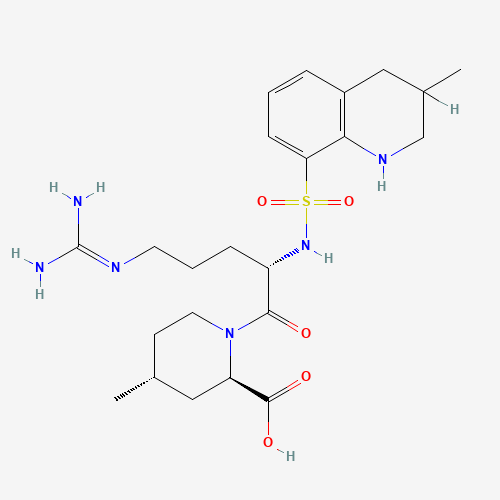
(2R,4R)-1-[(2S)-5-(diaminomethylideneamino)-2-[(3-methyl-1,2,3,4-tetrahydroquinolin-8-yl)sulfonylamino]-1-oxopentyl]-4-methyl-2-piperidinecarboxylic acid is a peptide.
科学粮草官-词典编辑部,修订于:2026-07-06
Toxicity
ToxicityArtificial Pollution Sources
Argatroban's production and administration as an antithrombotic(1) may result in its release to the environment through various waste streams(SRC).
Effect Level
collection=toxvaldb&kind=^EL$
Interactions
Pharmacodynamic interaction (increased prothrombin time (PT) and international normalized ratio (INR) relative to warfarin alone).
Adverse Effects
The most common adverse effect of argatroban, as with other anticoagulants, is bleeding, which can manifest as gastrointestinal, genitourinary, intracranial, retroperitoneal bleeding, hemoptysis, and other minor bleedings. Non-hemorrhagic complications include hypotension, dyspnea, fever, sepsis, and cardiac arrest. When used in PCI, chest pain, back pain, nausea, vomiting, hypotension, and headache can occur.
Toxicity Summary
The toxicity of argatroban from supratherapeutic dosage is related to its anticoagulant effect. There is no antidote to reverse its actions. In case of overdose, stop the drug and initiate appropriate transfusion therapy, eg, fresh frozen plasma. Patients with hepatic dysfunction are particularly susceptible to the excessive anticoagulant effect of argatroban due to reduced clearance. In such patients, the reversal of its effect takes a longer time.
Human Toxicity Excerpts
/OTHER TOXICITY INFORMATION/ Argatroban is a highly selective and reversible, small-molecule direct thrombin inhibitor that binds rapidly to the catalytic site/apolar region of both circulating (free) and clot-bound thrombin. Inhibition of thrombin prevents various steps in the coagulation process (e.g., activation of factors V, VIII, and XIII and of protein C; conversion of fibrinogen to fibrin; platelet activation and aggregation). At infusion rates up to 40 ug/kg per minute, argatroban produces dose-dependent increases in activated partial thromboplastin time (aPTT) and several other coagulation assays (activated clotting time [ACT], prothrombin time [PT], and thrombin time [TT]).
Drug Induced Liver Injury
References: DOI:10.1016/j.drudis.2019.09.022
Non-Human Toxicity Excerpts
/GENOTOXICITY/ Argatroban was not genotoxic in the Ames test, the Chinese hamster ovary cell (CHO/HGPRT) forward mutation test, the Chinese hamster lung fibroblast chromosome aberration test, the rat hepatocyte ... or the mouse micronucleus test.
Populations at Special Risk
Caution is advised in patients with hepatic dysfunction. Achievement of steady-state anticoagulation and reversal of the anticoagulant effect may require longer than 1-3 hours and 4 hours, respectively, because of the decreased clearance and increased elimination half-life of argatroban in such patients.
Antidote and Emergency Treatment
Excessive anticoagulation, with or without bleeding, may be controlled by discontinuing argatroban or by decreasing the argatroban dose. In clinical studies, anticoagulation parameters generally returned from therapeutic levels to baseline within 2 to 4 hours after discontinuation of the drug. Reversal of anticoagulant effect may take longer in patients with hepatic impairment. No specific antidote to argatroban is available; if life-threatening bleeding occurs and excessive plasma levels of argatroban are suspected, discontinue argatroban immediately and measure aPTT and other coagulation parameters. When argatroban was administered as a continuous infusion (2 ug/kg/min) prior to and during a 4-hour hemodialysis session, approximately 20% of Argatroban was cleared through dialysis.
Effects During Pregnancy and Lactation
◉ Effects on Lactation and Breastmilk









