


 一键配货
一键配货
化合物详情
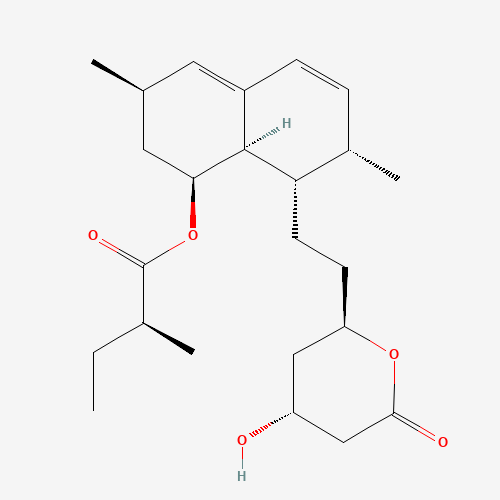
CAS75330-75-5
分子式C24H36O5
分子量404.54 g/mol g/mol
危化品
Lovastatin can cause developmental toxicity according to state or federal government labeling requirements.
科学粮草官-词典编辑部,修订于:2026-07-06
Toxicity
ToxicityEcotoxicity Values
EC50; Species: Xenopus laevis (African Clawed Frog) blastula; Conditions: freshwater, renewal, 23 °C, pH 6.5-9, hardness 16-400 mg/L CaCO3; Concentration: 20500 ug/L for 96 hr; Effect: development, increased deformation /98% purity/
Fate Summary
ATMOSPHERIC FATE: According to a model of gas/particle partitioning of semivolatile organic compounds in the atmosphere(1), lovastatin, which has an estimated vapor pressure of 2.2X10⁻¹² mm Hg at 25 °C(SRC), determined from a fragment constant method(2), is expected to exist solely in the particulate phase in the ambient atmosphere. Particulate-phase lovastatin may be removed from the air by wet and dry deposition(SRC). Lovastatin contains chromophores that absorb UV light at wavelengths >290 nm(3) and, therefore, may be susceptible to direct photolysis by sunlight(SRC).
Soil Adsorption / Mobility
Using a structure estimation method based on molecular connectivity indices(1), the Koc of lovastatin can be estimated to be 7400(SRC). According to a classification scheme(2), this estimated Koc value suggests that lovastatin is expected to be immobile in soil.
Environmental Bioconcentration
An estimated BCF of 300 was calculated in fish for lovastatin(SRC), using a log Kow of 4.26(1) and a regression-derived equation(1). According to a classification scheme(2), this BCF suggests the potential for bioconcentration in aquatic organisms is high(SRC).
Volatilization from Water / Soil
The Henry's Law constant for lovastatin is estimated as 2.1X10⁻¹⁰ atm-cu m/mole(SRC) using a fragment constant estimation method(1). This Henry's Law constant indicates that lovastatin is expected to be essentially nonvolatile from water and moist soil surfaces(2). Lovastatin is not expected to volatilize from dry soil surfaces(SRC) based upon an estimated vapor pressure of 2.2X10⁻¹² mm Hg(SRC), determined from a fragment constant method(3).
Environmental Abiotic Degradation
Lovastatin is not expected to undergo hydrolysis in the environment due to the lack of functional groups that hydrolyze under environmental conditions(1). Lovastatin contains chromophores that absorb UV light at wavelengths >290 nm(1) and, therefore, may be susceptible to direct photolysis by sunlight(SRC).
Environmental Water Concentrations
SURFACE WATER: Lovastatin was reported at a concentration range of 10.6-102.9 ng/L (18.3 ng/L median; 2.3% frequency in 120 samples)in the upper Tennessee River basin at the confluence of the Holston and French Rivers to the beginning of the Tennessee River Gorge, sampled Dec 12-13, 2006, May 7-9, July 27-29 and Oct 22-25, 2007(1).
Natural Pollution Sources
Lovastatin has been isolated from Monascus ruber and Apergillus terreus(1), via fermentation(2,3). It can also obtained from the fungus Pleurotus ostreatus(4,5). Lovastatin is found in some red yeast rice products; red yeast rice is used as food in Chinese cuisine(6).
Artificial Pollution Sources
Lovastatin's production and administration as a hypercholesterolemic drug(1) may result in its release to the environment through various waste streams(SRC).
Probable Routes of Human Exposure
Occupational exposure to lovastatin may occur through inhalation and dermal contact with this compound at workplaces where lovastatin is produced or used. The general public is not likely to be exposed to lovastatin unless by direct medical treatment. Limited monitoring data indicate that the general population may be exposed to lovastatin via contact with contaminated water. (SRC)
Environmental Fate / Exposure Summary
Lovastatin's production and administration as a hypercholesterolemic drug may result in its release to the environment through various waste streams. Lovastatin has been isolated from the microbes Monascus ruber and Apergillus terreus. If released to air, an estimated vapor pressure of 2.2X10⁻¹² mm Hg at 25 °C indicates lovastatin will exist solely in the particulate phase in the atmosphere. Particulate-phase lovastatin will be removed from the atmosphere by wet and dry deposition. Lovastatin contains chromophores that absorb UV light at wavelengths >290 nm and, therefore, may be susceptible to direct photolysis by sunlight. If released to soil, lovastatin is expected to be immobile based upon an estimated Koc of 7400. Volatilization from moist soil surfaces is not expected to be an imp...
Interactions
Lovastatin, like several other inhibitors of HMG-CoA reductase, is a substrate of cytochrome P450 3A4 (CYP3A4). Certain drugs which inhibit this metabolic pathway can raise the plasma levels of lovastatin and may increase the risk of myopathy. These include itraconazole, ketoconazole, posaconazole, voriconazole, the macrolide antibiotics erythromycin and clarithromycin, the ketolide antibiotic telithromycin, HIV protease inhibitors, boceprevir, telaprevir, the antidepressant nefazodone, or cobicistat-containing products. Combination of these drugs with lovastatin is contraindicated. If short-term treatment with strong CYP3A4 inhibitors is unavoidable, therapy with lovastatin should be suspended during the course of treatment
Toxicity Data
LD<sub>50</sub>>1000 mg/kg (orally in mice)
Hepatotoxicity
Likelihood score: B (likely cause of clinically apparent liver injury).
Adverse Effects
* Amiodarone:In patients taking lovastatin and amiodarone concomitantly, do not use more than 40 mg lovastatin per day as higher doses increase the risk of myopathy and rhabdomyolysis.
Exposure Routes
Studies suggest that <5% of the oral dose reaches the general circulation as active inhibitors. Time to peak serum concentration is 2-4 hours. Lovastatin undergoes extensive first-pass metabolism so the availability of the drug in the system is low and variable.
Toxicity Summary
Lovastatin is structurally similar to the HMG, a substituent of the endogenous substrate of HMG-CoA reductase. Lovastatin is a prodrug that is activated <i>in vivo</i> via hydrolysis of the lactone ring to form the ‘_-hydroxyacid. The hydrolyzed lactone ring mimics the tetrahedral intermediate produced by the reductase allowing the agent to bind to HMG-CoA reductase with 20,000 times greater affinity than its natural substrate. The bicyclic portion of lovastatin binds to the coenzyme A portion of the active site.
Human Toxicity Excerpts
/CASE REPORTS/ ... A 60-year-old black man developed rhabdomyolysis after receiving lovastatin for 14 months. Rhabdomyolysis developed in the absence of other medications previously reported to cause this adverse effect when administered concomitantly with lovastatin. Adverse drug reaction causality algorithms categorized this reaction as either possible or probable. Rhabdomyolysis is an uncommon adverse effect associated with lovastatin therapy. Although reported cases of lovastatin-induced rhabdomyolysis were associated with the coadministration of cyclosporine, erythromycin, gemfibrozil, or nicotinic acid, this adverse effect may occur in the absence of these agents.
Carcinogen Classification
No indication of carcinogenicity to humans (not listed by IARC).
Drug Induced Liver Injury
References: DOI:10.1016/j.drudis.2019.09.022
Non-Human Toxicity Values
LD50 Mouse oral > 20,000 mg/kg
Non-Human Toxicity Excerpts
/LABORATORY ANIMALS: Chronic Exposure or Carcinogenicity/ An increased incidence of hepatocellular carcinoma and adenoma was observed after 21 mo in mice given oral lovastatin 500 mg/kg daily resulting in plasma concns up to 3-4 times the estimated human exposure; similar changes were not observed at oral dosages of 20 or 100 mg/kg daily resulting in plasma concns up to 0.3-2 times the estimated human exposure. An increased incidence of pulmonary adenomas also was observed in female mice receiving oral lovastatin 500 mg/kg daily (resulting in plasma concns up to four times the estimated human exposure), but the relationship of these adenomas to administration of the drug is not known since the incidence of these tumors was within the range of that found in untreated animals in studies o...
Populations at Special Risk
The ACC/AHA cholesterol management guideline states that initiation of statin therapy for primary prevention of atherosclerotic cardiovascular disease (ASCVD) in patients older than 75 years of age requires consideration of additional factors, including increasing comorbidities, safety considerations, and priorities of care. Therefore, the potential for an ASCVD risk reduction benefit, adverse effects, and drug interactions, along with patient preferences, must be considered before initiating statin therapy in patients older than 75 years of age. /Statins/
Antidote and Emergency Treatment
/SRP:/ Advanced treatment: Consider orotracheal or nasotracheal intubation for airway control in the patient who is unconscious, has severe pulmonary edema, or is in severe respiratory distress. Positive-pressure ventilation techniques with a bag valve mask device may be beneficial. Consider drug therapy for pulmonary edema ... . Consider administering a beta agonist such as albuterol for severe bronchospasm ... . Monitor cardiac rhythm and treat arrhythmias as necessary ... . Start IV administration of D5W TKO /SRP: "To keep open", minimal flow rate/. Use 0.9% saline (NS) or lactated Ringer's (LR) if signs of hypovolemia are present. For hypotension with signs of hypovolemia, administer fluid cautiously. Watch for signs of fluid overload ... . Treat seizures with diazepam or lorazepam...
Effects During Pregnancy and Lactation
◉ Effects on Lactation and Breastmilk









