


 一键配货
一键配货
化合物详情
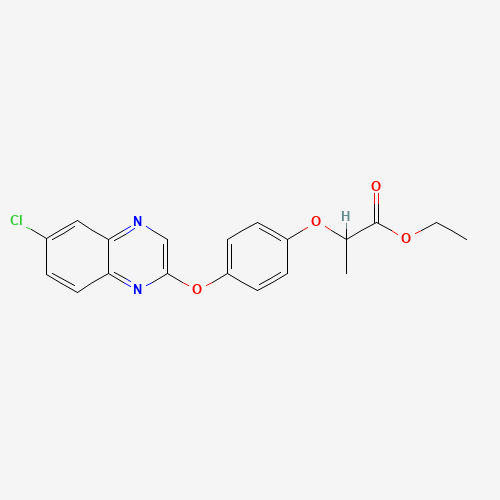
CAS76578-14-8
分子式C19H17ClN2O4
分子量372.8 g/mol
非危品
Quizalofop-ethyl can cause male reproductive toxicity according to an independent committee of scientific and health experts.
科学粮草官-词典编辑部,修订于:2026-07-06
Toxicity
ToxicityEPA Ecotoxicity
Pesticide Ecotoxicity Data from EPA: 39
Fate Summary
ATMOSPHERIC FATE: According to a model of gas/particle partitioning of semivolatile organic compounds in the atmosphere(1), quizalofop-ethyl, which has a vapor pressure of 6.49X10⁻⁹ mm Hg at 20 °C(2), is expected to exist solely in the particulate phase in the ambient atmosphere. Particulate-phase quizalofop-ethyl may be removed from the air by wet and dry deposition(SRC).
Soil Adsorption / Mobility
Koc values of 510 and 570(1) have been measured for quizalofop-ethyl in soil. According to a classification scheme(2), these Koc values suggest that quizalofop-ethyl has low mobility in soil.
Environmental Biodegradation
A field dissipation half-life of 60 days was reported(1); this value includes loss due to both abiotic and biotic degradation as well as transport processes. In soil, a DT50 value of less than 1 day has been reported; quizalofop is formed as the degradation product(2).
Environmental Bioconcentration
An estimated BCF of 400 was calculated for quizalofop-ethyl(SRC), using a log Kow of 4.28(1) and a regression-derived equation(2). According to a classification scheme(3), this BCF suggests the potential for bioconcentration in aquatic organisms is high(SRC).
Volatilization from Water / Soil
The Henry's Law constant for quizalofop-ethyl is 1.1X10⁻⁸ atm-cu m/mole(SRC) based upon its vapor pressure, 6.49X10⁻⁹ mm Hg(1), and water solubility, 0.30 mg/l(2). This Henry's Law constant indicates that quizalofop-ethyl is expected to be essentially nonvolatile from water surfaces(3). Quizalofop-ethyl's Henry's Law constant(1,2) indicates that volatilization from moist soil surfaces should not occur(SRC). Quizalofop-ethyl is not expected to volatilize from dry soil surfaces(SRC) based upon its vapor pressure(1).
Environmental Abiotic Degradation
A base-catalyzed second-order hydrolysis rate constant of 0.12 L/mole-sec(SRC) was estimated using a structure estimation method(1); this corresponds to half-lives of 1.8 years and 67 days at pH values of 7 and 8, respectively(1).
Artificial Pollution Sources
Quizalofop-ethyl's production may result in its release to the environment through various waste streams; it's use as a herbicide(1) will result in its direct release to the environment(SRC).
Probable Routes of Human Exposure
Occupational exposure to quizalofop-ethyl may occur through inhalation and dermal contact with this compound at workplaces where quizalofop-ethyl is produced or used. Because this compound is a herbicide used on crops intended for human consumption, the general population may be exposed to quizalofop-ethyl via ingestion of food and drinking water although no monitoring data were located. (SRC)
Environmental Fate / Exposure Summary
Quizalofop-ethyl's production may result in its release to the environment through various waste streams; it's use as a herbicide will result in its direct release to the environment. If released to air, a vapor pressure of 6.49X10⁻⁹ mm Hg at 20 °C indicates quizalofop-ethyl will exist solely in the particulate phase in the ambient atmosphere. Particulate-phase quizalofop-ethyl will be removed from the atmosphere by wet and dry deposition. If released to soil, quizalofop-ethyl is expected to have low mobility based upon Koc values of 510 and 570. Volatilization from moist soil surfaces is not expected to be an important fate process given this compound's Henry's Law constant of 1.1X10⁻⁸ atm-cu m/mole. Quizalofop-ethyl is not expected to volatilize from dry soil surfaces based upon its v...
Target Organs
Hepatic
Toxicity Data
LC50 (rat) = 5,800 mg/m3/4h
Adverse Effects
Occupational hepatotoxin - Secondary hepatotoxins: the potential for toxic effect in the occupational setting is based on cases of poisoning by human ingestion or animal experimentation.
RAIS Toxicity Values
Oral Chronic Reference Dose Reference: IRIS Current
Carcinogen Classification
No indication of carcinogenicity to humans (not listed by IARC).
Non-Human Toxicity Values
LC50 Rat inhalation 5.8 mg/L/4 hr
1 or Cancer Risk Level 1E-06
Fraction of Contaminant Absorbed Dermally from Soil: 0.1
Hazard Quotient Level 3 or Cancer Risk Level 1E-04
Fraction of Contaminant Absorbed Dermally from Soil: 0.1









