


 一键配货
一键配货
化合物详情
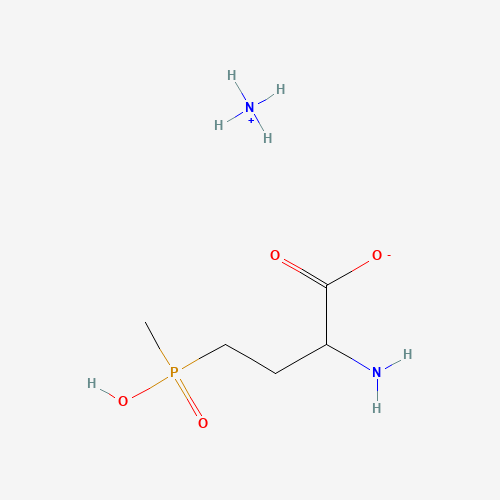
CAS77182-82-2
分子式C5H15N2O4P
分子量198.16 g/mol
非危品
Glufosinate-Ammonium is a synthetic organophosphate glutamine synthetase inhibitor and neurotoxin that is used as a pesticide. It is characterized as a highly soluble and volatile white to light yellow crystalline solid with a slightly pungent odor, and exposure occurs by inhalation, ingestion, or contact.
科学粮草官-词典编辑部,修订于:2026-07-06
Toxicity
ToxicityEPA Ecotoxicity
Pesticide Ecotoxicity Data from EPA: 132
Ecotoxicity Values
LC50 Golden orfe >1000 mg/l (96 hr) /Conditions of bioassay not specified./
Fate Summary
ATMOSPHERIC FATE: According to a model of gas/particle partitioning of semivolatile organic compounds in the atmosphere(1), glufosinate-ammonium, which has an estimated vapor pressure of 9.1X10⁻¹² mm Hg at 25 °C(SRC), determinded from a fragment constant method(2), is expected to exist solely in particulate phase in the ambient atmosphere. Particulate-phase glufosinate-ammonium may be removed from the air by wet and dry deposition(SRC).
Soil Adsorption / Mobility
Field studies have indicated that glufosinate-ammonium rarely leaches below 10-15 cm in soil(1,2), presumably because of rapid microbial degradation(1).
Environmental Biodegradation
AEROBIC: Glufosinate-ammonium was found to be persistent in an aerobic sandy aquifer material in laboratory batch and in situ microcosm studies at concentrations of 50-400 ppb(1); at 50 ppb, the initial half-life was about 20 days, but after 20 days, the glufosinate-ammonium concentration remained steady (about 25 ppb) throughout the 70 day incubation period(1); at 400 ppb in the in situ microcosm, glufosinate-ammonium concentrations remained between 275-350 ppb for 55 days before falling to 200 ppb at 75 days(1); the research suggests that in an aquifer with relatively low clay content and little labile organic carbon, glufosinate-ammonium will be persistent and transport will be essentially unretarded(1).
Environmental Bioconcentration
An estimated BCF of <3.2 was calculated for glufosinate-ammonium (SRC), using a log Kow of <0.1 at pH 7(1) and a regression-derived equation(2). According to a classification scheme(3), this BCF suggests the potential for bioconcentration in aquatic organisms is low(SRC).
Volatilization from Water / Soil
The Henry's Law constant for glufosinate-ammonium is estimated as 4.4X10⁻¹⁴ atm-cu m/mole(1). This Henry's Law constant indicates that glufosinate-ammonium is expected to be essentially nonvolatile from water surfaces(2).
Environmental Abiotic Degradation
The rate constant for the vapor-phase reaction of glufosinate-ammonium with photochemically-produced hydroxyl radicals has been estimated as 3.07X10⁻¹¹ cu cm/molecule-sec at 25 °C(SRC) using a structure estimation method(1). This corresponds to an atmospheric half-life of about 12.5 hours at an atmospheric concentration of 5X10+5 hydroxyl radicals per cu cm(1). The aqueous hydrolysis rate of glufosinate-ammonium is reported to be <0.0023/day at 25 °C and pH 5,7 and 9(2) which corresponds to a half-life of greater than 300 days(SRC). The aqueous photolysis rate of glufosinate-ammonium is also reported to be <0.0023/day(2) which corresponds to a half-life of greater than 300 days(SRC).
Artificial Pollution Sources
Glufosinate-ammonium's production may result in its release to the environment through various waste streams; it's use as a herbicide(1) will result in its direct release to the environment(SRC).
Probable Routes of Human Exposure
Occupational exposure to glufosinate-ammonium may occur through inhalation of dust and dermal contact with this compound at workplaces where glufosinate-ammonium is produced or used. (SRC)
Environmental Fate / Exposure Summary
Glufosinate-ammonium's production may result in its release to the environment through various waste streams; it's use as a herbicide will result in its direct release to the environment. If released to air, an estimated vapor pressure of 9.1X10⁻¹² mm Hg at 25 °C indicates glufosinate-ammonium will exist solely in particulate phase in the ambient atmosphere. Particulate-phase glufosinate-ammonium will be removed from the atmosphere by wet and dry deposition. If released to soil, glufosinate-ammonium is expected to have high to low soil mobility based on Koc values of 9.6 to 1,229. Field studies have indicated that glufosinate-ammonium rarely migrates below 10-15 cm in soil, presumably because of rapid microbial degradation. Microbial degradation is the primary degradation process in soi...
Symptoms
Nausea, vomiting, and diarrhea that is followed in 24h by impaired respiration. (T10)
Target Organs
Urinary
Toxicity Data
LC50 (rat) = 1,260 mg/m3
Health Effects
Seizures; muscle weakness (post-status epileptic myopathy); convulsions; and even death. (T10)
Adverse Effects
Reproductive Toxin - A chemical that is toxic to the reproductive system, including defects in the progeny and injury to male or female reproductive function. Reproductive toxicity includes developmental effects. See Guidelines for Reproductive Toxicity Risk Assessment.
Toxicity Summary
Glufosinate irreversibly inhibits the enzyme glutamine synthetase, which decreases ammonia detoxification. Increased ammonia levels lead to impairment of photorespiration and photosynthesis in plants. (T10)
RAIS Toxicity Values
Oral Chronic Reference Dose Reference: OPP
Human Toxicity Excerpts
/CASE REPORTS/ ... A case of a 64-yr-old man who ingested glufosinate ... /was reported/. The patient suffered mental disturbances and hematological changes together with GI effects shortly after ingesting the poison, and later developed generalized convulsions, impaired respiration and circulatory failure. During recovery he exhibited loss of short-term memory (retrograde and anterograde amnesia). Neurotoxicity is a characteristic of glufosinate poisoning, although the mechanism is not clear. From the analysis of clinical symptoms of previously published cases, glufosinate toxicity appears to arise both from the active ingredient and the surfactant in the formulation. /PHOSPHINOTHRICIN/
Carcinogen Classification
No indication of carcinogenicity to humans (not listed by IARC).
Non-Human Toxicity Values
LD50 Mouse (female) oral 416 mg/kg
Non-Human Toxicity Excerpts
/LABORATORY ANIMALS: Developmental or Reproductive Toxicity/ The effects of glufosinate ammonium on embryonic development in mice were examined using whole embryo & micromass cultures of midbrain & limb bud cells. In day 8 embryos cultured for 48 hr, glufosinate caused significant overall embryonic growth retardation & increased embryolethality to 37.5% at 10 ug/ml (5.0*10(-5) M). All embryos in the treated groups exhibited specific morphological defects including hypoplasia of the prosencephalon (forebrain) ... & visceral arches ... In day 10 embryos cultured for 24 hr, glufosinate significantly reduced the crown-rump length & the number of somite pairs, & produced a high incidence of morphological defects ... at 10 ug/ml. These embryos were characterized by blister in the lateral head...
1 or Cancer Risk Level 1E-06
Fraction of Contaminant Absorbed Dermally from Soil: 0.1
Antidote and Emergency Treatment
BASTA is a herbicide containing glufosinate-ammonium 18.5% and a surface-active agent. There were 6 fatalities in 34 cases of glufosinate-ammonium poisoning reported by the Japan Poison Information Center. To evaluate efficacy in the removal of glufosinate ammonium from the blood, 2 bottles were prepared containing 600 mL of heparinized bovine blood with 1 mL or 3 mL of BASTA. Direct hemoperfusion or hemodialysis was performed for 2 hours at a flow rate of 50 mL/min. The final glufosinate ammonium concn of the blood bottle containing 1 mL of BASTA decreased to 96.9% of the initial concn after direct hemoperfusion and to 0.5% after hemodialysis. The final glufosinate ammonium concn of the bottle containing 3 mL of BASTA decreased to 62.2% after direct hemoperfusion and to 0.9% after hemo...
Hazard Quotient Level 3 or Cancer Risk Level 1E-04
Fraction of Contaminant Absorbed Dermally from Soil: 0.1
USGS Health-Based Screening Levels for Evaluating Water-Quality
Reference: Smith, C.D. and Nowell, L.H., 2024. Health-Based Screening Levels for evaluating water-quality data (3rd ed.). DOI:10.5066/F71C1TWP









