

 一键配货
一键配货
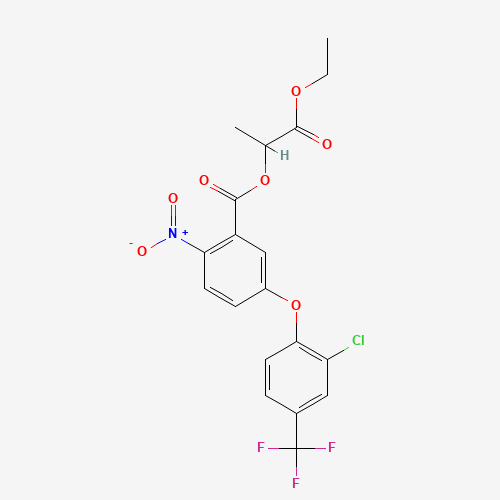
化合物详情
CAS77501-63-4
分子式C19H15ClF3NO7
分子量461.77 g/mol
非危品
Lactofen can cause cancer according to an independent committee of scientific and health experts.
科学粮草官-词典编辑部,修订于:2026-07-06
Toxicity
ToxicityEPA Ecotoxicity
Pesticide Ecotoxicity Data from EPA: 53
Ecotoxicity Values
LD50; Species: Apis mellifera (Honey bee) topical >160 ug/bee[USEPA, Office of Pesticide Programs; Pesticide Ecotoxicity Database (2000) on 5-
Fate Summary
ATMOSPHERIC FATE: According to a model of gas/particle partitioning of semivolatile organic compounds in the atmosphere(1), lactofen, which has a vapor pressure of7X10-8 mm Hg at 20 °C(2), will exist in both the vapor and particulate phases in the ambient atmosphere. Vapor-phase lactofen is degraded in the atmosphere by reaction with photochemically-produced hydroxyl radicals(SRC); the half-life for this reaction in air is estimated to be 5 days(SRC), calculated from its rate constant of 3.2X10⁻¹² cu cm/molecule-sec at 25 °C(SRC) that was derived using a structure estimation method(3). Lactofen absorbs light in the environmental UV spectrum and may undergo photolysis; the photodegradation half-life of lactofen was reported as 24 days(4).
Soil Adsorption / Mobility
The Koc of lactofen is 10,000(1). According to a classification scheme(2), this estimated Koc value suggests that lactofen is expected to be immobile in soil(SRC).
Environmental Biodegradation
ANAEROBIC: The biodegradation half-life of lactofen applied to a clay loam at an application rate of 5 mg/kg and maintained under anaerobic conditions was 30 days(4).
Environmental Bioconcentration
The BCF value of lactofen was 52, 380, and 830 in the edible, whole body, and viscera of bluegills exposed to 0.01 mg/L of lactofen in a flow through aquarium over the course of a 14 day exposure period(1). According to a classification scheme(2), these BCF data suggest bioconcentration in aquatic organisms is high(SRC).
Volatilization from Water / Soil
The Henry's Law constant for lactofen is estimated as 4.2X10⁻⁷ atm-cu m/mole(SRC) from its vapor pressure of 7X10⁻⁸ mm Hg at 20 °C(1) and water solubility of 0.1 mg/L(2). This Henry's Law constant indicates that lactofen is expected to be essentially nonvolatile from water surfaces(3). Lactofen is not expected to volatilize from dry soil surfaces(SRC) based upon its vapor pressure(1).
Environmental Abiotic Degradation
The rate constant for the vapor-phase reaction of lactofen with photochemically-produced hydroxyl radicals has been estimated as 3.2X10⁻¹² cu cm/molecule-sec at 25 °C(SRC) using a structure estimation method(1). This corresponds to an atmospheric half-life of about 5 days at an atmospheric concentration of 5X10+5 hydroxyl radicals per cu cm(1). A base-catalyzed second-order hydrolysis rate constant of 0.21 L/mole-sec(SRC) was estimated using a structure estimation method(2); this corresponds to half-lives of 1 year and 37 days at pH values of 7 and 8, respectively(2). Lactofen absorbs light in the environmental UV spectrum and may undergo photolysis, but the rate of this reaction is slow compared to biotic degradation(3,4). The photodegradation half-life of lactofen was reported as 24 d...
Artificial Pollution Sources
Lactofen's production may result in its release to the environment through various waste streams; its use as a post emergent herbicide(1) will result in its direct release to the environment(SRC).
Probable Routes of Human Exposure
Occupational exposure to lactofen may occur through inhalation and dermal contact with this compound at workplaces where lactofen is produced or used. (SRC)
Environmental Fate / Exposure Summary
Lactofen's production may result in its release to the environment through various waste streams; its use as a post emergent herbicide will result in its direct release to the environment. If released to air, a vapor pressure of 7X10⁻⁸ mm Hg at 20 °C indicates lactofen will exist in both the vapor and particulate phases in the ambient atmosphere. Vapor-phase lactofen will be degraded in the atmosphere by reaction with photochemically-produced hydroxyl radicals; the half-life for this reaction in air is estimated to be 5 days. Particulate-phase lactofen will be removed from the atmosphere by wet and dry deposition. Lactofen absorbs light in the environmental UV spectrum and may undergo photolysis; the photodegradation half-life of lactofen was reported as 24 days. If released to soil, la...
Target Organs
Hepatic
RAIS Toxicity Values
Oral Chronic Reference Dose Reference: OPP
Human Toxicity Excerpts
/SIGNS AND SYMPTOMS/ Lactofen has low acute toxicity via the oral, dermal, and inhalation routes of exposure; causes mild skin irritation; and is not a dermal sensitizer. The manufacturing use product is a moderate eye irritant.
Carcinogen Classification
No indication of carcinogenicity to humans (not listed by IARC).
Non-Human Toxicity Values
LD50 Rat percutaneous 2000 mg/kg
Non-Human Toxicity Excerpts
/LABORATORY ANIMALS: Subchronic or Prechronic Exposure/ In a 90-day subchronic toxicity study, rats were fed diets containing 0, 40, 200 or 1000 ppm lactofen (males: 0, 2.9, 14, 74 mg/kg/day; females: 0, 3.5, 17, or 85 mg/kg/day). At the high-dose level, increased relative (to body weight) liver weights in males (3.4%, control 2.8%) and females (3.1%, control 2.7%) and absolute liver weights in males (18.4 g, control 15.0 g) were observed. Gross findings were observed only in high-dose animals and included dark livers in high-dose males (15/19) and females 4/21); darkened renal cortex was also observed in high-dose males (15/19) and females (3/21). Histopathological evaluation of high-dose animals revealed brown pigmentation in hepatocytes and/or Kupffer cells (males, 17/19; females, 7/...
1 or Cancer Risk Level 1E-06
Fraction of Contaminant Absorbed Dermally from Soil: 0.1
Evidence for Carcinogenicity
EPA recently revised the cancer classification of lactofen based on new toxicity studies and the Agency's 1999 Cancer Risk Assessment Guidelines. Lactofen is now considered to be a threshold carcinogen, which means that lactofen is unlikely to be carcinogenic at low doses and is carcinogenic only at high doses.
Hazard Quotient Level 3 or Cancer Risk Level 1E-04
Fraction of Contaminant Absorbed Dermally from Soil: 0.1
USGS Health-Based Screening Levels for Evaluating Water-Quality
Reference: Smith, C.D. and Nowell, L.H., 2024. Health-Based Screening Levels for evaluating water-quality data (3rd ed.). DOI:10.5066/F71C1TWP