


 一键配货
一键配货
化合物详情
CAS79277-27-3
分子式C12H13N5O6S2
分子量387.39 g/mol
非危品
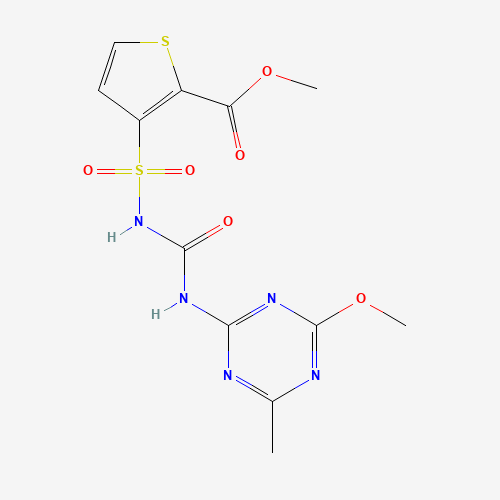
Thifensulfuron-methyl is a methyl ester resulting from the formal condensation of the carboxy group of thifensulfuron with methanol. It is used as a post-emergence herbicide for the control of grass and broad-leaved weeds. It has a role as a herbicide, an agrochemical, a xenobiotic and an environmental contaminant. It is a methyl ester, a member of 1,3,5-triazines, a member of thiophenes and a N-sulfonylurea. It is functionally related to a thifensulfuron.
科学粮草官-词典编辑部,修订于:2026-07-06
Toxicity
ToxicityEPA Ecotoxicity
Pesticide Ecotoxicity Data from EPA: 59
Ecotoxicity Values
LD50 Apis mellifera (Honey bee) topical 12.5 ug/bee/48 hr[USEPA, Office of Pesticide Programs; Pesticide Ecotoxicity Database (2000) on 3-[[[
Fate Summary
ATMOSPHERIC FATE: According to a model of gas/particle partitioning of semivolatile organic compounds in the atmosphere(1), thifensulfuron methyl, which has a vapor pressure of 1.28X10⁻¹⁰ mm Hg at 25 °C(2), is expected to exist solely in the particulate phase in the ambient atmosphere. Particulate-phase thifensulfuron methyl may be removed from the air by wet or dry deposition(SRC). Thifensulfuron methyl may undergo direct photolysis in the environment based on a measured half-life of 15 hours for the structurally similar compound metsulfuron methyl(4).
Soil Adsorption / Mobility
Koc values of thifensulfuron methyl range from 13-55(1). According to a classification scheme(2), this range of Koc values suggests that thifensulfuron methyl is expected to have very high to high mobility in soil. The pKa of thifensulfuron methyl is 4.0(3), indicating that the nitrogens in this compound will primarily exist in the anion form in the environment and anions generally do not adsorb more strongly to organic carbon and clay than their neutral counterparts(4).
Environmental Biodegradation
ANAEROBIC: Pseudo-first-order rate constants of 2.72X10⁻² and 1.32X10⁻² per day were determined for thifensulfuron methyl in native and sterile anaerobic sediment, respectively from a stagnant, slow-moving stream. These rate constants correspond to half-lives of 25 days in the native sediment and 53 days in the sterile sediment(1). Pseudo-first-order rate constants for thifensulfuron methyl in native and sterile anaerobic sediment from a eutrophic pond were 1.89X10⁻² and 0.68X10⁻² per day, respectively(1). These rate constants correspond to half-lives of 37 days in the native sediment and 102 days in the sterile sediment(1).
Environmental Bioconcentration
An estimated BCF of 0.04 was calculated for thifensulfuron methyl(SRC), using a log Kow of -1.56(1) and a regression-derived equation(2). According to a classification scheme(3), this BCF suggests the potential for bioconcentration in aquatic organisms is low(SRC).
Volatilization from Water / Soil
The Henry's Law constant for thifensulfuron methyl is estimated as 2.92X10⁻¹⁴ atm-cu m/mole(SRC) derived from its vapor pressure, 1.28X10⁻¹⁰ mm Hg(1), and water solubility, 2.24X10+3 mg/L(1). This Henry's Law constant indicates that thifensulfuron methyl is expected to be essentially nonvolatile from moist soil or water surfaces(2). Thifensulfuron methyl is not expected to volatilize from dry soil surfaces(SRC) based upon its vapor pressure(1).
Environmental Abiotic Degradation
Half-lives reported for the aqueous hydrolysis of thifensulfuron methyl are 4-6 days at pH 5, 180 days at pH 7, and 90 days at pH 9(1). Hydrolysis half-lives measured for thifensulfuron methyl at 29 °C and pH 5, 6, 8, 9, and 10 were 346, 1950, 739, 130, and 12 days, respectively(2). Hydrolysis half-lives measured for thifensulfuron methyl in aqueous buffer solutions at 28 °C and pH 4, 5, 9, and 10 were 1.7, 17, 6, and 0.4 days, respectively(3). Half-lives corresponding to measured hydrolysis rate constants determined for thifensulfuron methyl in aqueous buffer solutions were 7.3 days at pH 4 and 22 °C, 0.03 days at pH4 and 40 °C, 1.1 days at pH 7 and 40 °C, 18 days at pH 10 and 22 deg, and 0.19 days at pH 10 and 40 °C(4). Hydrolysis half-lives reported for thifensulfuron methyl in aqueo...
Environmental Water Concentrations
SURFACE WATER: Thifensulfuron methyl was detected above 0.01 ug/L in 1 out of 130 samples collected from Midwestern streams and rivers during 1998 at a concentration of 0.015 ug/L(1). The concentration of thifensulfuron methyl measured in water collected from the Iowa River near Rowan, IA in the summer of 1997 was 0.06 ug/L(2).
Ecotoxicity Excerpts
/OTHER TERRESTRIAL SPECIES/ Treated cereals may experience a temporary inhibition of growth and color changes in the leaves, but these have no ultimate effect on the yield.
Effluent Concentrations
Thifensulfuron methyl was measured in surface water runoff from farming systems on field-scale coastal plain watersheds in Maryland(1). The samples were collected during the first runoff event following the application of this herbicide(1). The average (maximum) concentrations of thifensulfuron methyl in runoff samples from a two-year crop rotation system were <0.05 (0.24), 0.01 (0.83), and 0.06 (0.34) ug/L at applications of 11.0, 3.30, and 5.50 g/ha, respectively. These concentrations correspond to losses of 0.02, 0.5, and 2.22% of applied thifensulfuron methyl, respectively(1). The average (maximum) concentrations of thifensulfuron in runoff samples from a three-year crop rotation system were 0.04 2.54), <0.05 (0.12), and <0.05 (0.07) ug/L at applications of 11.0, 3.30, and 5.50 g/ha...
Artificial Pollution Sources
Thifensulfuron methyl's production may result in its release to the environment through various waste streams; it's use as an herbicide(1) will result in its direct release to the environment(SRC).
Probable Routes of Human Exposure
Occupational exposure to thifensulfuron methyl may occur through dermal contact with this compound at workplaces where thifensulfuron methyl is produced or used. (SRC)
Environmental Fate / Exposure Summary
Thifensulfuron methyl's production may result in its release to the environment through various waste streams; it's use as a herbicide will result in its direct release to the environment. If released to air, a vapor pressure of 1.28X10⁻¹⁰ mm Hg at 25 °C indicates thifensulfuron methyl will exist solely in the particulate phase in the atmosphere. Particulate-phase thifensulfuron methyl will be removed from the atmosphere by wet or dry deposition. Thifensulfuron methyl may undergo direct photolysis in the environment based on a measured half-life of 15 hours for the structurally similar compound metsulfuron methyl. If released to soil, thifensulfuron methyl is expected to have very high to high mobility based upon Koc values ranging from 13-55. Volatilization from moist soil surfaces is...
Effect Level
collection=toxvaldb&kind=^EL$
Lethal Dose
collection=toxvaldb&kind=^LD$
Toxicity Data
LC50 (rat) > 7,900 mg/m3/4h
Screening Level
collection=toxvaldb&kind=^SL$
Lethal Concentration
collection=toxvaldb&kind=^LC$
RAIS Toxicity Values
Oral Chronic Reference Dose Reference: OPP
Non-Human Toxicity Values
LC50 Rat inhalation >7.9 mg/L air/4 hr
Reference and Risk Values
collection=toxvaldb&kind=^RRV$
Non-Human Toxicity Excerpts
/LABORATORY ANIMALS: Chronic Exposure or Carcinogenicity/ /In a/ chronic toxicity /study using/ dogs: NOAEL= 18.75 mg/kg/day. LOAEL= 18.75 mg/kg/day based on increased liver weight in high dose males and increased thyroid/parathyroid-to-body weight ratios in females at the high dose, and decreased body weight and body weight gain in females after week 22. /from table/
1 or Cancer Risk Level 1E-06
Fraction of Contaminant Absorbed Dermally from Soil: 0.1
Hazard Quotient Level 3 or Cancer Risk Level 1E-04
Fraction of Contaminant Absorbed Dermally from Soil: 0.1
USGS Health-Based Screening Levels for Evaluating Water-Quality
Reference: Smith, C.D. and Nowell, L.H., 2024. Health-Based Screening Levels for evaluating water-quality data (3rd ed.). DOI:10.5066/F71C1TWP









