


 一键配货
一键配货
化合物详情
CAS79622-59-6
分子式C13H4Cl2F6N4O4
分子量465.09 g/mol g/mol
危化品
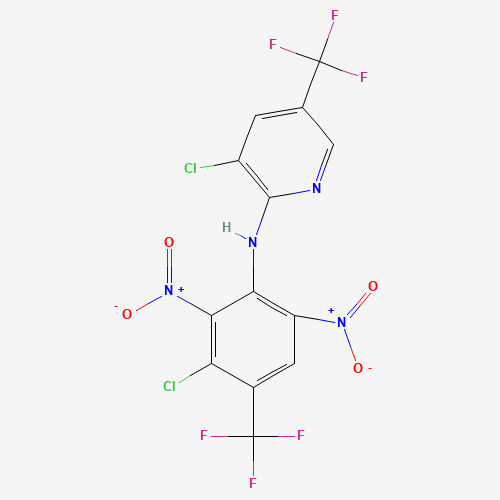
Fluazinam is a member of the class of aminopyridines that is 2-amino-5-(trifluoromethyl)pyridine in which one of the amino hydrogens is replaced by a 3-chloro-2,6-dinitro-4-(trifluoromethyl)phenyl group. A fungicide used to control grey mould, downy mildew and other fungal pathogens. It has a role as a xenobiotic, an allergen, an apoptosis inducer, an environmental contaminant and an antifungal agrochemical. It is a C-nitro compound, an aminopyridine, a chloropyridine, a secondary amino compound, a member of monochlorobenzenes and a member of (trifluoromethyl)benzenes.
科学粮草官-词典编辑部,修订于:2026-07-06
Toxicity
ToxicityEPA Ecotoxicity
Pesticide Ecotoxicity Data from EPA: 80
Ecotoxicity Values
LC50 Oncorhynchus mykiss (Rainbow trout, juvenile) 36 ug/L/96 hr (95% confidence interval: 33-56 ug/L); hardness: 28-30 mg/L CaCO3, flow through
Fate Summary
ATMOSPHERIC FATE: According to a model of gas/particle partitioning of semivolatile organic compounds in the atmosphere(1), fluazinam, which has a vapor pressure of 5.6X10⁻⁵ mm Hg at 25 °C(2) will exist in both the vapor and particulate phases in the ambient atmosphere. Vapor-phase fluazinam is degraded in the atmosphere by reaction with photochemically-produced hydroxyl radicals(SRC); the half-life for this reaction in air is estimated to be 240 days(SRC), calculated from its rate constant of 6.6X10⁻¹⁴ cu cm/molecule-sec at 25 °C(SRC) that was derived using a structure estimation method(3). Particulate-phase fluazinam may be removed from the air by wet and dry deposition(SRC). Fluazinam is expected to undergo direct photolysis based on a measured aquatic photolysis half-life of 2.5 day...
Soil Adsorption / Mobility
Koc values measured for fluazinam in four types of soils (unspecified) ranged from 1705-2316(1). According to a classification scheme(2), these Koc values suggest that fluazinam is expected to have slight to low mobility in soil. The pKa of fluazinam is 7.34(3), indicating that this compound will partially exist in cation form in the environment and cations generally adsorb more strongly to organic carbon and clay than their neutral counterparts(4). Fluazinam has been shown to adsorb more strongly in soils that are higher in organic matter(5). During a soil leaching study, 95% of the applied radioactivity remained in the top 5 cm of the soil(6).
Environmental Biodegradation
ANAEROBIC: The measured anaerobic aquatic metabolism half-life of fluazinam has been reported to be less than or equal to 8 hours(1). The half-life of fluazinam was 4.5 days at 1 kg/ha in anaerobic sandy loam (no aerobic pre-incubation) and 32 days at 10 °C and 1 kg/ha in anaerobic sandy loam (aerobic pre-incubation)(2).
Environmental Bioconcentration
Measured BCF values for fluazinam in fish were 348 for fillet, 1220 for whole fish, and 1850 for viscera(1). According to a classification scheme(2), these BCF values suggest the potential for bioconcentration in aquatic organisms is high to very high(SRC), provided the compound is not altered physically or chemically once released into the environment.
Volatilization from Water / Soil
The Henry's Law constant for fluazinam is estimated as 2.5X10⁻⁴ atm-cu m/mole(SRC) derived from its vapor pressure, 5.6X10⁻⁵ mm Hg(1), and water solubility, 1.35X10⁻¹ mg/L(1). This Henry's Law constant indicates that fluazinam is expected to volatilize from water surfaces(2). Based on this Henry's Law constant, the volatilization half-life from a model river (1 m deep, flowing 1 m/sec, wind velocity of 3 m/sec)(2) is estimated as 7 hours(SRC). The volatilization half-life from a model lake (1 m deep, flowing 0.05 m/sec, wind velocity of 0.5 m/sec)(2) is estimated as 11 days(SRC). However, volatilization from water surfaces is expected to be attenuated by adsorption to suspended solids and sediment in the water column. The estimated volatilization half-life from a model pond is 120 days...
Environmental Abiotic Degradation
The rate constant for the vapor-phase reaction of fluazinam with photochemically-produced hydroxyl radicals has been estimated as 6.6X10⁻¹⁴ cu cm/molecule-sec at 25 °C(SRC) using a structure estimation method(1). This corresponds to an atmospheric half-life of about 240 days at an atmospheric concentration of 5X10+5 hydroxyl radicals per cu cm(1). Fluazinam is expected to undergo hydrolysis in the environment based on measured half-lives of 42 days at pH 7 and 6 days at pH 9(2,3). The major hydrolysis product is 5-chloro-6-(3-chloro-alpha, alpha, alpha-trifluoro-2,6-dinitro-p-toluidino)nicotinic acid(2,4). This substance is also expected to undergo direct photolysis based on a measured aquatic photolysis half-life of 2.5 days(2,3). The measured photolysis half-life of fluazinam in soil...
Ecotoxicity Excerpts
/AQUATIC SPECIES/ The fungicide fluazinam, the insecticide lambda-cyhalothrin, and the herbicides asulam and metamitron were applied to indoor freshwater microcosms (water volume approximately 0.6 cu m). ...Concentrations of each pesticide were equal to 0%, 0.2%, 0.5%, 2%, and 5% spray drift emission of label-recommended rates. ...The half-lives of lambda-cyhalothrin, metamitron, and fluazinam were 1 to 2 days; that of asulam was >30 days. ...0.2% treatment regime was considered the community NOEC. The macroinvertebrate populations of Gammarus pulex, Asellus aquaticus, and Proasellus meridianus were the most sensitive end points, followed by species of copepods and cladocerans.
Artificial Pollution Sources
Fluazinam's production may result in its release to the environment through various waste streams; it's use as a fungicide(1) will result in its direct release to the environment(SRC).
Probable Routes of Human Exposure
Occupational exposure to fluazinam may occur through inhalation and dermal contact with this compound at workplaces where fluazinam is produced or used(SRC). Exposure studies indicate that field workers may be exposed to fluazinam during mixing, loading, and application activities involving this substance(1,2). Inhalation exposure levels for operators applying fluazinam to potato fields ranged from 0.58 to 9.76 ug/kg during mixing and loading and from 1.2 to 1.4 ug/kg during application(2). Dermal exposure levels measured in this study ranged from 280.48 to 680.42 ug/kg during mixing and loading and from 281.73 to 315.27 ug/kg during application(2).
Environmental Fate / Exposure Summary
Fluazinam's production may result in its release to the environment through various waste streams; it's use as a fungicide will result in its direct release to the environment. If released to air, a vapor pressure of 5.6X10⁻⁵ mm Hg at 25 °C indicates fluazinam will exist in both the vapor and particulate phases in the ambient atmosphere. Vapor-phase fluazinam will be degraded in the atmosphere by reaction with photochemically-produced hydroxyl radicals; the half-life for this reaction in air is estimated to be 240 days. Particulate-phase fluazinam will be removed from the atmosphere by wet and dry deposition. This substance is expected to undergo direct photolysis based on a measured aquatic photolysis half-life of 2.5 days. If released to soil, fluazinam is expected to have slight to l...
Symptoms
Fluazinam can cause eye irritation and moderate skin sensitization.
Effect Level
collection=toxvaldb&kind=^EL$
Lethal Dose
collection=toxvaldb&kind=^LD$
Toxicity Data
LC50 (rat) = 463 mg/m3
Health Effects
Fluazinam increases the risks of thyroid gland follicular cell and hepatocellular tumors in rats and mice. According to The Cancer Assessment Review Committee (CARC), there is suggestive evidence of carcinogenicity, but not sufficient to assess human carcinogenic potential.
Adverse Effects
Skin Sensitizer - An agent that can induce an allergic reaction in the skin.
Exposure Routes
Inhalation and dermal contact.
Effect Concentration
collection=toxvaldb&kind=^EC$
RAIS Toxicity Values
Oral Chronic Reference Dose Reference: OPP
Human Toxicity Excerpts
/SIGNS AND SYMPTOMS/ In spring 1992, several farmers in the western part of The Netherlands developed dermatitis on their hands, forearms and face. ...Complaints ranged from a mildly itchy, papular rash to a painful, weeping and blistering dermatitis. Medical aid was needed by 5/9 of them. Some of the farmers had in common that their complaints emerged after repeated application of a new fungicide over several weeks, Shirlan, with fluazinam as its active ingredient.
Carcinogen Classification
Not listed by IARC.
Non-Human Toxicity Values
LD50 Rabbit dermal >2000 mg/kg
Reference and Risk Values
collection=toxvaldb&kind=^RRV$
Non-Human Toxicity Excerpts
/LABORATORY ANIMALS: Subchronic or Prechronic Exposure/ A short-term dermal study showed some skin irritation after repeated applications of fluazinam to the shaved skin of albino rats. Clinical signs included decreased body weight and increased absolute and relative liver weights and hepatocellular hypertrophy.
Antidote and Emergency Treatment
/SRP:/ Advanced treatment: Consider orotracheal or nasotracheal intubation for airway control in the patient who is unconscious, has severe pulmonary edema, or is in respiratory arrest. Positive pressure ventilation techniques with a bag valve mask device may be beneficial. Monitor cardiac rhythm and treat arrhythmias as necessary ... . Start an IV with D5W /SRP: "To keep open", minimal flow rate/. Use lactated Ringer's if signs of hypovolemia are present. Watch for signs of fluid overload. Consider drug therapy for pulmonary edema ... . For hypotension with signs of hypovolemia, administer fluid cautiously. Watch for signs of fluid overload ... . Treat seizures with diazepam (Valium) ... . Use proparacaine hydrochloride to assist eye irrigation ... . /Poison A and B/









