


 一键配货
一键配货
化合物详情
CAS79902-63-9
分子式C25H38O5
分子量418.57 g/mol g/mol
危化品
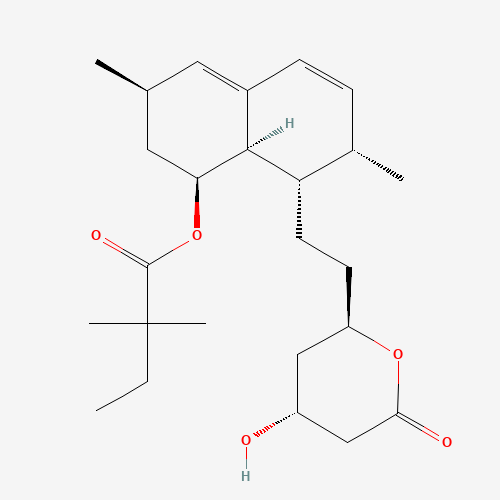
Simvastatin is a member of the class of hexahydronaphthalenes that is lovastatin in which the 2-methylbutyrate ester moiety has been replaced by a 2,2-dimethylbutyrate ester group. It is used as a cholesterol-lowering and anti-cardiovascular disease drug. It has a role as a ferroptosis inducer, a geroprotector, an EC 1.1.1.34/EC 1.1.1.88 (hydroxymethylglutaryl-CoA reductase) inhibitor, a prodrug and an EC 3.4.24.83 (anthrax lethal factor endopeptidase) inhibitor. It is a member of hexahydronaphthalenes, a delta-lactone, a fatty acid ester and a statin (semi-synthetic). It is functionally related to a lovastatin.
科学粮草官-词典编辑部,修订于:2026-07-06
Toxicity
ToxicityEcotoxicity Values
LC50; Species: Fundulus heteroclitus (Mummichog) length 45-75 mm; Conditions: saltwater, renewal, 24.08 °C, pH 7.58, dissolved oxygen 5.91 mg/L; Concentration: 2680 ug/L for 96 hr (95% confidence interval: 2210-3240 ug/L) /97% purity/
Fate Summary
ATMOSPHERIC FATE: According to a model of gas/particle partitioning of semivolatile organic compounds in the atmosphere(1), simvastatin, which has an estimated vapor pressure of 4.2X10⁻¹² mm Hg at 25 °C(SRC), determined from a fragment constant method(2), is expected to exist solely in the particulate phase in the ambient atmosphere. Particulate-phase simvastatin may be removed from the air by wet and dry deposition(SRC). Simvastatin contains chromophores that absorb light at wavelengths >290 nm(4) and, therefore, may be susceptible to direct photolysis by sunlight(SRC).
Soil Adsorption / Mobility
Atorvastatin (ATO), rosuvastatin (RST) and simvastatin (SIM) are commonly used drugs that belong to the statin family (lowering human blood cholesterol levels) and have been detected as contaminants in natural waters. Stability and removal of ATO, RST and SIM from spiked wastewater produced at the Al-Quds University campus were investigated. All three statins were found to undergo degradation in wastewater (activated sludge). The degradation reactions of the three drugs in wastewater at room temperature follow first-order kinetics with rate constants of 2.2X10⁻⁷/sec (ATO), 1.8X10⁻⁷/sec (RST) and 1.8X10⁻⁶/sec (SIM), which are larger than those obtained in pure water under the same conditions, 1.9X10⁻⁸/sec (ATO), 2.2X10⁻⁸/sec (RST) and 6.2X10⁻⁷/sec (SIM). Degradation products were identif...
Environmental Biodegradation
AEROBIC: This research investigates the environmental behavior of two widely prescribed cholesterol-lowering statin drugs that are expected to be present at significant concentrations in wastewater influents, namely: atorvastatin and simvastatin. Batch biodegradation experiments suggest that both statins are well degraded during secondary treatment, and removal rates exhibit a substrate-enhancement model reflecting elements of both first-order behavior and cometabolism. Resulting biodegradation parameters are used in conjunction with literature sorption parameters to construct a mass-balance model of statin concentrations during conventional treatment. Model results exhibit excellent accuracy compared to measurements from a medium-sized WWTP in the Southeastern USA. Influent concentrati...
Environmental Bioconcentration
An estimated BCF of 570 was calculated for simvastatin(SRC), using a log Kow of 4.68(1) and a regression-derived equation(2). According to a classification scheme(3), this BCF suggests the potential for bioconcentration in aquatic organisms is high(SRC).
Volatilization from Water / Soil
The Henry's Law constant for simvastatin is estimated as 2.8X10⁻¹⁰ atm-cu m/mole(SRC) using a fragment constant estimation method(1). This Henry's Law constant indicates that simvastatin is expected to be essentially nonvolatile from water and moist soil surfaces(2). Simvastatin is not expected to volatilize from dry soil surfaces(SRC) based upon an estimated vapor pressure of 4.2X10⁻¹² mm Hg(SRC), determined from a fragment constant method(3).
Environmental Abiotic Degradation
Simvastatin is not expected to undergo hydrolysis in the environment due to the lack of functional groups that hydrolyze under environmental conditions(1). Simvastatin contains chromophores that absorb light at wavelengths >290 nm(1) and, therefore, may be susceptible to direct photolysis by sunlight
Environmental Water Concentrations
SURFACE WATER: Simvastatin was tested for but not detected in grab samples from the Jarama, Manzares, Guadarrama, Henares, Tagus Rivers in the Madrid, Spain region. Samples were taken approximately 100 meters downstream from outfalls of sewage treatment plants in October, 2007; Detection limit = 8 ng/L(1).
Effluent Concentrations
Simvastatin was not detected in influent or effluent wastewater in treatment plants at the Spanish Mediterranean area (Castellon Province) of Valencia, Spain, sampled in two monitoring programs conducted in June 2008, January 2009 and in April, October, 2009, respectively; detection limit = 0.2 ug/L(1). Based on an annual consumption of 13,504 kg/yr, the estimated simvastatin elimination from primary and secondary treatment processes was 39.45 and 65.06%, respectively, from wastewater facilities in Spain in 2009, giving a predicted environmental occurrence of 27.13 ng/L(2).
Artificial Pollution Sources
Simvastatin's production and use as an antilipemic(1) may result in its release to the environment through various waste streams(SRC). It is a synthetic analog of lovastatin(1).
Probable Routes of Human Exposure
Occupational exposure to simvastatin may occur through inhalation and dermal contact with this compound at workplaces where simvastatin is produced or used. The general population may be exposed to simvastatin via ingestion of pharmaceutical products containing simvastatin. (SRC)
Environmental Fate / Exposure Summary
Simvastatin's production and administration as a medication may result in its release to the environment through various waste streams. If released to air, an estimated vapor pressure of 4.2X10⁻¹² mm Hg at 25 °C indicates simvastatin will exist solely in the particulate phase in the atmosphere. Particulate-phase simvastatin will be removed from the atmosphere by wet and dry deposition. Simvastatin contains chromophores that absorb light at wavelengths >290 nm and, therefore, may be susceptible to direct photolysis by sunlight. If released to soil, simvastatin is expected to have low mobility based upon an estimated Koc of 940. Volatilization from moist soil surfaces is not expected to be an important fate process based upon an estimated Henry's Law constant of 2.8X10⁻¹⁰ atm-cu m/mole. S...
Interactions
The risk of myopathy, including rhabdomyolysis, is increased by concomitant administration of amiodarone, dronedarone, ranolazine, or calcium channel blockers such as verapamil, diltiazem, or amlodipine.
Health Effects
The most common adverse reactions that lead to discontinuation of therapy include gastrointestinal disorders (0.5%), myalgia (0.1%), and arthralgia (0.1%).
Hepatotoxicity
Likelihood score: A (well known but rare cause of clinically apparent liver injury).
Adverse Effects
Drug concentrations, and consequently, incidence and severity of adverse effects, can become significantly increased when coadministered with CYP3A4 inhibitors. Concomitant medications administered with simvastatin should have an assessment performed for potential drug interactions to minimize the risk of adverse effects. Patients are commonly advised to stop eating grapefruits or drinking grapefruit juice while on statin therapy. However, more recent research has shown this risk can be minimized by spacing the consumption of grapefruit and statin dosing.
Exposure Routes
Absorption of simvastatin, estimated relative to an intravenous reference dose, in each of two animal species tested, averaged about 85% of an oral dose. In animal studies, after oral dosing, simvastatin achieved substantially higher concentrations in the liver than in non-target tissues. However, because simvastatin undergoes extensive first-pass metabolism, the availability of the drug in the systemic is low. Peak plasma concentration occurs 1.3 - 2.4 hours after administration.
Toxicity Summary
Simvastatin is a prodrug in which the 6-membered lactone ring of simvastatin is hydrolyzed <i>in vivo</i> to generate the beta,delta-dihydroxy acid, an active metabolite structurally similar to HMG-CoA (hydroxymethylglutaryl CoA). Once hydrolyzed, simvastatin competes with HMG-CoA for HMG-CoA reductase, a hepatic microsomal enzyme. Interference with the activity of this enzyme reduces the quantity of mevalonic acid, a precursor of cholesterol.
Human Toxicity Excerpts
/CASE REPORTS/ Four patients are described who developed sensorimotor neuropathy while being treated with simvastatin and had complete or partial resolution of clinical abnormalities after withdrawal of treatment. In one case onset was within days of commencing treatment, but in two cases symptoms did not develop for two years. The electrophysiological and pathological features of the neuropathy were those of axonal degeneration. Clinical evidence of proximal and distal weakness and muscle fasciculations and persistent abnormalities of sensory conduction after recovery suggest the possibility of toxic damage to anterior horn cells and dorsal root ganglia. Thirty eight other cases with symptoms suggestive of peripheral neuropathy have been reported to the Australian Adverse Drug Reaction...
Carcinogen Classification
No indication of carcinogenicity to humans (not listed by IARC).
Drug Induced Liver Injury
References: DOI:10.1016/j.drudis.2019.09.022
Non-Human Toxicity Values
LD50 Rat (female) ip 705 mg/kg
Non-Human Toxicity Excerpts
/LABORATORY ANIMALS: Subchronic or Prechronic Exposure/ Endothelial nitric oxide synthase (eNOS) activity is decreased after subarachnoid hemorrhage (SAH). Simvastatin increases eNOS activity. We hypothesized that simvastatin would increase eNOS protein and ameliorate SAH-induced cerebral vasospasm. Mice were treated with subcutaneous simvastatin or vehicle for 14 days and then subjected to endovascular perforation of the right anterior cerebral artery or sham surgery. Three days later, neurological deficits were scored (5 to 27; 27=normal), and middle cerebral artery diameter and eNOS protein were measured. The study was repeated, but simvastatin treatment was started after SAH or sham surgery. In SAH mice, simvastatin pretreatment increased middle cerebral artery diameter (SAH-simvast...
Populations at Special Risk
Zocor is contraindicated in patients with active liver disease which may include unexplained persistent elevations in hepatic transaminase levels.
Antidote and Emergency Treatment
/SRP:/ Advanced treatment: Consider orotracheal or nasotracheal intubation for airway control in the patient who is unconscious, has severe pulmonary edema, or is in severe respiratory distress. Positive-pressure ventilation techniques with a bag valve mask device may be beneficial. Consider drug therapy for pulmonary edema ... . Consider administering a beta agonist such as albuterol for severe bronchospasm ... . Monitor cardiac rhythm and treat arrhythmias as necessary ... . Start IV administration of D5W TKO /SRP: "To keep open", minimal flow rate/. Use 0.9% saline (NS) or lactated Ringer's (LR) if signs of hypovolemia are present. For hypotension with signs of hypovolemia, administer fluid cautiously. Watch for signs of fluid overload ... . Treat seizures with diazepam or lorazepam...
Effects During Pregnancy and Lactation
◉ Effects on Lactation and Breastmilk









