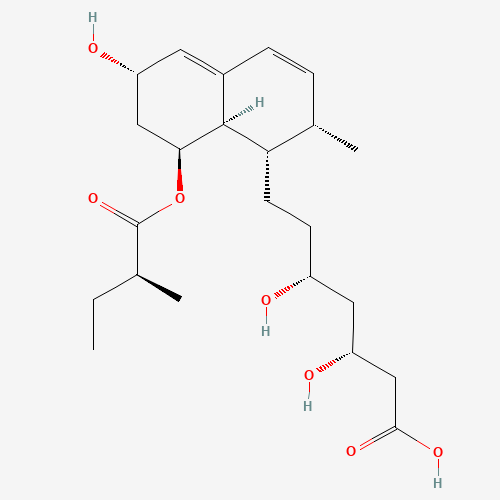
Fate Summary
ATMOSPHERIC FATE: According to a model of gas/particle partitioning of semivolatile organic compounds in the atmosphere(1), pravastatin, which has an estimated vapor pressure of 6.0X10⁻¹⁶ mm Hg at 25 °C(SRC), determined from a fragment constant method(2), is expected to exist solely in the particulate phase in the ambient atmosphere. Particulate-phase pravastatin may be removed from the air by wet and dry deposition(SRC). Pravastatin contains chromophores that absorb at wavelengths >290 nm(3) and, therefore, may be susceptible to direct photolysis by sunlight(SRC).
Soil Adsorption / Mobility
Using a structure estimation method based on molecular connectivity indices(1), the Koc of pravastatin can be estimated to be 250(SRC). According to a classification scheme(2), this estimated Koc value suggests that pravastatin is expected to have moderate mobility in soil. The pKa of pravastatin is 4.2(3), indicating that this compound will exist partially in the anion form in the environment and anions generally do not adsorb more strongly to soils containing organic carbon and clay than their neutral counterparts(4).
Environmental Bioconcentration
An estimated BCF of 3 was calculated in fish for pravastatin(SRC), using a log Kow of 2.18(1) and a regression-derived equation(2). According to a classification scheme(3), this BCF suggests the potential for bioconcentration in aquatic organisms is low(SRC).
Volatilization from Water / Soil
The Henry's Law constant for pravastatin is estimated as 2.01X10⁻¹⁵ atm-cu m/mole(SRC) using a fragment constant estimation method(1). This Henry's Law constant indicates that pravastatin is expected to be essentially nonvolatile from water surfaces(2). Pravastatin is not expected to volatilize from dry soil surfaces(SRC) based upon an estimated vapor pressure of 6.0X10⁻¹⁶ mm Hg(SRC), determined from a fragment constant method(3).
Environmental Abiotic Degradation
A base-catalyzed second-order hydrolysis rate constant of 1.5X10⁻³ L/mole-sec(SRC) was estimated using a structure estimation method(1); this corresponds to half-lives of 143 and 14 years at pH values of 7 and 8, respectively(1). Pravastatin contains chromophores that absorb at wavelengths >290 nm(2) and, therefore, may be susceptible to direct photolysis by sunlight(SRC).
Environmental Water Concentrations
SURFACE WATER: Pravastatin was tested for but not detected in the River Taff and the River Ely in South Wales, UK, which were monitored over a period of 10 months(1).
Effluent Concentrations
Pravastatin was not reported (limit of quantitation = 0.27 ug/L) in influent to a wastewater treatment plant of Lausanne, Switzerland. It was however detected in 2 samples of effluent into Vidy Bay, Lake Geneva, Switzerland at concentrations of approximately 0.26 ug/L. Sampling was conducted between Feb 20 and March 11, 2009(1).
Artificial Pollution Sources
Pravastatin's production and administration as a medication(1) may result in its release to the environment through various waste streams(SRC).
Probable Routes of Human Exposure
Occupational exposure to pravastatin may occur through inhalation and dermal contact with this compound at workplaces where pravastatin is produced or used. The general public is not likely to be exposed to pravastatin unless by direct medical treatment. (SRC)
Environmental Fate / Exposure Summary
Pravastatin's production and administration as a medication may result in its release to the environment through various waste streams. If released to air, an estimated vapor pressure of 6.0X10⁻¹⁶ mm Hg at 25 °C indicates pravastatin will exist solely in the particulate phase in the atmosphere. Particulate-phase pravastatin will be removed from the atmosphere by wet and dry deposition. Pravastatin contains chromophores that absorb at wavelengths >290 nm and, therefore, may be susceptible to direct photolysis by sunlight. If released to soil, pravastatin is expected to have moderate mobility based upon an estimated Koc of 250. The estimated pKa of pravastatin is 4.2, indicating that this compound will exist partially in the anion form in the environment and anions generally do not adsorb...
Interactions
Due to an increased risk of myopathy/rhabdomyolysis when hydroxymethylglutaryl-coenzyme A (HMG-CoA) reductase inhibitors are coadministered with gemfibrozil, concomitant administration of Pravachol with gemfibrozil should be avoided
Hepatotoxicity
Likelihood score: B (likely cause of clinically apparent liver injury).
Adverse Effects
Niacin: There is an enhanced risk of skeletal muscle adverse reactions when niacin is used in combination with pravastatin; a reduction in pravastatin dosage should be considered in this scenario.
Toxicity Summary
Rhabdomyolysis and other muscle symptoms can be indicative of toxicity. Several studies and case reports have also suggested an association between statin therapy and neuromuscular disorders such as dermatomyositis, polymyositis, and necrotizing myopathies. If rhabdomyolysis is ruled out and other muscle symptom pathologies are suspected, the statin-associated muscle symptoms clinical index (SAMS-CI) must be administered to determine if muscle symptoms are due to statin therapy. Stopping statin use, administration of replacement vitamin D (associated with myopathy), and switching statins are all viable options depending on the etiology of myopathy.
Human Toxicity Excerpts
/SIGNS AND SYMPTOMS/ Hypersensitivity reactions have occurred rarely with statin therapy during clinical trials or postmarketing surveillance. Such reactions may include anaphylaxis, angioedema, head/neck edema, contact dermatitis, lupus erythematosus-like syndrome, polymyalgia rheumatica, dermatomyositis, vasculitis, purpura, thrombocytopenia, leukopenia, hemolytic anemia, positive antinuclear antibody (ANA) titer, increased erythrocyte sedimentation rate, eosinophilia, arthritis, arthralgia, urticaria, asthenia, photosensitivity, fever, chills, flushing, malaise, dyspnea, toxic epidermal necrolysis, erythema multiforme, and Stevens-Johnson syndrome. /Statins/
Drug Induced Liver Injury
References: DOI:10.1016/j.drudis.2019.09.022
Non-Human Toxicity Values
LD50 Rat (female) iv 440 mg/kg
Non-Human Toxicity Excerpts
/LABORATORY ANIMALS: Chronic Exposure or Carcinogenicity/ In a 2-year study in mice fed pravastatin at doses of 250 and 500 mg/kg/day, there was an increased incidence of hepatocellular carcinomas in males and females at both 250 and 500 mg/kg/day (p<0.0001). At these doses, lung adenomas in females were increased (p=0.013). These effects in mice were observed at approximately 15 times (250 mg/kg/day) and 23 times (500 mg/kg/day) the HD of 80 mg, based on AUC. In another 2-year study in mice with doses up to 100 mg/kg/day (producing drug exposures approximately 2 times the HD of 80 mg, based on AUC), there were no drug-induced tumors.
Populations at Special Risk
Pravachol is contraindicated for use in pregnant woman because of the potential for fetal harm. As safety in pregnant women has not been established and there is no apparent benefit to therapy with Pravachol during pregnancy, Pravachol should be immediately discontinued as soon as pregnancy is recognized. Limited published data on the use of Pravachol in pregnant women are insufficient to determine a drug-associated risk of major congenital malformations or miscarriage.
Antidote and Emergency Treatment
To date, there has been limited experience with overdosage of pravastatin. If an overdose occurs, it should be treated symptomatically with laboratory monitoring and supportive measures should be instituted as required.
Effects During Pregnancy and Lactation
◉ Effects on Lactation and Breastmilk



 一键配货
一键配货