

 一键配货
一键配货
化合物详情
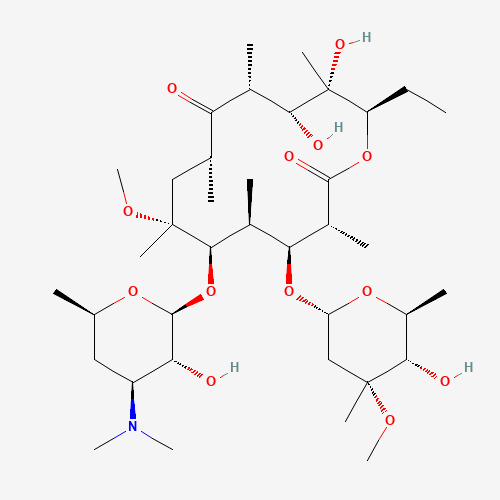
CAS81103-11-9
分子式C38H69NO13
分子量747.95 g/mol g/mol
危化品
Clarithromycin can cause developmental toxicity according to state or federal government labeling requirements.
科学粮草官-词典编辑部,修订于:2026-07-06
Toxicity
ToxicityEcotoxicity Values
EC50; Species: Daphnia magna (Water Flea) age <24 hr neonate; Conditions: freshwater, static, 20 °C; Concentration: 25720 ug/L for 24 hr (95% confidence interval: 21720-30450 ug/L); Effect: intoxication, immobilization />99% purity formulation/
Fate Summary
ATMOSPHERIC FATE: According to a model of gas/particle partitioning of semivolatile organic compounds in the atmosphere(1), clarithromycin, which has an estimated vapor pressure of 2.3X10⁻²⁵ mm Hg at 25 °C(SRC), determined from a fragment constant method(2), is expected to exist solely in the particulate phase in the ambient atmosphere. Particulate-phase clarithromycin may be removed from the air by wet or dry deposition(SRC). Clarithromycin has a reported UV max of 288 nm in methanol(3) and, therefore, may be susceptible to direct photolysis by sunlight(SRC).
Soil Adsorption / Mobility
Using a 2.4 meter soil column, treated effluent was applied to the top of the column over 23 days, simulating a recharge condition similar to those in arid or semiarid climates. The soil used was a Mohall-Laveen sandy loam from an area northwest of Phoenix, AZ with no known history of cultivation or irrigation. Secondarily treated effluent from a 17.5 million gallon/day municipal waste water treatment plant serving 120,000-150,000 residents near Phoenix, AZ was employed. Clarithromycin was not detected in the outflow of the column; reporting limit not determined(1). Clarithromycin was shown to absorb to suspended solids and sludge during waste water treatment plant processes; Kd values in activated sludge were 300 and 400 for October 2003 and February 2004, respectively, at municipal tr...
Environmental Biodegradation
AEROBIC: Clarithromycin, present at 2.43 mg/L, reached -3 and 0% of its theoretical BOD in 14 and 28 days, respectively, using a sewage inoculum at 2 drops/L in the Closed Bottle test(1). Clarithromycin was not removed in sewage treatment plants equipped with pretreatment, primary settling and activated sludge processes(2). In a mass balance assessment study, 1% persisted in sludge, 79% is released in effluents, and 20% is lost to degradation or otherwise unaccounted for during sewage treatment(3). Clarithromycin present at 3000 ng/g biosolid and stored under aerobic conditions exhibited a degradation rate constant of 0.596/day, 50% dissipation time of 1.2 days(4).
Environmental Bioconcentration
An estimated BCF of 56 was calculated in fish for clarithromycin(SRC), using a log Kow of 3.16(1) and a regression-derived equation(2). According to a classification scheme(3), this BCF suggests the potential for bioconcentration in aquatic organisms is moderate(SRC).
Volatilization from Water / Soil
A pKa of 8.99(1) indicates clarithromycin will exist almost entirely in the cation form at pH values of 5 to 9 and therefore volatilization from water and moist soil surfaces is not expected to be an important fate process. Clarithromycin is not expected to volatilize from dry soil surfaces(SRC) based upon an estimated vapor pressure of 2.3X10⁻²⁵ mm Hg(SRC), determined from a fragment constant method(3).
Environmental Abiotic Degradation
Clarithromycin may undergo hydrolysis in the environment due to the presence of functional groups that hydrolyze under environmental conditions(1). Clarithromycin has a reported UV max of 288 nm in methanol(2) and, therefore, may be susceptible to direct photolysis by sunlight(SRC).
Environmental Water Concentrations
SURFACE WATER: Clarithromycin concentrations in surface water of the Netherlands between 1996 and 2005 ranged from approximately 10 to 30 ng/L(1). The compound was detected in the River Elbe, Germany, at concentrations ranging from <30 to 30 ng/L; sampling was conducted in April 1998. The compound was detected at the mouths of the Saale and Mulde tributaries at 40 and <30 ng/L, respectively(2). A concentration of 8.3 ng/L was reported for the Lambro River, Italy; in the Po River, a maximum and median concentration of 20.3 and 1.6 ng/L, respectively, was reported using data from seven sampling sites(3).
Milk Concentrations
In 12 women who received oral clarithromycin in a dosage of 250 mg twice daily for 6 days, mean peak concentrations of clarithromycin and 14-hydroxyclarithromycin in milk were 25 and 75%, respectively, of corresponding serum concentrations.
Ecotoxicity Excerpts
/AQUATIC SPECIES/ Recent evidence indicates that a variety of antibiotic residues may affect the integrity of streams located downstream from wastewater treatment plants. Aquatic communities comprising bacterial and fungal decomposers and invertebrate detritivores (shredders) play an important role in the decomposition of allochthonous leaf litter, which acts as a primary energy source for small running waters. The aim of the present study was to assess whether an antibiotic mixture consisting of sulfamethoxazole, trimethoprim, erythromycin-H2O, roxithromycin, and clarithromycin has an effect on such a decomposer-detritivore system. Leaf discs were exposed to these antibiotics (total concentration of 2 or 200 ug/L) for approximately 20 days before offering these discs and corresponding...
Effluent Concentrations
Clarithromycin exhibited a median concentration of 0.87 ug/L (0.536 ug/L maximum) in 8 wastewater treatment plant final effluents sampled in five Canadian cities during 2002; detection limit = 0.001 ug/L(1). Clarithromycin was detected in one of 5 influent samples at a concentration of 112 ng/L (Feb 9, 2007) (limit of detection was 1 ng/L); it was not detected in effluent samples. Sampling took place at a wastewater treatment plant in Kentucky serving a local community of approximately 15,000 with an additional influx of approximately 10,000 students, academic year 2006-2007(2). Median concentrations of clarithromycin were 380 ng/L in raw influents and 240 ng/L in tertiary effluents of conventional wastewater treatment employed in Zurich, Switzerland(3). Clarithromycin concentration ran...
Artificial Pollution Sources
Clarithromycin's production and use as an antibiotic(1) may result in its release to the environment through various waste streams(SRC).
Probable Routes of Human Exposure
Occupational exposure to clarithromycin may occur through inhalation and dermal contact with this compound at workplaces where clarithromycin is produced or administered. Monitoring data indicate that the general population may be exposed to clarithromycin via dermal contact with water. Exposure to clarithromycin among the general population will also occur among those administered the drug, an antibiotic. (SRC)
Environmental Fate / Exposure Summary
Clarithromycin's production and administration as an antibiotic may result in its release to the environment through various waste streams. If released to air, an estimated vapor pressure of 2.3X10⁻²⁵ mm Hg at 25 °C indicates clarithromycin will exist solely in the particulate phase in the atmosphere. Particulate-phase clarithromycin will be removed from the atmosphere by wet or dry deposition. Clarithromycin has a reported UV max of 288 nm in methanol and, therefore, may be susceptible to direct photolysis by sunlight. If released to soil, clarithromycin is expected to have moderate mobility based upon an estimated Koc of 150. The pKa of clarithromycin is 8.99, indicating that this compound will exist almost entirely in the cation form in the environment and cations generally adsorb mo...
Interactions
The manufacturer of eszopiclone states that eszopiclone dosage should be reduced if the drug is used concomitantly with a potent CYP3A4 inhibitor, including clarithromycin. In such situations, the initial eszopiclone dosage should not exceed 1 mg but may be increased to 2 mg if clinically indicated.457
Lethal Dose
collection=toxvaldb&kind=^LD$
Hepatotoxicity
Likelihood score: B (highly likely cause of clinically apparent liver injury).
Human Toxicity Excerpts
/GENOTOXICITY/ In the in vitro chromosome aberration test, clarithromycin produced weakly positive results in one test and negative results in another.
Drug Induced Liver Injury
References: DOI:10.1016/j.drudis.2019.09.022
Non-Human Toxicity Values
LD50 Mouse intravenous 173 mg/kg
Non-Human Toxicity Excerpts
/GENOTOXICITY/ Clarithromycin failed to exhibit mutagenic potential in several in vitro tests, including the Salmonella mammalian microsome test, bacterial induced mutation frequency test, rat hepatocyte DNA synthesis assay, mouse lymphoma assay, mouse dominant lethal test, and mouse micronucleus test.
Antidote and Emergency Treatment
/SRP:/ Immediate first aid: Ensure that adequate decontamination has been carried out. If patient is not breathing, start artificial respiration, preferably with a demand valve resuscitator, bag-valve-mask device, or pocket mask, as trained. Perform CPR if necessary. Immediately flush contaminated eyes with gently flowing water. Do not induce vomiting. If vomiting occurs, lean patient forward or place on the left side (head-down position, if possible) to maintain an open airway and prevent aspiration. Keep patient quiet and maintain normal body temperature. Obtain medical attention. /Poisons A and B/
Effects During Pregnancy and Lactation
Relevant published information was not found as of the revision date.