


 一键配货
一键配货
化合物详情
CAS81334-34-1
分子式C13H15N3O3
分子量261.28 g/mol
非危品
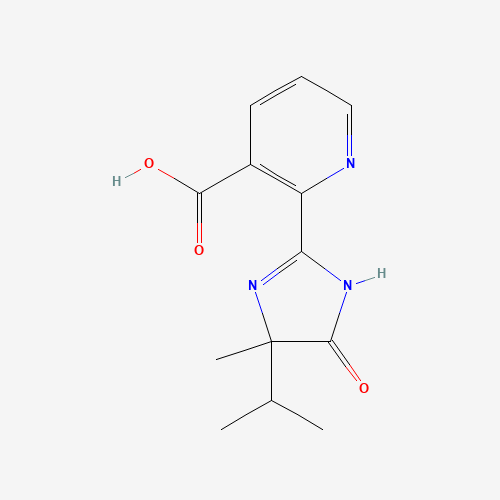
2-(4-isopropyl-4-methyl-5-oxo-4,5-dihydro-1H-imidazol-2-yl)nicotinic acid is a pyridinemonocarboxylic acid that is nicotinic acid which is substituted at position 2 by a 4,5-dihydro-imidazol-2-yl group, which in turn is substituted at positions 4, 4, and 5 by isopropyl, ethyl, and oxo groups, respectively. It is an imidazolone, a pyridinemonocarboxylic acid, a member of pyridines and a member of imidazolines.
科学粮草官-词典编辑部,修订于:2026-07-06
Toxicity
ToxicityEPA Ecotoxicity
Pesticide Ecotoxicity Data from EPA: 43
Ecotoxicity Values
LD50; Species: Anas platyrhynchos (Mallard Duck, age 24-28 wk) oral via capsule >2150 mg/kg
Fate Summary
ATMOSPHERIC FATE: According to a model of gas/particle partitioning of semivolatile organic compounds in the atmosphere(1), imazapyr, which has an estimated vapor pressure of 9.0X10⁻¹¹ mm Hg at 25 °C(SRC), determined from a fragment constant method(2), is expected to exist solely in the particulate phase in the ambient atmosphere. Particulate-phase imazapyr may be removed from the air by wet and dry deposition(SRC).
Soil Adsorption / Mobility
Using a clay loam (pH 7.4, OM 3.9%, sat capacity 54.8%, cation exchange capacity 17.4) and a loam (pH 7.75, OM 3.4%, sat capacity 45.8%, cation exchange capacity 19.84), 65 and 80% of the applied imazapyr leached out of the columns, respectively, the difference being attributed to greater clay and organic matter content in the clay loam(1). The Koc of imazapyr was found be 8.81(1). According to a classification scheme(2), this Koc value suggests that imazapyr is expected to have very high mobility in soil. In an adsorption study using 2 humic acids, no measurable adsorption of imazapyr occurred at pH 4.7, while at pH 3.6 and 3.7, the compound did adsorb(3). The pKa2, 3.6, indicates that at the lower pH values, about half of the amount of herbicide would exist in the nonionized form and...
Environmental Biodegradation
PURE CULTURE: Experiments were conducted to assess the ability of Streptomyces (strain PS1/5) to metabolize 12 herbicides representing several different classes including: acetanilides, triazines, ureas, uracils, & imidazoles. Incubations in aqueous culture with dextrin as carbon source & either ammonium or Casamino acids as nitrogen source resulted in transformations (>50%) of 8 of the herbicides tested: alachlor, metolachlor, atrazine, prometryne, ametryne, linuron, tebuthiuron, & bromacil; the remaining 4 herbicides (cyanazine, diuron, metribuzin, & imazapyr) were also transformed, but to a lesser extent. In most instances, biotransformations occurred concurrently with growth & results were consistent regardless of the nitrogen source (ammonium vs. Casamino acids). However, in some i...
Environmental Bioconcentration
An estimated BCF of 3 was calculated for imazapyr(SRC), using a log Kow of 0.22(1) and a regression-derived equation(2). According to a classification scheme(3), this BCF suggests the potential for bioconcentration in aquatic organisms is low(SRC).
Volatilization from Water / Soil
A pKa2 of 3.6(1) indicates imazapyr will exist almost entirely in the anion form at pH values of 5 to 9 and therefore volatilization from water and moist soil surfaces is not expected to be an important fate process(SRC). Imazapyr is not expected to volatilize from dry soil surfaces(SRC) based upon an estimated vapor pressure of 9.0X10⁻¹¹ mm Hg(SRC), determined from a fragment constant method(2).
Environmental Abiotic Degradation
Imazapyr is not expected to undergo hydrolysis in the environment due to the lack of functional groups that hydrolyze under environmental conditions(1). Exposure to UV light (using sun lamps, wavelengths >290 nm and <620 nm) in aqueous solutions caused complete degradation of imazapyr in 48 hrs, with a half-life of 7 hrs reported(2).
Environmental Water Concentrations
SURFACE WATER: Imazapyr was reported as not detected to 0.03 ug/L in 38 surface water samples collected June to Oct 1997 from the Tensas, Iowa, Mississippi, Wabash and Illinois rivers(1). Imazapyr was detected in <5% of 129 surface water samples collected from 75 surface water sites from the Upper Mississippi, Missouri, and Ohio River basins in the United States from May to Aug 1998 at median and maximum concentrations of <0.01 and 0.072 ug/L, respectively, method reporting limit of 0.01 ug/L(2).
Ecotoxicity Excerpts
/FIELD STUDIES/ An in situ microcosm study ...was conducted to assess the effects of a single application of imazapyr (stirred into the water column) at the following mean concentrations: 0.19, 2.1 or 19.8 mg/L (equivalent to 1, 10 or 100 times the expected environmental concentration from a normal application rate) on the macroinvertebrate community of a logged pond cypress dome. In situ microcosms were set up in schedule-40 polyvinyl chloride water pipes (diameter 7.62 cm; height 45.7 cm; area 45.6 sq cm) driven approximately 12 cm into the substrate and leaving a mean water column depth of 32.1 cm. The microcosms were immediately dosed with the selected treatments of imazapyr and left undisturbed for two weeks. Forty eight microcosms were set up (3 blocks of 16, each block consisting...
Effluent Concentrations
Imazapyr, applied aerially as a liquid at a rate of 2.2 kg active ingredient/ha to two experimental forest plots in Alabama, was detected in the surface water of nearby streams at a concentration of 680 and 130 ug/L(1). The herbicide fell directly into streams during application(1).
Artificial Pollution Sources
Imazapyr's production may result in its release to the environment through various waste streams; its use as a herbicide(1) will result in its direct release to the environment(SRC).
Probable Routes of Human Exposure
Occupational exposure to imazapyr may occur through inhalation of particulates and dermal contact with this compound at workplaces where imazapyr is produced or used(SRC). A study conducted in Georgia measuring the breathing zone concentrations of smoke suspended particulate matter, herbicide residues, and carbon monoxide found that no herbicide residues, including imazapyr, were detected in the 140 smoke samples from the 14 fires(1). Sites had been treated with labeled rates of forestry herbicides, including imazapyr and were burned within 30-149 days post application(1).
Other Environmental Concentrations
Concentrations of imazapyr following forestry application in Georgia were measured at 3 sites at 69, 1 and 30, and 106 days post application(1). Residues on hardwood foliage were <0.5, 4.6 and 1.5, and <0.5 mg/kg; on ground litter: <0.5, 4.1 and 2.1, and <0.5 mg/kg; and on surface soil: <0.5, <0.5 and <0.5, abd <0.5 mg/kg, respectively(1).
Environmental Fate / Exposure Summary
Imazapyr's production may result in its release to the environment through various waste streams; its use as an herbicide will result in its direct release to the environment. If released to air, an estimated vapor pressure of 9.0X10⁻¹¹ mm Hg at 25 °C indicates imazapyr will exist solely in the particulate phase in the ambient atmosphere. Particulate-phase imazapyr will be removed from the atmosphere by wet and dry deposition. If released to soil, imazapyr is expected to have very high mobility based upon a Koc of 8.81. Volatilization from moist soil is not expected because the acid exists as an anion and anions do not volatilize. Imazapyr is expected to biodegrade based on aerobic soil half-lives of 17.7 to 63.1 days at simulated application rates of 100 to 200 g/ha, incubated for 60 d...
RAIS Toxicity Values
Oral Chronic Reference Dose Reference: OPP
Human Toxicity Excerpts
/CASE REPORTS/ ... Six cases of acute poisoning with Arsenal (imazapyr 23.1%) occurred during the period 1993-1997 in a single hospital. Emergency room records & medical charts were reviewed. ... Of 6 cases, 5 were suicide attempts & 1 was an act of violence inflicted on a child. Three of the 6 patients (50%) presented with severe symptoms, including impairment of consciousness & respiratory distress requiring intubation. Other presentations included metabolic acidosis (2), hypotension (2), leukocytosis (3), fever (2), mild elevation of hepatic transaminase & creatinine (2), unconjugated hyperbilirubinemia (2), oral ulceration (2), pharyngolaryngitis (2), & chemical burns of the cornea (1). All cases had copious vomiting after ingestion of Arsenal. No mortality occurred. ... According t...
Carcinogen Classification
No indication of carcinogenicity to humans (not listed by IARC).
Non-Human Toxicity Values
LD50 Rabbit (male & female) percutaneous >2000 mg/kg
Non-Human Toxicity Excerpts
/LABORATORY ANIMALS: Chronic Exposure or Carcinogenicity/ In a carcinogenicity study, /imazapyr/ (99.5% ai) was administered to 65 CD-1 mice/sex/dose in the diet at dose levels of 0, 1000, 5000 or 10,000 ppm (equivalent to 0, 126, 674 or 1301 mg/kg bw/day in males and 0, 151, 776 or 1639 mg/kg bw/day in females) for 18 months. There were no compound related effects on mortality, clinical signs, body weight, food consumption, hematology, clinical chemistry, organ weights, or gross and histologic (including tumors) pathology. The NOAEL is >10,000 ppm (1301 mg/kg/day in males and 1639 mg/kg/day in females). This was the highest dose tested (HDT); therefore, there is no LOAEL.
Antidote and Emergency Treatment
Supportive measures are ordinarily sufficient for successful management of excessive exposures to these herbicides ... . If the patient's condition deteriorates in spite of good supportive care, the operation of an alternative or additional toxicant should be suspected. /Herbicides/
USGS Health-Based Screening Levels for Evaluating Water-Quality
Reference: Smith, C.D. and Nowell, L.H., 2024. Health-Based Screening Levels for evaluating water-quality data (3rd ed.). DOI:10.5066/F71C1TWP









