


 一键配货
一键配货
化合物详情
CAS81335-77-5
分子式C15H19N3O3
分子量289.33 g/mol
非危品
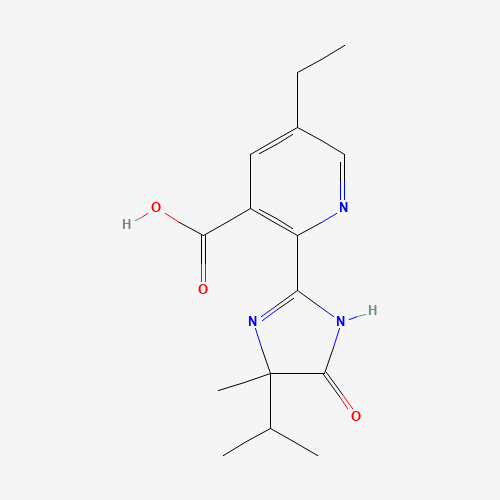
Imazethapyr is a member of pyridines and an aromatic carboxylic acid.
科学粮草官-词典编辑部,修订于:2026-07-06
Toxicity
ToxicityEPA Ecotoxicity
Pesticide Ecotoxicity Data from EPA: 55
Ecotoxicity Values
LC50; Species: Onchorhynchus mykiss (Rainbow trout); Concentration: 340 mg/L for 96 hr /Conditions of bioassay not specified/
Fate Summary
ATMOSPHERIC FATE: According to a model of gas/particle partitioning of semivolatile organic compounds in the atmosphere(1), imazethapyr, which has an estimated vapor pressure of 2.3X10⁻¹¹ mm Hg at 25 °C(SRC), determined from a fragment constant method(2), is expected to exist solely in the particulate phase in the ambient atmosphere. Particulate-phase imazethapyr may be removed from the air by wet or dry deposition(SRC).
Soil Adsorption / Mobility
Imazethapyr had a reported mean Koc of 13.2 (range of 2 to 55) in 101 allophanic and non-allophanic surface soil samples collected throughout New Zealand(1). Imazethapyr had a reported Koc of 19 at pH 7.7 and an increased Koc of 163 as the pH was reduced to 5.4(2). Imazethapyr has a reported Koc range of 75 to 173(3). Koc values for Trani (55.1% sand, 22.0% silt, 22.9% clay, pH 7.5, organic carbon 1.46%) and Andria (69.1% sand, 18% silt, 12.9% clay, pH 7.8, organic carbon 0.62%) soils were 1.4 and 12.9, respectively(4). According to a classification scheme(5), these reported Koc values suggest that imazethapyr is expected to have very high to moderate mobility in soil. In an adsorption study using 2 humic acids, no measurable adsorption of imazethapyr occurred at pH 4.7, while at pH 3.6...
Environmental Biodegradation
AEROBIC: 14C Radio-labeled imazethapyr was incubated for 12 weeks at 28 °C in the dark in two soil types; Drummer silty loam (9% sand, 57% silt, 34% clay, pH 5.7, 5.8% organic carbon) and Cisne silt (14% sand, 74% silt, 12% clay, pH 7.0, 1.3% organic carbon)(1). Imazethapyr was biodegraded 18.2 and 26.8% in Drummer loam when 14C labeled on the carboxyl group and ring structure, respectively(1). Imazethapyr was biodegraded 46.9 and 53.5% in Cisne silt when 14C labeled on the carboxyl group and ring structure, respectively(1). Maury silt loam (8% sand, 67% silt, 25% clay, 2.6% organic matter, pH 6.3) was used in an 8 week study with radio-labeled 14C imazethapyr to determine effects of temperature and moisture on biodegradation(2). 14CO2 evolution from soil incubated at 15 and 30 °C was 1...
Environmental Bioconcentration
An estimated BCF of 3 was calculated in fish for imazethapyr(SRC), using a log Kow of 1.49(1) and a regression-derived equation(2). According to a classification scheme(3), this BCF suggests the potential for bioconcentration in aquatic organisms is low(SRC).
Volatilization from Water / Soil
A pKa2 of 3.9(1) indicates imazethapyr will exist almost entirely in the anion form at pH values of 5 to 9 and therefore volatilization from water surfaces is not expected to be an important fate process(SRC). Volatilization of imazethapyr from moist soil surfaces is not expected to be an important fate process(SRC) given an estimated Henry's Law constant of 1.0X10⁻¹⁶ atm-cu m/mole(SRC), calculated using a fragment constant estimation method(2). Volatilization of 14C radio-labeled imazethapyr (ring and chain labeled) from dry soil was 1.5% from Taloka silt loam (23% sand, 62% silt, 15% clay, 1.7% organic matter, pH 6.3) and 1.0% from Sharkey silty clay (9% sand, 40% silt, 51% clay, 2.4% organic matter, pH 6.7), soil was incubated at 49 °C for a maximum of 168 hours(3); these values are...
Environmental Abiotic Degradation
Imazethapyr is not expected to undergo hydrolysis in the environment due to the lack of functional groups that hydrolyze under environmental conditions(1). Exposure to UV light (using sunlamps, wavelengths >290 nm and <620 nm) in aqueous solutions caused complete degradation of imazethapyr in 48 hrs, with a half-life of 4 hrs reported(2). Imazethapyr had measured aqueous photodegradation half-lives of 4.0 to 5.1 hours in 3 rice paddy waters collected from Beaumont and Eagle Lake, TX and Clarksdale, MS(3). Photo decomposition of 14C-imazethapyr from Taloka silt loam, irradiated with sunlight between 8:00 am and 5:00 pm from June 26 thru July 5th was 8% for 43 hours, chain labeled degraded more than ring labeled imazethapyr(4).
Environmental Water Concentrations
SURFACE WATER: Imazethapyr was detected in 92 of 129 surface water samples collected from 75 surface water sites from the Upper Mississippi, Missouri, and Ohio River basins in the United States from May to Aug 1998 at median and maximum concentrations of 0.031 and 0.689 ug/L, respectively, method reporting limit of 0.01 ug/L(1). Imazethapyr was detected in 12 of 206 surface water samples at a maximum concentration of 11.0 ng/L taken from 15 drinking water reservoirs located in Manitoba, Saskatchewan and Alberta, Canada, samples were collected May to Aug 2003, Oct 2003, Jan 2004, and April 2004 and 2005(2). Imazethapyr was detected in 8% of samples taken from the Kisco river with a maximum concentration of 0.074 ug/L and in 25% of samples taken from the middle branch of the Croton River...
Ecotoxicity Excerpts
/OTHER TERRESTRIAL SPECIES/ Imazethapyr is a member of the imidazolinone class of herbicides. These chemicals are active through inhibition of acetohydroxyacid synthase (AHAS) which is involved in amino acid synthesis (leucine, isoleucine, and valine). The inhibition causes a disruption in protein synthesis that leads to an interference in cell growth.
Artificial Pollution Sources
Imazethapyr's production may result in its release to the environment through various waste streams; its use as a herbicide(1) will result in its direct release to the environment(SRC).
Probable Routes of Human Exposure
Occupational exposure to imazethapyr may occur through inhalation of spray mists or aerosols and dermal contact with this herbicide during or after its application or at workplaces where imazethapyr is produced. (SRC)
Environmental Fate / Exposure Summary
Imazethapyr's production may result in its release to the environment through various waste streams; its use as a herbicide will result in its direct release to the environment. If released to air, an estimated vapor pressure of 2.3X10⁻¹¹ mm Hg at 25 °C indicates imazethapyr will exist solely in the particulate phase in the atmosphere. Particulate-phase imazethapyr will be removed from the atmosphere by wet or dry deposition. If released to soil, imazethapyr is expected to have very high to moderate mobility based upon Koc values of 1.4 to 173. The pKa2 of imazethapyr is 3.9, indicating that this compound will exist almost entirely in anion form in the environment and anions generally do not adsorb more strongly to soils containing organic carbon and clay than their neutral counterparts...
Target Organs
Hematologic
Toxicity Data
LC50 (rat) = 3,270 mg/m3
Adverse Effects
Occupational hepatotoxin - Secondary hepatotoxins: the potential for toxic effect in the occupational setting is based on cases of poisoning by human ingestion or animal experimentation.
RAIS Toxicity Values
Oral Chronic Reference Dose Reference: OPP
Non-Human Toxicity Values
LC50 Rat inhalation 3.27 mg/L /Duration not specified/
Non-Human Toxicity Excerpts
/LABORATORY ANIMALS: Chronic Exposure or Carcinogenicity/ An 18-month carcinogenicity study with mice fed diets containing 0, 1,000, 5,000, or 10,000 ppm with no carcinogenic effects observed under the conditions of the study at levels up to and including 10,000 ppm (1,500 mg/ kg/day) (highest dose tested [HDT]), a systemic no-observed-effect level (NOEL) of 5,000 ppm (750 mg/kg/day), and a systemic LOEL of 10,000 ppm (1,500 mg/kg/day), based on decreased body weight gain in both sexes.
1 or Cancer Risk Level 1E-06
Fraction of Contaminant Absorbed Dermally from Soil: 0.1
Antidote and Emergency Treatment
Skin decontamination. Skin contamination should be treated promptly by washing with soap and water. Contamination of the eyes should be treated immediately by prolonged flushing of the eyes with large amounts of clean water. If dermal or ocular irritation persists, medical attention should be obtained without delay. /Herbicides/
Hazard Quotient Level 3 or Cancer Risk Level 1E-04
Fraction of Contaminant Absorbed Dermally from Soil: 0.1
USGS Health-Based Screening Levels for Evaluating Water-Quality
Reference: Smith, C.D. and Nowell, L.H., 2024. Health-Based Screening Levels for evaluating water-quality data (3rd ed.). DOI:10.5066/F71C1TWP









