

 一键配货
一键配货
化合物详情
CAS81409-90-7
分子式C26H37N5O2
分子量451.6 g/mol g/mol
危化品
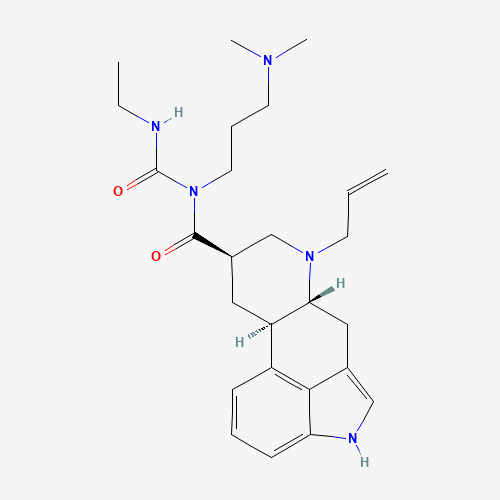
Cabergoline is an N-acylurea that is (8R)-ergoline-8-carboxamide in which the hydrogen attached to the piperidine nitrogen (position 6) is substituted by an allyl group and the hydrogens attached to the carboxamide nitrogen are substituted by a 3-(dimethylamino)propyl group and an N-ethylcarbamoyl group. A dopamine D2 receptor agonist, cabergoline is used in the management of Parkinson's disease and of disorders associated with hyperprolactinaemia. It has a role as an antineoplastic agent, an antiparkinson drug and a dopamine agonist.
科学粮草官-词典编辑部,修订于:2026-07-06
Toxicity
ToxicitySymptoms
Side effects of cabergoline include nausea, constipation, dry mouth, sleep disturbances, vertigo, depression, hypotension, and peripheral edema. Convulsive ergotism can cause painful seizures and spasms, diarrhea, paresthesias, itching, headaches, nausea and vomiting. Usually the gastrointestinal effects precede the central nervous system effects. As well as seizures there can be hallucinations and mental effects including mania or psychosis. Gangrenous ergotism causes dry gangrene as a result of vasoconstriction induced in the more poorly vascularized distal structures, such as the fingers and toes. Symptoms include desquamation, weak periphery pulse, loss of peripheral sensation, edema and ultimately the death and loss of affected tissues. (L1920, L1936) Overdosage might be expected t...
Treatment
Treatment for ergotism consists of vasodilators, anticoagulants and low molecular weight dextrans. If necessary, a sympathetic nerve blockade may be carried out, such as brachial plexus blockade. Temporary sedation (e.g. haloperidol) will be necessary in hallucination and diazepam is used for convulsions. There is no specific antidote. (L1921)
Health Effects
Cabergoline use may cause valvular heart disease and fibrosis. Ingestion of ergoline alkaloids is known to cause the disease ergotism. Ergotism occurs in two forms, gangrenous and convulsive, likely depending on the different kinds and amounts of ergoline alkaloids present. (A2913, L1935, L1936)
Exposure Routes
Oral (L1935) First-pass effect is seen, however the absolute bioavailability is unknown.
Toxicity Summary
Ergoline alkaloids have been shown to have the significant affinity towards the 5-HT1 and 5-HT2 serotonin receptors, D1 and D2 dopamine receptors, and alpha-adrenergic receptors. This can result in a number of different effects, including vasoconstriction, convulsions, and hallucinations. (A2914, A2915, A2916, L1935) The dopamine D<sub>2</sub> receptor is a 7-transmembrane G-protein coupled receptor associated with G<sub>i</sub> proteins. In lactotrophs, stimulation of dopamine D<sub>2</sub> causes inhibition of adenylyl cyclase, which decreases intracellular cAMP concentrations and blocks IP3-dependent release of Ca<sup>2+</sup> from intracellular stores. Decreases in intracellular calcium levels may also be brought about via inhibition of calcium influx through voltage-gated calcium c...
Carcinogen Classification
No indication of carcinogenicity to humans (not listed by IARC).
Drug Induced Liver Injury
References: DOI:10.1016/j.drudis.2019.09.022
Effects During Pregnancy and Lactation
In a small preliminary study, women wishing to stop lactation at 1 month postpartum were given cabergoline 500 mg daily for 7 days. The degree of mammary duct dilation was compared before and after treatment in these women and in women who slowly decreased breastfeeding to stop lactation. More mothers who received cabergoline had a reduction in mammary duct dilation on ultrasound than women who did not.