

 一键配货
一键配货
化合物详情
CAS81777-89-1
分子式C12H14ClNO2
分子量239.7 g/mol
非危品
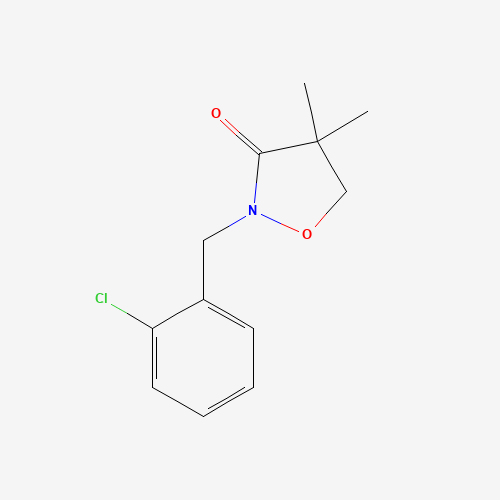
Clomazone is an isoxazolidinone that is 1,2-oxazolidin-3-one substituted by a 2-chlorobenzyl group at position 2 and two methyl groups at position 4. It has a role as a carotenoid biosynthesis inhibitor, a herbicide, an agrochemical, a xenobiotic and an environmental contaminant. It is an isoxazolidinone and a member of monochlorobenzenes.
科学粮草官-词典编辑部,修订于:2026-07-06
Toxicity
ToxicityEPA Ecotoxicity
Pesticide Ecotoxicity Data from EPA: 48
Ecotoxicity Values
LC50 Colinus virginianus (Northern bobwhite, 14 days old) dietary >5620 ppm/8 days[USEPA, Office of Pesticide Programs; Pesticide Ecotoxicity Database (2000) on 2-
Fate Summary
ATMOSPHERIC FATE: According to a model of gas/particle partitioning of semivolatile organic compounds in the atmosphere(1), dimethazone, which has a vapor pressure of 1.44X10⁻⁴ mm Hg at 25 °C(2), is expected to exist solely as a vapor in the ambient atmosphere. Vapor-phase dimethazone is degraded in the atmosphere by reaction with photochemically-produced hydroxyl radicals(SRC); the half-life for this reaction in air is estimated to be 5.8 hours(SRC), calculated from its rate constant of 2.2X10⁻¹¹ cu cm/molecule-sec at 25 °C(SRC) that was derived using a structure estimation method(3). Aqueous solutions of dimethazone have a half life of 30 days when exposed to sunlight(2).
Soil Adsorption / Mobility
Koc values of dimethazone in 19 different soils were measured(1). The Koc values ranged from 60 in silt loam from Lebanon, MO with a pH of 4.5 to 573 in sandy loam from Goldsboro, GA with a pH of 5.2(1). The majority of soil samples had Koc values from 100-150(1). According to a classification scheme(2), these Koc values suggest that dimethazone is expected to have moderate mobility in soil.
Environmental Biodegradation
AEROBIC: Pure culture studies showed oxidation to be the most likely route for degradation(1). Slant cultures using typical soil microbes were incubated with 10 mg dimethazone/25 ml dimethylformamide for 73 hours at 28 °C. Degradation products detected in 17 of the 41 cultures screened included 5-hydroxydimethazone, hydroxymethyldimethazone, 5-ketodimethazone, 3'-hydroxydimethazone and 6-ketodimethazone(1).
Environmental Bioconcentration
An estimated BCF of 17 was calculated for dimethazone(SRC), using a log Kow of 2.5(1) and a regression-derived equation(2). According to a classification scheme(3), this BCF suggests the potential for bioconcentration in aquatic organisms is low(SRC).
Volatilization from Water / Soil
The Henry's Law constant for dimethazone is 4.13X10⁻⁸ atm-cu m/mole(1). This Henry's Law constant indicates that dimethazone is expected to be essentially nonvolatile from moist soil and water surfaces(2). Dimethazone is not expected to volatilize from dry soil surfaces(SRC) based upon a vapor pressure of 1.44X10⁻⁴ mm Hg(1).
Environmental Abiotic Degradation
The rate constant for the vapor-phase reaction of dimethazone with photochemically-produced hydroxyl radicals has been estimated as 2.2X10⁻¹¹ cu cm/molecule-sec at 25 °C(SRC) using a structure estimation method(1). This corresponds to an atmospheric half-life of about 5.8 hours at an atmospheric concentration of 5X10+5 hydroxyl radicals per cu cm(1). Aqueous solutions of dimethazone have a half life of 30 days when exposed to sunlight(3). Dimethazone is not expected to undergo hydrolysis in the environment due to the lack of functional groups that hydrolyze under environmetnal conditions(2).
Ecotoxicity Excerpts
/AQUATIC SPECIES/ ...Liver glycogen /of the silver catfish (Rhamdia quelen)/ increased significantly (P<0.05) in all periods and concentrations tested. The maximum glycogen increase reaches 250% after 12 hr of exposure. Muscle glycogen reduced significantly after 24, 48, 96 and 192 hr for both clomazone concentrations (P<0.05). Significantly elevated plasma glucose values (P<0.05) and variation in glucose in the liver and muscle of exposed fish were observed. Muscle lactate levels increased after 12, 24 and 48 hr of clomazone exposure (22-67%), but reduced in the liver (P<0.05). Protein levels were enhanced in the liver and white muscle, except at 96 and 192h of exposure, whereas it increased in the plasma in the period from 48 to 96 hr (P<0.05). Alanine aminotransferase (ALT) and aspar...
Artificial Pollution Sources
Dimethazone's production may result in its release to the environment through various waste streams; it's use as a herbicide(1) will result in its direct release to the environment(SRC).
Probable Routes of Human Exposure
Occupational exposure to dimethazone may occur through dermal contact with this compound at workplaces where dimethazone is produced or used. The most likely route of exposure is through dermal contact when manufacturing or applying this compound to crops. (SRC)
Environmental Fate / Exposure Summary
Dimethazone's production may result in its release to the environment through various waste streams; it's use as a herbicide will result in its direct release to the environment. If released to air, a vapor pressure of 1.4X10⁻⁴ mm Hg at 25 °C indicates dimethazone will exist solely as a vapor in the atmosphere. Vapor-phase dimethazone will be degraded in the atmosphere by reaction with photochemically-produced hydroxyl radicals; the half-life for this reaction in air is estimated to be 5.8 hours. Aqueous solutions of dimethazone have a half-life of greater than 30 days when exposed to sunlight. If released to soil, dimethazone is expected to have moderate mobility based upon a Koc values ranging from 60-573. Volatilization from moist soil surfaces is not expected to be an important fate...
Toxicity Data
LC50 (rat) = 4,800 mg/m3/4h
Toxicity Summary
Clomazone induces oxidative stress and AChE inhibition in human erythrocytes (in vitro), suggesting a role for reactive oxygen species in the toxicity mechanism induced by clomazone in humans. (A15208)
RAIS Toxicity Values
Oral Chronic Reference Dose Reference: OPP
Carcinogen Classification
No indication of carcinogenicity to humans (not listed by IARC).
Non-Human Toxicity Values
LC50 Rat inhalation 4.8 mg/L/4 hr
Non-Human Toxicity Excerpts
/LABORATORY ANIMALS: Chronic Exposure or Carcinogenicity/ FMC 57020 Technical (purity = 88.8%) was admixed to the feed (plus 2% corn oil) and fed to 6 beagle dogs per sex per dose at dose levels of 0 (untreated diet), 100, 500, 2500, or 5000 (reduced from 7500 ppm at Day 8) (0, 19.4, 97.8, 493.9, 1038.4 mg/kg/day, respectively, for males and 0, 20.7, 104.0, 529.4, 1011.9 mg/kg/day, respectively, for females, (values calculated by the reviewer)) for 1 year (2 animals per sex per dose were sacrificed after 3 months of treatment). No animals died. At the high dose level, decreased body weight and low food consumption were observed in the first 2 weeks of treatment; therefore, the high dose level was decreased from 7500 ppm to 5000 ppm. A treatment-related increase in serum cholesterol leve...
Antidote and Emergency Treatment
Supportive measures are ordinarily sufficient for successful management of excessive exposures to these herbicides ... . If the patient's condition deteriorates in spite of good supportive care, the operation of an alternative or additional toxicant should be suspected. /Other herbicides/