


 一键配货
一键配货
化合物详情
CAS82097-50-5
分子式C14H16ClN5O5S
分子量401.83 g/mol
非危品
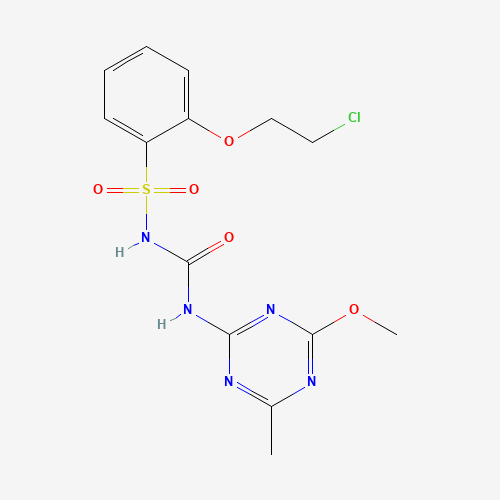
Triasulfuron is an N-sulfonylurea that is N-[o-(2-chloroethoxy)phenyl]sulfonylurea in which one of the hydrogens attached to the non-sulfonylated nitrogen has been replaced by a 4-methoxy-6-methyl-1,3,5-triazin-2-yl group. A herbicide used to control broad-leaved weeds in cereals, its use within the EU has been banned after September 2017 on the grounds of potential groundwater contamination and risks to aquatic life. It has a role as a herbicide and an agrochemical. It is an organochlorine compound, a methoxy-1,3,5-triazine and a N-sulfonylurea.
科学粮草官-词典编辑部,修订于:2026-07-06
Toxicity
ToxicityBody Burden
Triasulfuron geometric mean concentrations in urine for the US population from years 2003-2008 were below the detection limit of 0.07 ug/L(1).
EPA Ecotoxicity
Pesticide Ecotoxicity Data from EPA: 77
Ecotoxicity Values
LD50; Species: Colinus virginianus (Northern Bobwhite Quail) age 175 days; oral via capsule >2150 mg/kg /94.5% purity/
Fate Summary
ATMOSPHERIC FATE: According to a model of gas/particle partitioning of semivolatile organic compounds in the atmosphere(1), triasulfuron, which has a vapor pressure of <1.5X10⁻⁸ mm Hg at 25 °C(2), is expected to exist solely in the particulate phase in the ambient atmosphere. Particulate-phase triasulfuron may be removed from the air by wet and dry deposition(SRC). Triasulfuron absorbs at wavelengths >290 nm(3) and, therefore, may be susceptible to direct photolysis by sunlight(SRC). Triasulfuron photodegrades in aqueous solution exposed to sunlight(4).
Soil Adsorption / Mobility
Soil adsorption studies using 9 soils (organic content 0.6-25%, pH 6.2-7.8) determined a Koc range of 7-25(1). Using three Italian soils (organic matter 1.3, 4.4 and 6.3%), measured Kd values were 0.46, 1.13 and 6.43 respectively(2); these correspond to Koc values of 48, 61 and 173 respectively(SRC). Triasulfuron Koc values of 9.2 and 9.6 were determined in a loam soil and a clay loam soil, respectively(3). The USDA Pesticide Properties Database list a Koc range of 51.6 to 190.6 for triasulfuron with a recommended value of 105(4). According to a classification scheme(5), these Koc values suggest that triasulfuron is expected to have very high to moderate mobility in soil. The content of humic acids and soil pH can effect the soil adsorption of triasulfuron(2,6), although some laboratory...
Environmental Biodegradation
ANAEROBIC: Laboratory studies at 20 °C found a triasulfuron dissipation half-life of about 280 days under anaerobic conditions(1).
Environmental Bioconcentration
An estimated BCF of 1 was calculated in fish for triasulfuron(SRC), using a log Kow of 1.10(1) and a regression-derived equation(2). According to a classification scheme(3), this BCF suggests the potential for bioconcentration in aquatic organisms is low(SRC). BCF values of 9-30 were determined for triasulfuron in green alga (Chlorella fusca)(4).
Volatilization from Water / Soil
A pKa of 4.64(1) indicates triasulfuron will exist partially in anion form at pH 5 and almost entirely in anion form at pH 7-9(SRC), and therefore, since anions do not volatilize, volatilization of anionic triasulfuron will not be an important fate process(SRC). The Henry's Law constant for non-ionized triasulfuron is estimated as <2.5X10⁻¹⁰ atm-cu m/mole(SRC) derived from its vapor pressure, <1.5X10⁻⁸ mm Hg(1), and water solubility, 32-13500 mg/L at pH 5-8.2(1). This Henry's Law constant indicates that non-ionized triasulfuron is expected to be essentially nonvolatile from water surfaces(2). Triasulfuron's estimated Henry's Law constant and ionization indicates that volatilization from moist soil surfaces is not expected to occur(SRC). Triasulfuron is not expected to volatilize from dr...
Environmental Abiotic Degradation
Pseudo-first-order hydrolysis rate constants (and corresponding half-lives) for triasulfuron in aqueous buffer solution were measured as follows(1): 0.0795/day at pH 4, 22 °C (8.72 days half-life), 0.9631/day at pH 4, 40 °C (0.72 days half-life), 0.0183/day at pH 7, 40 °C (37.8 days half-life) and 0.0131/day at pH 10, 40 °C (52.9 days half-life)(1). The aqueous hydrolysis of triasulfuron was measured over a pH range of 2-9 at 25 °C with resulting pH half-lives of pH 2 (2.89 days), pH 3 (4.93 days), pH 4 (7.78 days), pH 5 (13.8 days), pH 6 (27.1 days), pH 7 492 days and pH 9 (387 days)(2); primary pathway of degradation was the cleavage of the sulfonylurea bridge(2). Pseudo-first-order hydrolysis rate constants (and corresponding half-lives) for triasulfuron in aqueous buffer solution at...
Environmental Water Concentrations
SURFACE WATER: Water samples collected from 75 surface water sites in the Upper Mississippi, Misouri and Ohio River basins in 1998 (129 samples), as part of a US Geological Survey study, were analyzed for a variety sulfonylurea and other herbicides, and triasulfuron was not detected in any sample (minimum reporting level of 0.005 ug/L)(1).
Ecotoxicity Excerpts
/AQUATIC SPECIES/ The toxicological effects of the sulfonylurea herbicide triasulfuron and its photoproducts were assessed on four aquatic organisms. Toxicity varied with tested organism and with triasulfuron irradiation time. Triasulfuron and its photoproducts had no significant effects on the crustacean (Cladocera) Daphnia magna (causing 50% effective concentration [EC50] [48 hr] = 49 +/- 1 mg/L) and the marine bacteria Vibrio fischeri (EC50 [30 min] > 100 mg/L). In contrast, primary producers (the duckweed Lemna minor, the microalgae Pseudokirchneriella subcapitata, and Chlorella vulgaris) were very sensitive to triasulfuron (EC50s < 11 microg/L). For these organisms, triasulfuron photoproducts were less toxic than the parent compound but the residual toxicity observed still represen...
Artificial Pollution Sources
Triasulfuron's production may result in its release to the environment through various waste streams; its use as a herbicide to control broad-leaved weeds pre- and post-emergence in wheat, barley and triticale(1) will result in its direct release to the environment(SRC).
Probable Routes of Human Exposure
Occupational exposure to triasulfuron may occur through inhalation and dermal contact with this compound at workplaces where triasulfuron is produced or used. The general population may be exposed to triasulfuron via inhalation and dermal contact in localized agricultural areas where triasulfuron is being applied or recently applied as a herbicide. (SRC)
Environmental Fate / Exposure Summary
Triasulfuron's production may result in its release to the environment through various waste streams; its use as a herbicide to control broad-leaved weeds pre- and post-emergence in wheat, barley and triticale will result in its direct release to the environment. If released to air, a vapor pressure of <1.5X10⁻⁸ mm Hg at 25 °C indicates triasulfuron will exist solely in the particulate phase in the atmosphere. Particulate-phase triasulfuron will be removed from the atmosphere by wet and dry deposition. Triasulfuron absorbs at wavelengths >290 nm and, therefore, may be susceptible to direct photolysis by sunlight. If released to soil, triasulfuron is expected to have very high to moderate mobility based upon measured Koc values of 7-190.6. The pKa of triasulfuron is 4.64, indicating that...
Effect Level
collection=toxvaldb&kind=^EL$
Target Organs
Hepatic
Lethal Dose
collection=toxvaldb&kind=^LD$
Screening Level
collection=toxvaldb&kind=^SL$
Toxicity Summary
IDENTIFICATION AND USE: Triasulfuron is a fine white powder. it is used as a selective herbicide pre- and post-emergence for the control of annual broad-leaved weeds in wheat, barley, and triticale. HUMAN STUDIES: There are no data available. ANIMAL STUDIES: In rats fed triasulfuron for 90 days reduced body weight and kidney toxicity observed at 10,000 ppm. In mice fed triasulfuron for 2 years, centrilobular hepatocytomegaly was observed in male mice receiving 1000, 5000, and 10,000 ppm and in females receiving 10,000 ppm. Increased centrilobular degeneration, focal accumulation of inflammatory cells, microgranulomas, and pigment depositions were also observed in the liver of 10,000-ppm males. In dogs, fed triasulfuron in the diet for 1 year, effects seen at 5000 ppm include liver vacuo...
Lethal Concentration
collection=toxvaldb&kind=^LC$
RAIS Toxicity Values
Oral Chronic Reference Dose Reference: IRIS Current
Carcinogen Classification
No indication of carcinogenicity to humans (not listed by IARC).
Non-Human Toxicity Values
LC50 Rat inh >5185 mg/cu m (4 hr)
Reference and Risk Values
collection=toxvaldb&kind=^RRV$
Non-Human Toxicity Excerpts
/LABORATORY ANIMALS: Chronic Exposure or Carcinogenicity/ Dietary levels tested: 0, 10, 1000, and 6000 ppm (Male: 0, 0.3, 32.1, and 220.8 mg/kg/day; Female: 0, 0.4, 42.9. and 274.4 mg/kg/day); Sprague-Dawley rats, 70/sex/dose with a 12-month sacrifice of 10/sex/dose, were fed triasulfuron in the diet for 2 years. Based on a decrease in mean body weight gain in both sexes throughout the study and a decrease in mean absolute heart and testes weight in males, the LEL for systemic toxicity is 6000 ppm (220.8 mg/kg/day). The NOEL for systemic toxicity is 1000 ppm (32.1 mg/kg/day).
1 or Cancer Risk Level 1E-06
Fraction of Contaminant Absorbed Dermally from Soil: 0.1
Antidote and Emergency Treatment
/SRP:/ Advanced treatment: Consider orotracheal or nasotracheal intubation for airway control in the patient who is unconscious, has severe pulmonary edema, or is in severe respiratory distress. Positive-pressure ventilation techniques with a bag valve mask device may be beneficial. Consider drug therapy for pulmonary edema ... . Consider administering a beta agonist such as albuterol for severe bronchospasm ... . Monitor cardiac rhythm and treat arrhythmias as necessary ... . Start IV administration of D5W TKO /SRP: "To keep open", minimal flow rate/. Use 0.9% saline (NS) or lactated Ringer's (LR) if signs of hypovolemia are present. For hypotension with signs of hypovolemia, administer fluid cautiously. Watch for signs of fluid overload ... . Treat seizures with diazepam (Valium) or l...
Hazard Quotient Level 3 or Cancer Risk Level 1E-04
Fraction of Contaminant Absorbed Dermally from Soil: 0.1
USGS Health-Based Screening Levels for Evaluating Water-Quality
Reference: Smith, C.D. and Nowell, L.H., 2024. Health-Based Screening Levels for evaluating water-quality data (3rd ed.). DOI:10.5066/F71C1TWP









