


 一键配货
一键配货
化合物详情
CAS84087-01-4
分子式C10H5Cl2NO2
分子量242.06 g/mol
非危品
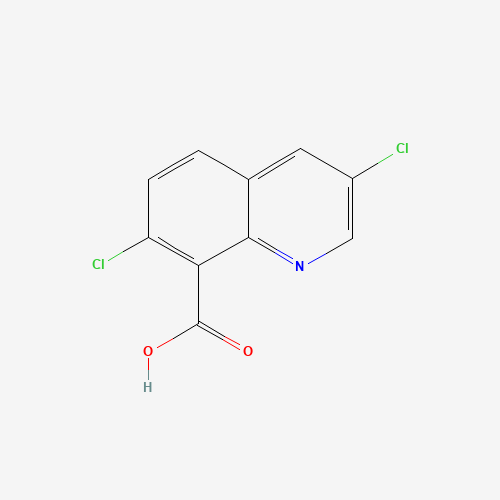
Quinclorac is a quinolinemonocarboxylic acid that is quinoline-8-carboxylic acid in which the hydrogens at positions 3 and 7 have been replaced by chlorines. It is used (particularly as its dimethylamine salt, known as quinclorac-dimethylammonium) as a (rather persistent) herbicide for the post-emergence control of weeds in rice, grass and turf. It is not approved for use within the European Union. It has a role as a herbicide, a synthetic auxin and an agrochemical. It is a monocarboxylic acid, a quinolinemonocarboxylic acid and an organochlorine compound. It is a conjugate acid of a quinclorac(1-).
科学粮草官-词典编辑部,修订于:2026-07-06
Toxicity
ToxicityEPA Ecotoxicity
Pesticide Ecotoxicity Data from EPA: 64
Ecotoxicity Values
LD50; Species: Colinus virginianus (Northern Bobwhite Quail) age 20 weeks; oral via capsule >2000 mg/kg /98.3% purity/
Fate Summary
ATMOSPHERIC FATE: According to a model of gas/particle partitioning of semivolatile organic compounds in the atmosphere(1), quinclorac, which has an estimated vapor pressure of 4.0X10⁻⁸ mm Hg at 25 °C(SRC), determined from a fragment constant method(2), will exist in both the vapor and particulate phases in the ambient atmosphere. Vapor-phase quinclorac is degraded in the atmosphere by reaction with photochemically-produced hydroxyl radicals(SRC); the half-life for this reaction in air is estimated to be 13 days(SRC), calculated from its rate constant of 1.3X10⁻¹² cu cm/molecule-sec at 25 °C(SRC) that was derived using a structure estimation method(2). Particulate-phase quinclorac may be removed from the air by wet and dry deposition(SRC). Quinclorac contains chromophores that absorb at...
Soil Adsorption / Mobility
A sorption coefficient Kd of <1 indicates that leaching is a probable route of dissipation in the soil environment. Some leaching was observed, as quinclorac was detected below the 12 inch soil depth in the several of the terrestrial field dissipation studies. Detections of residues of quinclorac and its degradates in the soil down to 42-48 inches were reported in terrestrial field studies performed in KS, CA, MO, and NJ(1). Soil column leaching experiments were conducted using 3 of 5 major soil zones found in Alberta, Canada, and 10 g of quinclorac-spiked soils, equivalent to 120 g/ha. Quinclorac was reported to leach very rapidly (84 to 97% by 0.67 rain year) in brown Skiff loam (pH 6.0; 2.1% OM) and dark brown Lethridge loam (pH 7.6; 2.7% OM). Intermediate leaching (69-76% by 3.0 rai...
Environmental Biodegradation
AEROBIC: Quinclorac is stable to aerobic and anaerobic biodegradation in soil(1). Biodegradation of <10% was reported in 28 days using an unspecified ready aquatic biodegradability test(2). Following an aerobic aquatic metabolism study, it was reported that a primary degradate, 3-chloro-8-quinoline carboxylic acid, was detected at maximum 55.7% of initial radioactivity after 6 months and 30.8% after 12 months(1).
Environmental Bioconcentration
A log BCF of -0.38722 (BCF <1) was reported in fish for quinclorac(SRC), using bluegill (Lepomis macrochirus) which were exposed over a 4-week period in the OPPTS 850.1730 test(1). According to a classification scheme(2), this BCF suggests the potential for bioconcentration in aquatic organisms is low(SRC).
Volatilization from Water / Soil
A pKa of 4.34(1) indicates quinclorac will exist partially in the anion form at pH values of 5 to 9 and, therefore, volatilization from water surfaces is not expected to be an important fate process(SRC). The Henry's Law constant for the neutral species of quinclorac is estimated as 7.6X10⁻¹² atm-cu m/mole(SRC) developed using a fragment constant estimation method(2). This Henry's Law constant indicates that quinclorac is expected to be essentially nonvolatile from water and moist soil surfaces(2). Quinclorac is not expected to volatilize from dry soil surfaces(SRC) based upon an estimated vapor pressure of 4.0X10⁻⁸ mm Hg(SRC), determined from a fragment constant method(2).
Environmental Abiotic Degradation
The rate constant for the vapor-phase reaction of quinclorac with photochemically-produced hydroxyl radicals has been estimated as 1.3X10⁻¹² cu cm/molecule-sec at 25 °C(SRC) using a structure estimation method(1). This corresponds to an atmospheric half-life of about 13 hours at an atmospheric concentration of 5X10+5 hydroxyl radicals per cu cm(1). Quinclorac contains chromophores that absorb at wavelengths >290 nm(2) and, therefore, may be susceptible to direct photolysis by sunlight(SRC) The compound is reported to be stable to hydrolysis and photolysis in sterile water(3). Quinclorac was reported to be stable under both UV light and sunlight under aqueous conditions(4). However, the compound undergoes rapid photolysis in non-sterile rice paddy, natural river waters and solutions cont...
Environmental Water Concentrations
Reports of surface water or ground water monitoring studies that included quinclorac indicated that quinclorac was present in samples from 31 Arkansas wells and 2 Colorado surface water samples as a result of surveys by the United States Geological Survey (USGS) online National Water Quality Assessment Data Warehouse (NAWQA) database, and the EPA publication, EPA Pesticides in Ground Water, A Compilation of Monitoring Studies 1971-1991 National Summary(1).
Ecotoxicity Excerpts
/OTHER TERRESTRIAL SPECIES/ This work sought to ascertain survival and possible changes in levels of glycogen, triglycerides, total lipids, cholesterol, protein, and lipid peroxidation in gills, liver, and muscle of bullfrog tadpoles (Lithobates catesbeianus) exposed to low concentrations of atrazine (2.5 ug/L), glyphosate (18 ug/L), and quinclorac (0.025 ug/L) at laboratorial conditions. Tadpoles showed a reduction of glycogen and triglyceride in all organs and an increase in lipid peroxidation (LPO) compared with control animals. Total lipid in gills and muscle increased in exposure to atrazine, and gills alone in exposure to glyphosate, but decreased in gills, liver, and muscle after quinclorac. Cholesterol increased in gills and liver after atrazine, in gills and muscle after glypho...
Artificial Pollution Sources
Quinclorac's production may result in its release to the environment through various waste streams; its use as a herbicide to control weeds on agricultural crops, and turf in residential and commercial areas(1) will result in its direct release to the environment(SRC).
Probable Routes of Human Exposure
Occupational exposure to quinclorac may occur through inhalation of dust and dermal contact with this compound at workplaces where quinclorac is produced or used. Use data indicate that the general population may be exposed to quinclorac via dermal contact with consumer products containing quinclorac. (SRC)
Environmental Fate / Exposure Summary
Quinclorac's production may result in its release to the environment through various waste streams; its use as a herbicide will result in its direct release to the environment. If released to air, an estimated vapor pressure of 4.0X10⁻⁸ mm Hg at 25 °C indicates quinclorac will exist in both the vapor and particulate phases in the atmosphere. Vapor-phase quinclorac will be degraded in the atmosphere by reaction with photochemically-produced hydroxyl radicals; the half-life for this reaction in air is estimated to be 13 hrs. Particulate-phase quinclorac will be removed from the atmosphere by wet and dry deposition. Quinclorac contains chromophores that absorb at wavelengths >290 nm and, therefore, may be susceptible to direct photolysis by sunlight. If released to soil, quinclorac is expe...
Effect Level
collection=toxvaldb&kind=^EL$
Lethal Dose
collection=toxvaldb&kind=^LD$
Toxicity Summary
IDENTIFICATION AND USE: Quinclorac is a herbicide. HUMAN STUDIES: It induced chromosomal aberrations in cultured human lymphocytes. ANIMAL STUDIES: It produced no sensitization reactions in a guinea-pig maximization test. Quinclorac was fed to groups of Beagle dogs in the diet at a dose of 0, 1,000, 3,000, 9,000 or 27,000 ppm for 28 days. At 27,000 ppm, feed consumption was reduced in females, and there was body weight loss over the duration of the study in both sexes. Kidney lesions were present at the top dose level. In mice Quinclorac was administered in a diet, at dose levels of 0, 4,000, 8,000, or 16,000 ppm. At 8000 and 16000 ppm there was an increase in water intake in males and females and blood urea nitrogen in males. There was decreased kidney weight in males and females and r...
Lethal Concentration
collection=toxvaldb&kind=^LC$
RAIS Toxicity Values
Oral Chronic Reference Dose Reference: OPP
Human Toxicity Excerpts
/GENOTOXICITY/ Test: Chromosomal aberrations; Target: Human lymphocytes; Concentration or dose tested: 250, 500 and 1,000 ug/mL (+/-S9); Purity (%): 96.5; Results: Positive +/-S9. /From table/
Carcinogen Classification
No indication of carcinogenicity to humans (not listed by IARC).
Non-Human Toxicity Values
LD50 Wistar rat (male and female) dermal >2,000 mg/kg bw /99.4% purity/
Reference and Risk Values
collection=toxvaldb&kind=^RRV$
Non-Human Toxicity Excerpts
/LABORATORY ANIMALS: Subchronic or Prechronic Exposure/ Quinclorac (purity 98.29%) was applied to the shaved skin of groups of New Zealand White rabbits at 40 or 200 mg/kg bw per day (five of each sex) or 0 or 1000 mg/kg bw per day (10 of each sex) for 6 hours/day, 7 days/week, for 21 applications. Animals were observed for clinical signs, local irritation, and feed consumption and body weight changes. Ophthalmoscopy and blood sampling were performed during week 3. At necropsy, a range of tissues was examined, and a limited number of organs were weighed and examined microscopically. There were no deaths or clinical signs of toxicity. Animals of the high-dose group showed partly yellowish discolored skin, which was attributed to the color of the applied test material. A significant incre...
Antidote and Emergency Treatment
/SRP:/ Advanced treatment: Consider orotracheal or nasotracheal intubation for airway control in the patient who is unconscious, has severe pulmonary edema, or is in severe respiratory distress. Positive-pressure ventilation techniques with a bag valve mask device may be beneficial. Consider drug therapy for pulmonary edema ... . Consider administering a beta agonist such as albuterol for severe bronchospasm ... . Monitor cardiac rhythm and treat arrhythmias as necessary ... . Start IV administration of D5W TKO /SRP: "To keep open", minimal flow rate/. Use 0.9% saline (NS) or lactated Ringer's (LR) if signs of hypovolemia are present. For hypotension with signs of hypovolemia, administer fluid cautiously. Watch for signs of fluid overload ... . Treat seizures with diazepam (Valium) or l...









