

 一键配货
一键配货
化合物详情
CAS84371-65-3
分子式C29H35NO2
分子量429.59 g/mol g/mol
危化品
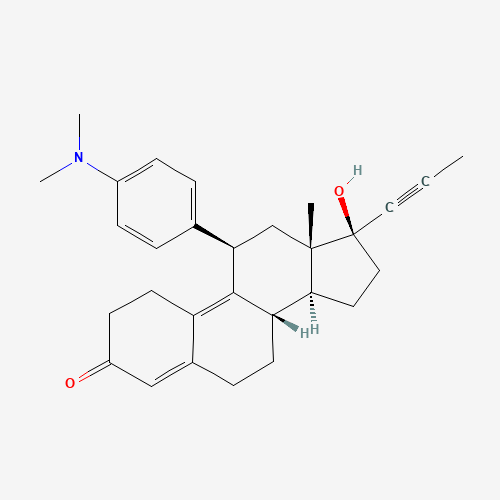
Mifepristone is a 3-oxo-Delta(4) steroid, a tertiary amino compound and an acetylenic compound. It has a role as a hormone antagonist, a contraceptive drug, a synthetic oral contraceptive and an abortifacient. It derives from a hydride of an estrane.
科学粮草官-词典编辑部,修订于:2026-07-06
Toxicity
ToxicityFate Summary
ATMOSPHERIC FATE: According to a model of gas/particle partitioning of semivolatile organic compounds in the atmosphere(1), mifepristone, which has an estimated vapor pressure of 8.0X10⁻¹⁴ mm Hg at 25 °C(SRC), determined from a fragment constant method(2), is expected to exist solely in the particulate phase in the ambient atmosphere. Particulate-phase mifepristone may be removed from the air by wet and dry deposition(SRC). Mifepristone does not contain chromophores that absorb light at wavelengths >290 nm and therefore is not expected to be susceptible to direct photolysis by sunlight(SRC).
Soil Adsorption / Mobility
Using a structure estimation method based on molecular connectivity indices(1), the Koc for mifepristone can be estimated to be 89,000(SRC). According to a classification scheme(2), this estimated Koc value suggests that mifepristone is expected to be immobile in soil.
Environmental Bioconcentration
An estimated BCF of 2,800 was calculated for mifepristone(SRC), using an estimated log Kow of 5.39(1) and a regression-derived equation(2). According to a classification scheme(3), this BCF suggests the potential for bioconcentration in aquatic organisms is very high(SRC), provided the compound is not altered physically or chemically once released into the environment(SRP).
Volatilization from Water / Soil
The Henry's Law constant for mifepristone is estimated as 5.0X10⁻⁵ atm-cu m/mole(SRC) using a fragment constant estimation method(1). This Henry's Law constant indicates that mifepristone is expected to be essentially nonvolatile. Mifepristone is not expected to volatilize from dry soil surfaces(SRC) based upon an estimated vapor pressure of 8.0X10⁻¹⁴ mm Hg(SRC), determined from a fragment constant method(3).
Environmental Abiotic Degradation
The rate constant for the vapor-phase reaction of mifepristone with ozone has been estimated as 1.5X10⁻¹⁴ cu cm/molecule-sec at 25 °C(SRC) that was derived using a structure estimation method(1). This corresponds to an atmospheric half-life of about 1.1 min at an atmospheric concentration of 7X10+11 ozone molecules per cu cm(2). Mifepristone is not expected to undergo hydrolysis in the environment due to the lack of hydrolyzable functional groups(3). Mifepristone does not contain chromophores that absorb light at wavelengths >290 nm and therefore is not expected to be susceptible to direct photolysis by sunlight(SRC).
Artificial Pollution Sources
Mifepristone's production and use as an abortifacient(1) may result in its release to the environment through various waste streams(SRC).
Probable Routes of Human Exposure
Occupational exposure to mifepristone may occur through inhalation dermal contact with this compound at workplaces where mifepristone is produced or used. Exposure to the drug among the general population may be limited to those being administered the drug mifepristone, (an abortifacient). (SRC)
Environmental Fate / Exposure Summary
Mifepristone's production and use as abortifacient may result in its release to the environment through various waste streams. If released to air, an estimated vapor pressure of 8.0X10⁻¹⁴ mm Hg at 25 °C indicates mifepristone will exist solely in the particulate phase in the ambient atmosphere. Particulate-phase mifepristone will be removed from the atmosphere by wet and dry deposition. Mifepristone does not contain chromophores that absorb light at wavelengths >290 nm and therefore is not expected to be susceptible to direct photolysis by sunlight. If released to soil, mifepristone is expected to have no mobility based upon an estimated Koc of 89,000. Volatilization from water and moist soil surfaces is not expected to be an important fate process based upon an estimated Henry's Law co...
Symptoms
Nearly all of the women who receive mifepristone will report adverse reactions, and many can be expected to report more than one such reaction. About 90% of patients report adverse reactions following administration of misoprostol on day three of the treatment procedure. Side effects include more heavy bleeding than a heavy manstrual period, abdominal pain, uterine cramping, nausea, vomiting, and diarrhea.
Treatment
If the compound has been ingested, rapid gastric lavage should be performed using 5% sodium bicarbonate. For skin contact, the skin should be washed with soap and water. If the compound has entered the eyes, they should be washed with large quantities of isotonic saline or water. In serious cases, atropine and/or pralidoxime should be administered. Anti-cholinergic drugs work to counteract the effects of excess acetylcholine and reactivate AChE. Atropine can be used as an antidote in conjunction with pralidoxime or other pyridinium oximes (such as trimedoxime or obidoxime), though the use of '-oximes' has been found to be of no benefit, or possibly harmful, in at least two meta-analyses. Atropine is a muscarinic antagonist, and thus blocks the action of acetylcholine peripherally.
Interactions
Excessive bleeding may occur with concomitant use of anticoagulant therapy and mifepristone.
Health Effects
Acute exposure to cholinesterase inhibitors can cause a cholinergic crisis characterized by severe nausea/vomiting, salivation, sweating, bradycardia, hypotension, collapse, and convulsions. Increasing muscle weakness is a possibility and may result in death if respiratory muscles are involved. Accumulation of ACh at motor nerves causes overstimulation of nicotinic expression at the neuromuscular junction. When this occurs symptoms such as muscle weakness, fatigue, muscle cramps, fasciculation, and paralysis can be seen. When there is an accumulation of ACh at autonomic ganglia this causes overstimulation of nicotinic expression in the sympathetic system. Symptoms associated with this are hypertension, and hypoglycemia. Overstimulation of nicotinic acetylcholine receptors in the central...
Hepatotoxicity
Likelihood score: D (possible cause of clinically apparent liver injury).
Adverse Effects
* Drugs metabolized by CYP2B6: Mifepristone is an inhibitor of CYP2B6 and may increase the concentration of drugs metabolized by CYP2B6, such as bupropion and efavirenz. Use with caution.
Exposure Routes
Oral. The absolute bioavailability of a 20 mg oral dose is 69%
Toxicity Summary
Mifepristone is a cholinesterase or acetylcholinesterase (AChE) inhibitor. A cholinesterase inhibitor (or 'anticholinesterase') suppresses the action of acetylcholinesterase. Because of its essential function, chemicals that interfere with the action of acetylcholinesterase are potent neurotoxins, causing excessive salivation and eye-watering in low doses, followed by muscle spasms and ultimately death. Nerve gases and many substances used in insecticides have been shown to act by binding a serine in the active site of acetylcholine esterase, inhibiting the enzyme completely. Acetylcholine esterase breaks down the neurotransmitter acetylcholine, which is released at nerve and muscle junctions, in order to allow the muscle or organ to relax. The result of acetylcholine esterase inhibitio...
Human Toxicity Excerpts
/HUMAN EXPOSURE STUDIES/ Myocardial infarction occurred in at least one patient 3 days following use of mifepristone and vaginal misoprostol; a causal relationship to the regimen has not been established.
Carcinogen Classification
No indication of carcinogenicity to humans (not listed by IARC).
Drug Induced Liver Injury
References: DOI:10.1016/j.drudis.2019.09.022
Non-Human Toxicity Excerpts
/GENOTOXICITY/ Mifepristone was not found to be mutagenic in multiple assays, including the Ames test, Saccharomyces cerevisiae D4 cell conversion test, and Schizosaccharomyces pompe P1 cell forward mutation test. No positive results were noted during tests designed to induce chromosomal damage, including induction of chromosome aberrations in CHO cells, induction of genetic damage in V79 Chinese hamster lung cells, and the mouse micronucleus assay.
Antidote and Emergency Treatment
Advanced treatment: Consider orotracheal or nasotracheal intubation for airway control in the patient who is unconscious, has severe pulmonary edema, or is in respiratory arrest. Positive pressure ventilation techniques with a bag valve mask device may be beneficial. Monitor cardiac rhythm and treat arrhythmias as necessary ... . Start an IV with D5W /SRP: "To keep open", minimal flow rate/. Use lactated Ringer's if signs of hypovolemia are present. Watch for signs of fluid overload. Consider drug therapy for pulmonary edema ... . For hypotension with signs of hypovolemia, administer fluid cautiously. Watch for signs of fluid overload ... . Treat seizures with diazepam (Valium) ... . Use proparacaine hydrochloride to assist eye irrigation ... . /Poison A and B/
Effects During Pregnancy and Lactation
Studies have not been done to see if mifepristone could affect fertility or increase the chance of birth defects above the background risk. In general, exposures that fathers or sperm donors have are unlikely to increase the risks to a pregnancy. For more information, please see the MotherToBaby fact sheet Paternal Exposures at https://mothertobaby.org/fact-sheets/paternal-exposures-pregnancy/.