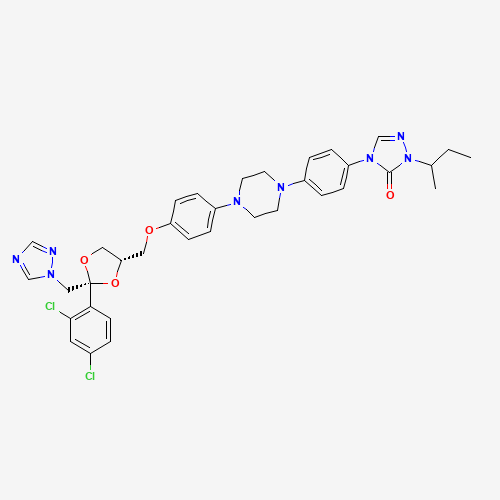
Fate Summary
ATMOSPHERIC FATE: According to a model of gas/particle partitioning of semivolatile organic compounds in the atmosphere(1), itraconazole, which has an estimated vapor pressure of 2.6X10⁻²⁰ mm Hg at 25 °C(SRC), determined from a fragment constant method(2), is expected to exist solely in the particulate phase in the ambient atmosphere. Particulate-phase itraconazole may be removed from the air by wet or dry deposition(SRC). Itraconazole does not contain chromophores that absorb at wavelengths >290 nm(3), and therefore is not expected to be susceptible to direct photolysis by sunlight(SRC).
Soil Adsorption / Mobility
The Koc of itraconazole is estimated as 6,600(SRC), using a log Kow of 5.66(1) and a regression-derived equation(2). According to a classification scheme(3), this estimated Koc value suggests that itraconazole is expected to be immobile in soil. The pKa of itraconazole is 3.7(4), indicating that this compound will exist almost entirely in the cation form in the environment and cations generally adsorb more strongly to soils containing organic carbon and clay than their neutral counterparts(5).
Environmental Biodegradation
AEROBIC: Itraconazole biodegradation is not expected to biodegrade in the environment, based on a modeling study indicating a time frame on the order of months and longer(1).
Environmental Bioconcentration
An estimated BCF of 2,500 was calculated in fish for itraconazole(SRC), using a log Kow of 5.66(1) and a regression-derived equation(2). According to a classification scheme(3), this BCF suggests the potential for bioconcentration in aquatic organisms is very high(SRC), provided the compound is not metabolized by the organism(SRC).
Volatilization from Water / Soil
A pKa of 3.7(1) indicates itraconazole will exist almost entirely in the cation form at pH values of 5 to 9 and therefore volatilization from water and moist soil surfaces is not expected to be an important fate process(SRC). Itraconazole is not expected to volatilize from dry soil surfaces(SRC) based upon an estimated vapor pressure of 2.6X10⁻²⁰ mm Hg(SRC), determined from a fragment constant method(2).
Environmental Abiotic Degradation
Itraconazole is not expected to undergo hydrolysis in the environment due to the lack of functional groups that hydrolyze under environmental conditions(1). Itraconazole does not contain chromophores that absorb at wavelengths >290 nm(1), and therefore is not expected to be susceptible to direct photolysis by sunlight(SRC).
Milk Concentrations
Itraconazole is distributed into human milk and the expected benefits of itraconazole for the nursing woman should be weighed against the potential risk to the infant from exposure to the drug.
Artificial Pollution Sources
Itraconazole's production and use as a medication(1) may result in its release to the environment through various waste streams(SRC).
Probable Routes of Human Exposure
Occupational exposure to itraconazole may occur through inhalation and dermal contact with this compound at workplaces where itraconazole is produced or used. Exposure to itraconazole among the general population may be limited to those administered the drug, an antifungal. (SRC)
Other Environmental Concentrations
As a secondary release pathway to the environment, bathing, washing, and laundering have been suggested as possible release routes following consumer use of pharmaceuticals. Itraconzole is mostly excreted through sebaceous glands and moderately excreted by the sweat glands, based upon data compiled using a sweat patch or wipe(1).
Environmental Fate / Exposure Summary
Itraconazole's production and use as medication may result in its release to the environment through various waste streams. If released to air, an estimated vapor pressure of 2.6X10⁻²⁰ mm Hg at 25 °C indicates itraconazole will exist solely in the particulate phase in the atmosphere. Particulate-phase itraconazole will be removed from the atmosphere by wet or dry deposition. Itraconazole does not contain chromophores that absorb at wavelengths >290 nm, and therefore is not expected to be susceptible to direct photolysis by sunlight. If released to soil, itraconazole is expected to have no mobility based upon an estimated Koc of 6,600. The pKa of itraconazole is 3.7, indicating that this compound will exist almost entirely in the cation form in the environment and cations generally adsor...
Interactions
Itraconazole may inhibit the metabolism of busulfan, docetaxel and vinca alkaloids.
Toxicity Data
No significant lethality was observed when itraconazole was administered orally to mice and rats at dosage levels of 320 mg/kg or to dogs at 200 mg/kg.
Hepatotoxicity
Likelihood score: B (likely cause of clinically apparent liver injury).
Adverse Effects
The most common adverse effects are gastrointestinal disturbances, such as nausea, mild diarrhea, vomiting, and abdominal pain. Researchers noted these side effects in 2 to 39% of patients that have used itraconazole. When itraconazole administration is via the intravenous formulation, there is also a risk of injection site reactions, headache, and rash.
Exposure Routes
The absolute oral bioavailability of itraconazole is 55%, and is maximal when taken with a full meal.
Toxicity Summary
Itraconazole interacts with 14-α demethylase, a cytochrome P-450 enzyme necessary to convert lanosterol to ergosterol. As ergosterol is an essential component of the fungal cell membrane, inhibition of its synthesis results in increased cellular permeability causing leakage of cellular contents. Itraconazole may also inhibit endogenous respiration, interact with membrane phospholipids, inhibit the transformation of yeasts to mycelial forms, inhibit purine uptake, and impair triglyceride and/or phospholipid biosynthesis.
Human Toxicity Excerpts
/CASE REPORTS/ An 80-year-old man was admitted to the hospital with a diagnosis of pulmonary aspergilloma. A new azole antifungal agent, D 0870, was administered to the patient for 7 days orally, and itraconazole (400 mg/day) was started. After 1 month of chemotherapy, facial and pretibial edema were observed and the patient's serum potassium concentration decreased to 2.5 mEq/L. A chest radiograph disclosed cardiomegaly with cardiac effusion and right pleural effusion on admission. The serum potassium concentration rose after the cessation of itraconazole therapy. The serum ITCZ concentration remained high for 2 weeks after admission. Although reports of hypopotassemia induced by ITCZ are rare, /investigators/ concluded that blood concentrations should be monitored more carefully when...
Carcinogen Classification
No indication of carcinogenicity to humans (not listed by IARC).
Drug Induced Liver Injury
References: DOI:10.1016/j.drudis.2019.09.022
Non-Human Toxicity Values
LD50 Guinea pig oral >160 mg/kg
Non-Human Toxicity Excerpts
/LABORATORY ANIMALS: Chronic Exposure or Carcinogenicity/ Commercially available itraconazole oral solution and itraconazole injection contain hydroxypropyl-beta-cyclodextrin (HP-beta-CD) as an excipient. HP-beta-CD has produced pancreatic adenocarcinomas in rat carcinogenicity studies but similar effects were not observed in a mouse carcinogenicity study.
Populations at Special Risk
Itraconazole Capsules should not be administered for the treatment of onychomycosis in patients with evidence of ventricular dysfunction such as congestive heart failure (CHF) or a history of CHF. If signs or symptoms of congestive heart failure occur during administration of itraconazole capsules, discontinue administration. When itraconazole was administered intravenously to dogs and healthy human volunteers, negative inotropic effects were seen.
Antidote and Emergency Treatment
/SRP:/ Advanced treatment: Consider orotracheal or nasotracheal intubation for airway control in the patient who is unconscious, has severe pulmonary edema, or is in severe respiratory distress. Positive-pressure ventilation techniques with a bag valve mask device may be beneficial. Consider drug therapy for pulmonary edema ... . Consider administering a beta agonist such as albuterol for severe bronchospasm ... . Monitor cardiac rhythm and treat arrhythmias as necessary ... . Start IV administration of D5W /SRP: "To keep open", minimal flow rate/. Use 0.9% saline (NS) or lactated Ringer's if signs of hypovolemia are present. For hypotension with signs of hypovolemia, administer fluid cautiously. Watch for signs of fluid overload ... . Treat seizures with diazepam or lorazepam ... . Use...
Effects During Pregnancy and Lactation
◉ Effects on Lactation and Breastmilk



 一键配货
一键配货