

 一键配货
一键配货
化合物详情
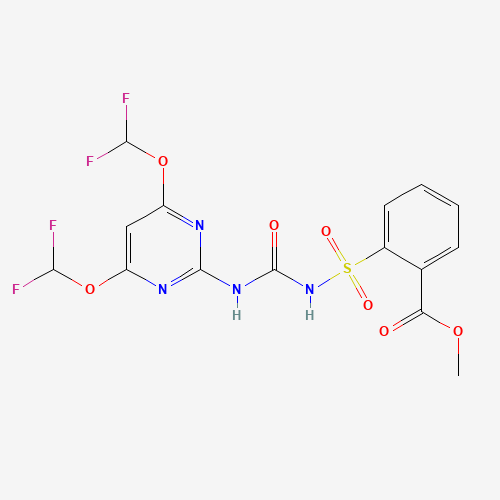
CAS86209-51-0
分子式C15H12F4N4O7S
分子量468.34 g/mol
非危品
Primisulfuron-methyl is a urea herbicide that is used on crop and non- crop areas for the control of grass weeds and many kinds of broad-leaved weeds. The compound is a selective postemergence systemic herbicide that is rapidly absorbed by plants and transported throughout the plant roots and foliage. The herbicide works by blocking cell growth in the active growing regions of the plant. The herbicide also acts to inhibit photosynthesis
科学粮草官-词典编辑部,修订于:2026-07-06
Toxicity
ToxicityEPA Ecotoxicity
Pesticide Ecotoxicity Data from EPA: 56
Ecotoxicity Values
LD50 Worms >100 mg/kg soil/14 days
Fate Summary
ATMOSPHERIC FATE: According to a model of gas/particle partitioning of semivolatile organic compounds in the atmosphere(1), primisulfuron-methyl, which has a vapor pressure of <3X10⁻¹⁰ mm Hg at 20 °C(2), is expected to exist solely in the particulate phase in the ambient atmosphere. Particulate-phase primisulfuron-methyl may be removed from the air by wet and dry deposition(SRC).
Soil Adsorption / Mobility
In a one year field lysimeter study using undisturbed Dothan soils (90 cm length soil columns), an average Rf value of 0.16 was measured for primisulfuron-methyl. After 90 days, the 14C from the initially applied primisulfuron-methyl was 14% in the 4 cm section, 16% in the 11 cm section and 4% in the 19 cm section; loss of radioactivity was mainly attributed to escape of CO2 although further data were not given(1). A Koc of 20 was reported for primisulfuron-methyl(2). Multivariate regression analysis was used to determine the importance of various soil characteristics on the Kd value of primisulfuron-methyl; the Kd value was determined on a Ravenna silt loam soil. In this study, clay content had a strong effect (90% of r2) on the adsorption of this pesticide while total organic content...
Environmental Biodegradation
AEROBIC: Field dissipation half-lives of 12.6, 13, 6.6, 11.8, 3.8, 5.1, 11, and 14 days have been reported for NY bare sandy loam, MS bare clay loam, MO bare sandy loam, MO crop sandy loam, GA bare loamy sand, GA crop loamy sand, WI bare loamy sand, and WI crop loamy sand soil studies, respectively(1). As this compound hydrolyzes, particularly at lower pH values, field dissipation half-lives for this compound are likely to include loss due to hydrolysis, biodegradation and possibly leaching(SRC). Half-lives of 30 and 63 days were reported in two sandy loam soils incubated under aerobic conditions in the laboratory; under anaerobic conditions, half-lives of 41 and 89 days were reported for the same two soils(1). Half-lives of 25.6 and 26.8 days were observed for primisulfuron-methyl appl...
Environmental Bioconcentration
An estimated BCF of 14 was calculated for primisulfuron-methyl(SRC), using an estimated log Kow of 2.41(1) and a regression-derived equation(2). According to a classification scheme(3), this BCF suggests the potential for bioconcentration in aquatic organisms is low(SRC).
Volatilization from Water / Soil
A pKa of 5.1 indicates primisulfuron-methyl will exist almost entirely as an anion at pH values of 5 to 9 and therefore volatilization from both moist soil and water surfaces is not expected to be an important fate process. The Henry's Law constant for the neutral species is estimated as 1.4X10⁻¹² atm-cu m/mole(SRC) using a fragment constant estimation method(1); this indicates that this species is expected to be essentially nonvolatile from both moist soil and water surfaces(2). Primisulfuron-methyl is not expected to volatilize from dry soil surfaces(SRC) based upon a vapor pressure of <3.75X10⁻⁸ mm Hg(3).
Environmental Abiotic Degradation
The hydrolysis of primisulfuron-methyl was measured in buffer solution at pH 4, 7, and 10 following Organization for Economic Cooperation and Development (OECD) guidelines(1). Hydrolysis occurs at the sulfonylurea bridge; saccharin was detected as a hydrolysis product(1). Pseudo-first order hydrolysis rate constants of 2.14 (half-life of 0.32 days), 0.017(half-life of 41 days), and 0.0073 days-1 (half-life of 95 days) were reported at pH 4, 7, and 10, respectively, following incubation at 40 °C(1). At pH 4 and an incubation temperature of 22 °C, a pseudo first-order hydrolysis rate constant of 0.1238 (half-life of 5.6 days) was measured(1). Hydrolysis half-lives of 2.34, 1.41, 1.06, and 0.65 days were reported for primisulfuron-methyl at 15, 20, 25, and 30 °C and at pH 4(2). At pH 2, 3,...
Environmental Water Concentrations
SURFACE WATER: 130 surface water samples from 75 streams, large rivers, and reservoir outflows in the Upper Mississippi, Missouri, and Ohio River basins were collected in 1998; 0% of the samples contained detections of primisulfuron-methyl above the method reporting limit (MRL) (median is <0.01 ug/l; maximum is <0.01 ug/l)(1).
Ecotoxicity Excerpts
/OTHER TERRESTRIAL SPECIES/ Primisulfuron-methyl is nontoxic to honey bees.
Artificial Pollution Sources
Primisulfuron-methyl's production may result in its release to the environment through various waste streams; it's use as a herbicide(1) will result in its direct release to the environment(SRC).
Sediment/Soil Concentrations
Weakly adsorbed by soil components and accordingly leaching can occur in soils. Short-to-moderate soil persistence.
Probable Routes of Human Exposure
Occupational exposure to primisulfuron-methyl may occur through dermal contact with this compound at workplaces where primisulfuron-methyl is produced or used. (SRC)
Environmental Fate / Exposure Summary
Primisulfuron-methyl's production may result in its release to the environment through various waste streams; it's use as a herbicide will result in its direct release to the environment. If released to air, a vapor pressure of <3.75X10⁻⁸ mm Hg at 25 °C indicates primisulfuron-methyl will exist solely in the particulate phase in the ambient atmosphere. Particulate-phase primisulfuron-methyl will be removed from the atmosphere by wet and dry deposition. If released to soil, primisulfuron-methyl is expected to have moderate to very high mobility based upon Koc values generally less than 100. Sorption was shown to decrease with increasing pH. A pKa of 5.1 indicates primisulfuron-methyl will exist almost entirely as an anion at pH values of 5 to 9 and therefore volatilization from both soil...
Effect Level
collection=toxvaldb&kind=^EL$
Lethal Dose
collection=toxvaldb&kind=^LD$
Toxicity Data
LC50 (rat) > 4,800 mg/m3/4h
RAIS Toxicity Values
Oral Chronic Reference Dose Reference: OPP
Carcinogen Classification
No indication of carcinogenicity to humans (not listed by IARC).
Non-Human Toxicity Values
LC50 Rat inhalation >4.8 mg/L air/4 hr
Reference and Risk Values
collection=toxvaldb&kind=^RRV$
Non-Human Toxicity Excerpts
/LABORATORY ANIMALS: Chronic Exposure or Carcinogenicity/ Doses of 125 mg/kg/day administered in the diet to dogs over a 1-yr period produced decreased body weight gain, anemia, increased liver weight, and thyroid hyperplasia (abnormal growth). Rats fed dietary doses of about 180 mg/kg/day over 90 days showed effects similar to those noted in dogs, as well as spleen weight increases. In another study, doses of 480 mg/kg/day in rats over 18 months produced increased incidence of tooth disorders, chronic nephritis (kidney damage), and testicular atrophy. In two 18-month studies in mice, testicular atrophy, chronic nephritis, and increased tooth and bone disorders were seen at doses of 180 mg/kg/day and 360 mg/kg/day, respectively.
Antidote and Emergency Treatment
Advanced treatment: Consider orotracheal or nasotracheal intubation for airway control in the patient who is unconscious, has severe pulmonary edema, or is in respiratory arrest. Positive pressure ventilation techniques with a bag valve mask device may be beneficial. Monitor cardiac rhythm and treat arrhythmias as necessary ... . Start an IV with D5W /SRP: "To keep open", minimal flow rate/. Use lactated Ringer's if signs of hypovolemia are present. Watch for signs of fluid overload. Consider drug therapy for pulmonary edema ... . For hypotension with signs of hypovolemia, administer fluid cautiously. Watch for signs of fluid overload ... . Treat seizures with diazepam (Valium) ... . Use proparacaine hydrochloride to assist eye irrigation ... . /Poison A and B/
USGS Health-Based Screening Levels for Evaluating Water-Quality
Reference: Smith, C.D. and Nowell, L.H., 2024. Health-Based Screening Levels for evaluating water-quality data (3rd ed.). DOI:10.5066/F71C1TWP