


 一键配货
一键配货
化合物详情
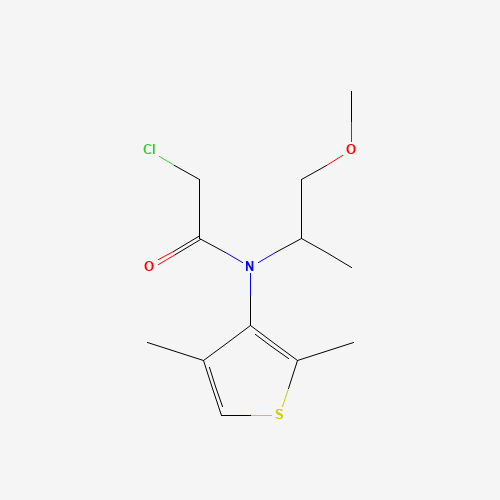
CAS87674-68-8
分子式C12H18ClNO2S
分子量275.79 g/mol
非危品
2-chloro-N-(2,4-dimethylthiophen-3-yl)-N-(1-methoxypropan-2-yl)acetamide is an organochlorine compound that is 2-chloroacetamide substituted by a 2,4-dimethylthiophen-3-yl and a 1-methoxypropan-2-yl group at the nitrogen atom. It is an ether, a member of thiophenes, an organochlorine compound and an aromatic amide.
科学粮草官-词典编辑部,修订于:2026-07-06
Toxicity
ToxicityEPA Ecotoxicity
Pesticide Ecotoxicity Data from EPA: 45
Ecotoxicity Values
LD50; Species: Apis mellifera (Honey Bee) worker; oral >1000 ug/bee /97% purity/
Fate Summary
ATMOSPHERIC FATE: According to a model of gas/particle partitioning of semivolatile organic compounds in the atmosphere(1), dimethenamid, which has a vapor pressure of 2.75X10⁻⁴ mm Hg at 25 °C(2), is expected to exist solely as a vapor in the ambient atmosphere. Vapor-phase dimethenamid is degraded in the atmosphere by reaction with photochemically-produced hydroxyl radicals(SRC); the half-life for this reaction in air is estimated to be 7.4 hours(SRC), calculated from its rate constant of 5.2X10⁻¹¹ cu cm/molecule-sec at 25 °C(SRC) that was derived using a structure estimation method(2). Dimethenamid contains chromophores that absorb at wavelengths >290 nm(3) and, therefore, may be susceptible to direct photolysis by sunlight(SRC).
Soil Adsorption / Mobility
Using a structure estimation method based on molecular connectivity indices(1), the Koc of dimethenamid can be estimated to be 140(SRC). According to a classification scheme(2), this estimated Koc value suggests that dimethenamid is expected to have high mobility in soil(SRC).
Environmental Biodegradation
ANAEROBIC: In a study of dimethenamid dissipation under anaerobic redox conditions in soil(1), a disapperance time (DT50) of 14C-dimethenamid occurred in 13-14 days in soil-water biometers that had glucose pre-treatment, NO3- and ((SO4)2-) amendment, or were unamended. 14C-Metabolites accumulated up to 20% of applied 14C. At least two major metabolites were observed in nonautoclaved treatments, whereas only one was observed in autoclaved microcosms. More than 50% of the applied 14C was eventually incorporated into soil-bound residue. Another study(2) observed 16-25 day half-lives of dimethenamid in anaerobic soil slurries. Degradation in sediment was microbially-mediated. Under anaerobic aquatic conditions, dimethenamid half-life was 35 days, with major transformation products M3, M13 (...
Environmental Bioconcentration
Dimethenamid is not expected to bioconcentrate(1); in one study average steady state bioconcentration factors for dimethenamid residues were 20 for the edible tissues, 100 for the nonedible tissue and 57 for whole fish, with depuration half-life for whole body as 10.7 days with approximately 80% of the residues eliminated 14 days after exposure stopped(1). According to a classification scheme(2), this BCF suggests bioconcentration in aquatic organisms is moderate(SRC).
Volatilization from Water / Soil
The Henry's Law constant for dimethenamid is 8.21X10⁻⁸ atm-cu m/mole(1). This Henry's Law constant indicates that dimethenamid is expected to be essentially nonvolatile from water and moist soil surfaces(2). Dimethenamid is not expected to volatilize from dry soil surfaces(SRC) based upon a vapor pressure of 2.75X10⁻⁴ mm Hg(3).
Environmental Abiotic Degradation
The rate constant for the vapor-phase reaction of dimethenamid with photochemically-produced hydroxyl radicals has been estimated as 5.2X10⁻¹¹ cu cm/molecule-sec at 25 °C(SRC) using a structure estimation method(1). This corresponds to an atmospheric half-life of about 7.4 hours at an atmospheric concentration of 5X10+5 hydroxyl radicals per cu cm(1). Dimethenamid is not expected to undergo hydrolysis in the environment due to the lack of functional groups that hydrolyze under environmental conditions(2). Dimethenamid contains chromophores that absorb at wavelengths >290 nm(2) and, therefore, is susceptible to direct photolysis by sunlight(SRC). Photolysis half-lives have been reported as approximately 7.8 days on soil and 23-33 days in water(3).
Environmental Water Concentrations
RAIN: At an agricultural site in St. Damase, Quebec, Canada in 2004, dimethenamid was detected in precipitation at concentrations of 80 ng/L in May and 14 ng/L in June. Dimethanimid was detected in rainwater samples collected in 3 locations in the canton of Zurich, Switzerland between February and October 1996 at a median concentration of 24 ng/L, maximum concentration 78 ng/L and total load 300 ng/(sq m/year)(2). Dimethenamid was reported at a concentraiton of 6 ug/L in a single rain event in Switzerland, sampled July 18-20, 1994(3).
Ecotoxicity Excerpts
/PLANTS/ Chemicals called safeners protect cereal crops from herbicide toxicity. Proteomic methods (2-D PAGE and LC-MS/MS) were utilized to identify safener- and/or herbicide-regulated proteins in three tissues (root, leaf, and coleoptile) of Triticum tauschii seedlings to better understand a safener's mechanism of action. Growth experiments showed that the safener cloquintocet-mexyl protected seedlings from injury by the herbicide dimethenamid. In total, 29 safener-induced and 10 herbicide-regulated proteins were identified by LC-MS/MS. These proteins were classified into two major categories based on their expression patterns, and were further classified into several functional groups. Surprisingly, mutually exclusive sets of proteins were identified following herbicide or safener tre...
Artificial Pollution Sources
Dimethenamid's production may result in its release to the environment through various waste streams; its use as a herbicide(1) will result in its direct release to the environment(SRC).
Probable Routes of Human Exposure
Occupational exposure to dimethenamid may occur through inhalation and dermal contact with this compound at workplaces where dimethenamid is produced or used. Limited monitoring data indicate that the general population is likely to be exposed to dimethenamid via ingestion of and dermal contact with water in localized areas where dimethenamid was being applied or recently applied as a herbicide. (SRC)
Environmental Fate / Exposure Summary
Dimethenamid's production may result in its release to the environment through various waste streams; its use as a herbicide(1) will result in its direct release to the environment. If released to air, a vapor pressure of 2.75X10⁻⁴ mm Hg at 25 °C indicates dimethenamid will exist solely as a vapor in the atmosphere. Vapor-phase dimethenamid will be degraded in the atmosphere by reaction with photochemically-produced hydroxyl radicals; the half-life for this reaction in air is estimated to be 7.4 hrs. Dimethenamid contains chromophores that absorb at wavelengths >290 nm and, therefore, may be susceptible to direct photolysis by sunlight. If released to soil, dimethenamid is expected to have high mobility based upon an estimated Koc of 140. Volatilization from moist soil surfaces is not e...
Effect Level
collection=toxvaldb&kind=^EL$
Interactions
The first elongation step to form very-long-chain fatty acids (VLCFAs) is catalyzed by the VLCFA-synthase. CoA-activated fatty acids react with malonyl-CoA to condense a C2-unit. As shown with recombinant enzyme this reaction is specifically inhibited by chloroacetamide herbicides. The inhibition is alleviated when the inhibitor (e.g. metazachlor) is incubated together with adequate concentrations of the substrate (e.g. oleoyl-CoA). Malonyl-CoA has no influence. However, once a chloroacetamide has been tightly bound to the synthase after an appropriate time it cannot be displaced anymore by the substrate. In contrast, oleoyl-CoA, is easily removed from the synthase by metazachlor. The irreversible binding of the chloroacetamides and their competition with the substrate explains the very...
Lethal Dose
collection=toxvaldb&kind=^LD$
Toxicity Summary
IDENTIFICATION AND USE: Dimethenamid is a herbicide and a racemic mixture of the M (or R) and P (or S) stereoisomers. When this compound was originally registered in various countries, all studies of toxicity were conducted with the racemic mixture. Later, it was discovered that only the P (or S) enantiomer has useful herbicidal activity. HUMAN STUDIES: In 50 people handling racemic dimethenamid and its formulated products over 7 years there were no reported cases of skin irritation or other adverse health effects. Dimethenamid did not increase sister chromatid exchange frequency in cultured human lymphocytes. ANIMAL STUDIES: In short-term studies with racemic dimethenamid, the signs of toxicity observed in mice, rats and dogs were similar, with reduced body-weight gain and liver enlarg...
RAIS Toxicity Values
Oral Chronic Reference Dose Reference: OPP
Other Toxicity Values
collection=toxvaldb&kind=^Other$
Human Toxicity Excerpts
/GENOTOXICITY/ ... Isolated and cultured peripheral lymphocytes (mostly T cells) were used from two human donors to study the effects of the chloroacetanilides and their metabolites on primary human cells. In tests at 10 uM, the SCE frequency was increased by alachlor and possibly acetochlor but not by butachlor, metolachlor, dimethachlor (a 2,6-dimethyl analog) and dimethenamid (an analog based on 2,4-dimethyl-3-thienylamine). At 0.3 microM in cultured human lymphocytes, alachlor, the corresponding chloroacetanilide (N-dealkyl-alachlor) and aniline metabolites (and their 4-hydroxy derivatives), and diethylbenzoquinone were inactive or active in only one of the two donors whereas at 0.1-0.3 uM the SCE ratio for treated cells divided by the controls was always higher for diethylbenzoquin...
Carcinogen Classification
No indication of carcinogenicity to humans (not listed by IARC).
Non-Human Toxicity Values
LC50 Rat inhalation > 4990 ug/L/4 hr
Reference and Risk Values
collection=toxvaldb&kind=^RRV$
Non-Human Toxicity Excerpts
/LABORATORY ANIMALS: Acute Exposure/ Racemic-dimethenamid (purity, 91.4%) was evaluated for acute dermal irritation potential in six male New Zealand White rabbits. Approximately 0.5 mL of the undiluted test subtance was applied to the skin under a gauze patch (6 sq cm) secured in position with transparent tape. The trunk was wrapped in a nonabsorbent binder for 4 he, after which the application site was uncovered and washed with water. The skin irritation was scored at 30- 60 min and 24, 48 and 72 hr after removal of the test material. Very slight erythema was observed in five of six rabbits after 30-60 min, and very slight odema occurred in one rabbit during the same period. All rabbits were free of dermal irritation by 24 hr after treatment. The Meeting concluded that racemic dimethe...
Antidote and Emergency Treatment
/SRP:/ Advanced treatment: Consider orotracheal or nasotracheal intubation for airway control in the patient who is unconscious, has severe pulmonary edema, or is in severe respiratory distress. Positive-pressure ventilation techniques with a bag valve mask device may be beneficial. Consider drug therapy for pulmonary edema ... . Consider administering a beta agonist such as albuterol for severe bronchospasm ... . Monitor cardiac rhythm and treat arrhythmias as necessary ... . Start IV administration of D5W TKO /SRP: "To keep open", minimal flow rate/. Use 0.9% saline (NS) or lactated Ringer's (LR) if signs of hypovolemia are present. For hypotension with signs of hypovolemia, administer fluid cautiously. Watch for signs of fluid overload ... . Treat seizures with diazepam (Valium) or l...
USGS Health-Based Screening Levels for Evaluating Water-Quality
Reference: Smith, C.D. and Nowell, L.H., 2024. Health-Based Screening Levels for evaluating water-quality data (3rd ed.). DOI:10.5066/F71C1TWP









