


 一键配货
一键配货
化合物详情
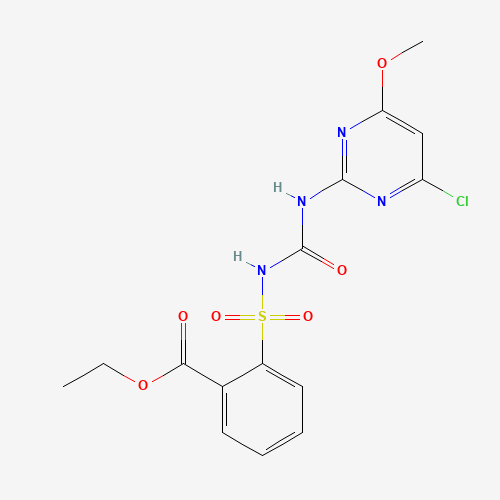
CAS90982-32-4
分子式C15H15ClN4O6S
分子量414.82 g/mol
非危品
Physical Description | Chlorimuron ethyl appears as colorless crystals. Used as an herbicide.
科学粮草官-词典编辑部,修订于:2026-07-06
Toxicity
ToxicityEPA Ecotoxicity
Pesticide Ecotoxicity Data from EPA: 41
Ecotoxicity Values
LC50; Species: Oncorhynchus mykiss (Rainbow trout); Conditions: freshwater; static; Concentration: 8400 ug/L for 4 day /96% AI formulated product/[USEPA, Office of Pesticide Programs; Pesticide Ecotoxicity Database (2000) on 2-[[[
Fate Summary
ATMOSPHERIC FATE: According to a model of gas/particle partitioning of semivolatile organic compounds in the atmosphere(1), chlorimuron-ethyl, which has a measured vapor pressure of 4X10-12 mm Hg at 25 °C(2), will exist solely in the particulate phase in the ambient atmosphere. Particulate-phase chlorimuron-ethyl may be physically removed from the air by wet and dry deposition(SRC).
Soil Adsorption / Mobility
The Koc of chlorimuron-ethyl ranged from 30 in a sandy loam (pH 6.6, 1.1% organic matter) to 170 in a silt loam (pH 5.2, 7.5% organic matter)(1). According to a classification scheme(2), these Koc values indicate that chlorimuron-ethyl is expected to have high to very high mobility in soil(SRC).
Environmental Bioconcentration
An estimated BCF value of 17 was calculated in fish for chlorimuron-ethyl(SRC), using a measured log Kow of 2.50(1) and a regression-derived equation(2). According to a recommended classification scheme(3), this BCF value suggests the potential for bioconcentration in aquatic organisms is low(SRC).
Volatilization from Water / Soil
The Henry's Law constant for chlorimuron-ethyl is estimated as 1.8X10⁻¹⁵ atm-cu m/mole(SRC) from its experimental values for vapor pressure, 4X10-12 mm Hg(1), and water solubility, 1,200 mg/L(2). This value indicates that chlorimuron-ethyl will be essentially nonvolatile from water and moist soil surfaces(SRC). Chlorimuron-ethyl is not expected to volatilize from dry soil surfaces(SRC) based upon its vapor pressure(1).
Environmental Abiotic Degradation
The hydrolysis rate constant for chlorimuron-ethyl was reported as 0.041 days-1 at pH = 5 and <0.2 days-1 at pH 7 and 9(1). This corresponds to hydrolysis half-lives of approximately 17 days at pH 5 and less than 3.5 days at pH 7-9(SRC). The aqueous photolysis rate constant of chlorimuron-ethyl at pH 5 and 25 °C was reported as 0.058 days-1(1); corresponding to a half-life of approximately 12 days(SRC). The photolysis rate constant of chlorimuron-ethyl applied to a soil surface (pH 5.8) was 0.0194 days-1(1); corresponding to a half-life of approximately 36 days(SRC).
Environmental Water Concentrations
SURFACE WATER: The maximum concn of chlorimuron-ethyl measured in 129 water samples from streams and rivers obtained in the Midwestern United States in 1998 was 0.304 ug/L(1).
Effluent Concentrations
The average (maximum) runoff of chlorimuron-ethyl from 3 treated farm plots in Maryland over a 3 year period ranged from 0.025-0.17 ug/L(0.34-2.96 ug/L) for field A, 0.18-1.08 ug/L (5-25.3 ug/L) for field B, and 0.07-0.18 ug/L (0.29-0.47 ug/L) for field C(1).
Artificial Pollution Sources
Chlorimuron-ethyl's production may result in its release to the environment through various waste streams(SRC); its use as a post-emergence herbicide for soya beans and peanut crops(1) will result in its direct release to the environment(SRC).
Probable Routes of Human Exposure
Occupational exposure to chlorimuron-ethyl may occur through dermal contact with this compound at workplaces where chlorimuron-ethyl is produced or used. The general population may be exposed to chlorimuron-ethyl via ingestion of contaminated drinking water. (SRC)
Environmental Fate / Exposure Summary
Chlorimuron-ethyl's production may result in its release to the environment through various waste streams; its use as a post-emergence herbicide for soya beans and peanut crops will result in its direct release to the environment. If released to air, a vapor pressure of 4X10-12 mm Hg at 25 °C indicates chlorimuron-ethyl will exist solely in the particulate phase in the atmosphere. Particulate-phase chlorimuron-ethyl may be physically removed from the air by wet and dry deposition. Chlorimuron-ethyl undergoes aqueous photolysis and photodegradation on soil surfaces, suggesting direct photolysis may be possible in air. If released to soil, chlorimuron-ethyl is expected to have very high to high mobility based upon Koc values in the range of 30 to 170 measured in 4 soils. Volatilization fr...
Interactions
BAS 145 138 protected corn from injury due to low levels of chlorimuron ethyl. Inhibition of root growth was used to monitor injury. BAS 145 138 did not affect uptake, but it caused a two fold increase in the rate of chlorimuron ethyl metabolism in corn roots and shoots. The increase in chlorimuron ethyl metabolism was correlated positively to growth. Routes of metabolism that were accelerated in response to BAS 145 138 included hydroxylation of chlorimuron ethyl at the 5-position of the pyrimidine ring, the formation of the corresponding glucoside, the formation of two glutathione conjugates, and the formation of two unidentified metabolites. The most dramatic of the effects was on the formation of the glucoside of 5-hydroxychlorimuron ethyl. In the roots, the level of this metabolite...
Target Organs
Hematologic
Toxicity Data
LC50 (rat) > 5,000 mg/m3/4h
RAIS Toxicity Values
Oral Chronic Reference Dose Reference: OPP
Human Toxicity Excerpts
/EPIDEMIOLOGY STUDIES/ ...Eight of 16 herbicides were associated with wheeze /among 2,255 Iowa commercial pesticide applicators enrolled in the Agricultural Health Study/ in single-agent models; the risk was almost exclusively associated with the herbicide chlorimuron-ethyl (odds ratio (OR) = 1.62, 95% confidence interval (CI): 1.25, 2.10). Inclusion of chlorimuron-ethyl in models for the other herbicides virtually eliminated the associations. The odds ratios for four organophosphate insecticides (terbufos, fonofos, chlorpyrifos, and phorate) were elevated when these chemicals were modeled individually and remained elevated when chlorimuron-ethyl was included. The association for dichlorvos was not attenuated by chlorimuron-ethyl (OR = 2.48, 95% CI: 1.08, 5.66). Dose-response trends wer...
Non-Human Toxicity Values
LD50 Rat oral >5000 mg/kg
Non-Human Toxicity Excerpts
/GENOTOXICITY/ Genetic toxicity studies were negative for the Ames mutagenicity assay, in vivo bone marrow chromosome aberration assay for 6, 12, 24, and 48 hours, in vitro mammalian gene mutation in Chinese hamster ovary cells, and unscheduled DNA synthesis assay.
1 or Cancer Risk Level 1E-06
Fraction of Contaminant Absorbed Dermally from Soil: 0.1
Antidote and Emergency Treatment
Supportive measures are ordinarily sufficient for successful management of excessive exposures to these herbicides ... . If the patient's condition deteriorates in spite of good supportive care, the operation of an alternative or additional toxicant should be suspected. /Other herbicides/
Hazard Quotient Level 3 or Cancer Risk Level 1E-04
Fraction of Contaminant Absorbed Dermally from Soil: 0.1
USGS Health-Based Screening Levels for Evaluating Water-Quality
Reference: Smith, C.D. and Nowell, L.H., 2024. Health-Based Screening Levels for evaluating water-quality data (3rd ed.). DOI:10.5066/F71C1TWP









