


 一键配货
一键配货
化合物详情
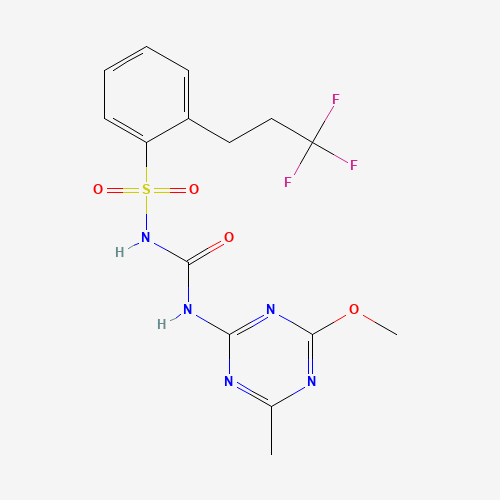
CAS94125-34-5
分子式C15H16F3N5O4S
分子量419.38 g/mol
非危品
Prosulfuron is a member of triazines.
科学粮草官-词典编辑部,修订于:2026-07-06
Toxicity
ToxicityEPA Ecotoxicity
Pesticide Ecotoxicity Data from EPA: 50
Ecotoxicity Values
LD50; Species: Anas platyrhynchos (Mallard Duck) age 20 weeks; oral via capsule 1094 mg/kg /99.2% purity/
Fate Summary
ATMOSPHERIC FATE: According to a model of gas/particle partitioning of semivolatile organic compounds in the atmosphere(1), prosulfuron, which has a vapor pressure of <2.63X10⁻⁸ mm Hg at 25 °C(2), is expected to exist solely in the particulate phase in the ambient atmosphere. Particulate-phase prosulfuron may be removed from the air by wet and dry deposition(SRC). Photodegradation studies in water indicate direct photolysis is not an important fate process(3).
Soil Adsorption / Mobility
Based Freundlich Kfoc (organic carbon normalized Freundlich adsorption coefficient), batch sorption studies in 8 different soils (organic carbon content 0.36-19.34%) determined a Koc range of 3.9-37.3 and an arithmetic Koc mean of 14.2(1). A measured Koc range of 4-251 has also been reported(2). According to a classification scheme(3), these Koc ranges suggest that prosulfuron is expected to have very high to moderate mobility in soil. A pKa of 3.76(2) indicates prosulfuron will exist partially in anion form at pH 5 and almost entirely in anion form at pH 6-9(SRC). Tests using various sorbents and 10 variable-charge soil types found that anion exchange of prosulfuron accounted for up to 82% of overall sorption in the pH range of 3 to 7(4); humic acid and anion-cation exchange capacities...
Environmental Biodegradation
AEROBIC: Laboratory soil dissipation half-lives of prosulfuron at 20 °C ranged from 15.4-229 days with a geometric mean of 62.1 days(1). A compilation of 11 field studies lists a prosulfuron dissipation half-life of 3.8-38.9 days (average of 11.9 days)(1). A field dissipation half-life of 4-36 days is also reported, with the rate depending on temperature, soil moisture and organic content(2). Field dissipation of 90% is reported to range from 14-120 days with a typical value of 60 days(2).
Environmental Bioconcentration
An estimated BCF of 1 was calculated in fish for prosulfuron(SRC), using a log Kow of 1.50(1) and a regression-derived equation(2). According to a classification scheme(3), this BCF suggests the potential for bioconcentration in aquatic organisms is low(SRC).
Volatilization from Water / Soil
A pKa of 3.76(1) indicates prosulfuron will exist partially in anion form at pH 5 and almost entirely in anion form at pH 6-9(SRC), and therefore, since anions do not volatilize, volatilization of anionic prosulfuron will not be an important fate process(SRC). The Henry's Law constant for non-ionized prosulfuron is estimated as <5.0X10⁻¹⁰ atm-cu m/mole(SRC) derived from its vapor pressure, <2.63X10⁻⁸ mm Hg(1), and water solubility, 87-43000 mg/L at pH 5-7.7(1). This Henry's Law constant indicates that non-ionized prosulfuron is expected to be essentially nonvolatile from water surfaces(2). Prosulfuron's estimated Henry's Law constant and ionization indicates that volatilization from moist soil surfaces is not expected to occur(SRC). Prosulfuron is not expected to volatilize from dry soi...
Environmental Abiotic Degradation
The hydrolysis of prosulfuron in buffered aqueous solution at pH 5, 7 and 9 at 25 °C found that prosulfuron was stable at neutral (pH 7) and alkaline (pH 9) conditions, but hydrolyzed under acidic conditions (pH 5) with a half-life of about 10 days(1). One of the major routes of hydrolysis involve hydrolysis of the sulfonylurea bridge to yield the corresponding phenyl- and triazine-cleavage products and minor amounts of desmethyl-prosulfuron and dihydroxmethyltriazine(1). The hydrolysis half-life of prosulfuron in buffered aqueous solution was determined as follows(2): 0.97 days (pH 2), 1.73 days (pH 3), 2.64 days (pH 4), 19 days (pH 5), 224 days (pH 6.5) and 330 days (pH 7.5). The hydrolysis half-life at pH 5 (25 °C) is also reported to be 5-12 days yielding prosulfuron phenyl sulfonam...
Environmental Water Concentrations
RAIN WATER: Prosulfuron was not detected (detection quantification limit 10 ng/L) during ambient rain sampling conducted between 2009-2011 at three wetland areas of the St. Lawrence River basin, Canada(1). Water samples collected from 75 surface water sites in the Upper Mississippi, Missouri and Ohio River basins in 1998 (129 samples) as part of a US Geological Survey study, were analyzed for a variety of sulfonylurea and other herbicides; prosulfuron was detected 6 samples above the MRL (minimum reporting level of 0.005 ug/L) and at a maximum concentration of 0.036 ug/L(2). Sampling of surface waters in Ontario, Canada between 2006-2008 resulted in the following positive detections of prosulfuron: 2006 - 5 of 150 samples (1.75-4.13 ng/L); 2007 - 2 of 120 samples (2.48-3,72 ng/L); 2008...
Ecotoxicity Excerpts
/OTHER TOXICITY INFORMATION/ The effect of four triazinyl-sulfonylurea herbicides (cinosulfuron, prosulfuron, thifensulfuron methyl, triasulfuron) on soil microbial biomass, soil respiration, metabolic activity, metabolic quotient, and some enzymatic activities (acid and alkaline phosphatase, beta-glucosidase, arylsulphatase, and fluorescein diacetate hydrolysis) were monitored under controlled conditions over 30 days. The herbicides were applied at the normal field dose (FD) and at ten-fold (10 FD) the field dose, in order to mimic a long term toxic effect. The measured soil microbial parameters showed that the FD had slight effects on soil microflora, while at 10 FD the tested herbicides exerted a stronger detrimental effect on soil microbial biomass and its biochemical activities.
Atmospheric Concentrations
RURAL/REMOTE: Prosulfuron was not detected (detection limit not reported) during ambient air sampling conducted between 2009-2011 at three wetland areas of the St. Lawrence River basin, Canada(1).
Artificial Pollution Sources
Prosulfuron's production may result in its release to the environment through various waste streams; its use as a post-emergence herbicide for broad spectrum control in maize, sorghum, cereals, pasture and turf(1) will result in its direct release to the environment(SRC).
Probable Routes of Human Exposure
Occupational exposure to prosulfuron may occur through inhalation and dermal contact with this compound at workplaces where ptosulfuron is produced or used. The general population may be exposed to prosulfuron via inhalation and dermal contact in localized agricultural areas where prosulfuron is being applied or recently applied as a herbicide. (SRC)
Environmental Fate / Exposure Summary
Prosulfuron's production may result in its release to the environment through various waste streams; its use as a post-emergence herbicide for broad spectrum control in maize, sorghum, cereals, pasture and turf will result in its direct release to the environment. If released to air, a vapor pressure of <2.63X10⁻⁸ mm Hg at 25 °C indicates prosulfuron will exist solely in the particulate phase in the atmosphere. Particulate-phase prosulfuron will be removed from the atmosphere by wet and dry deposition. Photodegradation studies in water indicate direct photolysis is not an important fate process. If released to soil, soil is expected to have very high to moderate mobility based upon a Koc range of 4-251. A pKa of 3.76 indicates prosulfuron will exist partially in anion form at pH 5 and a...
Effect Level
collection=toxvaldb&kind=^EL$
Lethal Dose
collection=toxvaldb&kind=^LD$
Toxicity Summary
IDENTIFICATION AND USE: Prosulfuron is a triazinyl-sulfonylurea herbicide. HUMAN STUDIES: There are no data available. ANIMAL STUDIES: It is not skin or eye irritant, or sensitizer. In a subchronic oral toxicity study, prosulfuron technical was administered to 4 beagle dogs/sex/dose via the diet at dose levels of 0, 15, 150, 1500, or 3000 ppm for 90 days. Hematotoxicity was observed in both sexes. Hepatotoxicity was observed in both sexes at the two highest dose levels. At the highest dose tested, two males displayed myocardial necrosis with fibrosis and dystrophic mineralization in the ventricular and papillary muscles, and one female displayed myocardial degeneration. A 90-day feeding study in mice was conducted in which prosulfuron was administered orally to mice at dietary levels of...
Effect Concentration
collection=toxvaldb&kind=^EC$
RAIS Toxicity Values
Oral Chronic Reference Dose Reference: OPP
Carcinogen Classification
No indication of carcinogenicity to humans (not listed by IARC).
Non-Human Toxicity Values
LD50 Rat (female) oral 546 mg/kg bw
Reference and Risk Values
collection=toxvaldb&kind=^RRV$
Non-Human Toxicity Excerpts
/LABORATORY ANIMALS: Subchronic or Prechronic Exposure/ In a 21-day dermal toxicity study, doses of 0, 10, 100, 500 or 1,000 mg/kg/day CGA-152005 Technical, were applied to the clipped backs of Chbb:NZW rabbits for 6 hours/day, 7 days/week, for 3 weeks. No significant treatment-related toxicity was reported with the possible exception of the lung lesions (edema and intestinal pneumonia) which may suggest a slight treatment-related decline in the general health of the high dose males, and increased absolute and relative liver weights in both sexes at 500 and 1000 mg/kg/day. However, these findings were not considered sufficient to establish a systemic toxicity LOAEL. The increased liver weights, however, were considered indicative of dermal absorption of CGA-152005. Based on the absence...
Antidote and Emergency Treatment
/SRP:/ Advanced treatment: Consider orotracheal or nasotracheal intubation for airway control in the patient who is unconscious, has severe pulmonary edema, or is in severe respiratory distress. Positive-pressure ventilation techniques with a bag valve mask device may be beneficial. Consider drug therapy for pulmonary edema ... . Consider administering a beta agonist such as albuterol for severe bronchospasm ... . Monitor cardiac rhythm and treat arrhythmias as necessary ... . Start IV administration of D5W TKO /SRP: "To keep open", minimal flow rate/. Use 0.9% saline (NS) or lactated Ringer's (LR) if signs of hypovolemia are present. For hypotension with signs of hypovolemia, administer fluid cautiously. Watch for signs of fluid overload ... . Treat seizures with diazepam (Valium) or l...
USGS Health-Based Screening Levels for Evaluating Water-Quality
Reference: Smith, C.D. and Nowell, L.H., 2024. Health-Based Screening Levels for evaluating water-quality data (3rd ed.). DOI:10.5066/F71C1TWP









