


 一键配货
一键配货
化合物详情
CAS95058-81-4
分子式C9H11F2N3O4
分子量263.2 g/mol g/mol
危化品
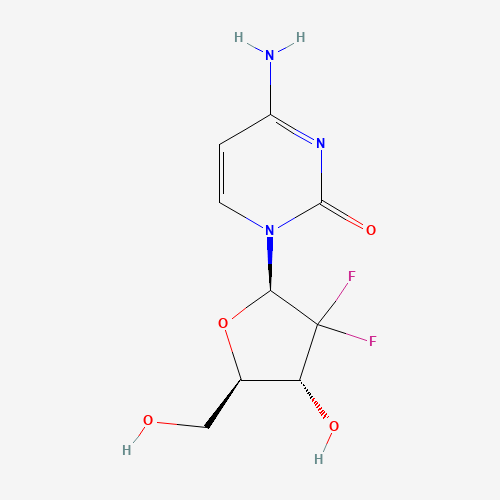
Gemcitabine is a 2'-deoxycytidine having geminal fluoro substituents in the 2'-position. An inhibitor of ribonucleotide reductase, gemcitabine is used in the treatment of various carcinomas, particularly non-small cell lung cancer, pancreatic cancer, bladder cancer and breast cancer. It has a role as a radiosensitizing agent, an antimetabolite, an antineoplastic agent, a xenobiotic, an immunosuppressive agent, an antiviral drug, a photosensitizing agent, a prodrug, a DNA synthesis inhibitor, an EC 1.17.4.1 (ribonucleoside-diphosphate reductase) inhibitor and an environmental contaminant. It is a pyrimidine 2'-deoxyribonucleoside and an organofluorine compound.
科学粮草官-词典编辑部,修订于:2026-07-06
Toxicity
ToxicityEnvironmental Water Concentrations
While data specific to gemcitabine were not located(SRC, 2007), the literature suggests that some pharmaceutically active compounds originating from human and veterinary therapy are not eliminated completely in municipal sewage treatment plants and are therefore discharged into receiving waters(1). Wastewater treatment processes often were not designed to remove them from the effluent(2). Selected organic waste compounds may be degrading to new and more persistent compounds that may be released instead of or in addition to the parent compound(2). Studies have indicated that several polar pharmaceutically active compounds can leach through soil(1).
Milk Concentrations
It is not known wether gemcitabine or its metabolites are distributed into breast milk.
Probable Routes of Human Exposure
/PRECAUTIONS FOR ANTINEOPLASTIC AGENTS:/ ... exposure may be through inadvertent ingestion of the drug on foodstuffs (eg, workers' lunches), inhalation of drug dusts or droplets or direct skin contact. /Antineoplastic agents/
Interactions
/The authors/ investigated the possible pharmacokinetic interactions of gemcitabine and oxaliplatin in patients with advanced solid tumors. Ten patients with advanced stage solid tumors were treated with gemcitabine (1500 mg/sq m) as a 30-min intravenous infusion on days 1 and 8, followed by oxaliplatin (130 mg/sq m) as a 4-hr intravenous infusion, on day 8 every 21 days. Pharmacokinetic data for 24 hr after dosing were obtained for both day 1 (gemcitabine without oxaliplatin coadministration) and day 8 (gemcitabine with oxaliplatin) during the first cycle of treatment. Gemcitabine levels in plasma were quantified using a reverse-phase high-performance liquid chromatography assay with ultraviolet detection, and total and ultrafiltrated platinum levels by flameless atomic absorption spec...
Hepatotoxicity
Likelihood score: C (probable rare cause of clinically apparent liver injury).
Human Toxicity Excerpts
/CASE REPORTS/ /Investigators/ hereby report a case of radiation recall dermatitis and myositis occurring on gemcitabine monotherapy, five months after completing chemoradiation for locally advanced pancreatic cancer. Radiation recall resolved spontaneously with withdrawal of gemcitabine. This ... case report ... describes gemcitabine-induced radiation recall in rectus abdominus muscles after gemcitabine-based radiation therapy.
Drug Induced Liver Injury
References: DOI:10.1016/j.drudis.2019.09.022
Non-Human Toxicity Excerpts
/GENOTOXICITY/ Gemcitabine was mutagenic in in vitro (mouse lymphoma assay) and in vivo (mouse micronucleus assay) mammalian test systems. However, it was not mutagenic in the Ames test, in vivo sister chromatid exchange, or in in vitro (chromosomal aberration assay and unscheduled DNA synthesis) test systems.
Populations at Special Risk
... Gemcitabine is characterized by a narrow therapeutic index, and its liver elimination depends upon a key enzymatic step, driven by cytidine deaminase (CDA). CDA is prone to gene polymorphism, including the 208A>G mutation, which can result in marked enzymatic deficiency with subsequent impact on drug exposure levels and related toxicities. We have developed a simple and inexpensive method to determine phenotypically CDA status in cancer patients, as an attempt to detect those at risk upon gemcitabine intake. Conjointly to genotypic investigations, this method was used to phenotype, in a retrospective setting, a female patient displaying extremely severe, and eventually lethal, toxicities after administration of a standard gemcitabine/carboplatin protocol. Phenotypic investigation sh...
Antidote and Emergency Treatment
Enhanced elimination. Because of the rapid intracellular incorporation of most of these agents, dialysis and other extracorporeal removal procedures are generally not effective. /Antineoplastic agents/
Effects During Pregnancy and Lactation
A telephone follow-up study was conducted on 74 women who received cancer chemotherapy at one center during the second or third trimester of pregnancy to determine if they were successful at breastfeeding postpartum. Only 34% of the women were able to exclusively breastfeed their infants, and 66% of the women reported experiencing breastfeeding difficulties. This was in comparison to a 91% breastfeeding success rate in 22 other mothers diagnosed during pregnancy, but not treated with chemotherapy. Other statistically significant correlations included: 1. mothers with breastfeeding difficulties had an average of 5.5 cycles of chemotherapy compared with 3.8 cycles among mothers who had no difficulties; and 2. mothers with breastfeeding difficulties received their first cycle of chemothera...









