


 一键配货
一键配货
化合物详情
CAS95635-55-5
分子式C24H33N3O4
分子量427.54 g/mol g/mol
危化品
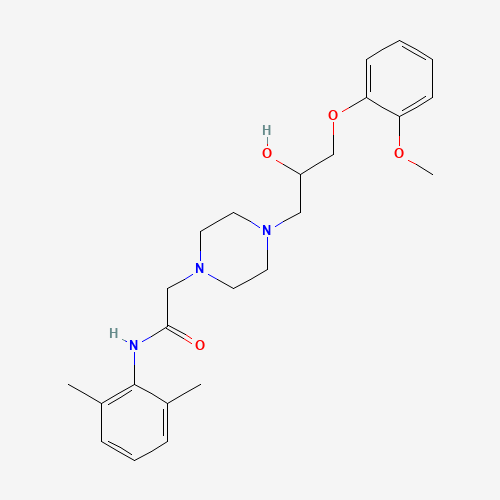
N-(2,6-dimethylphenyl)-2-{4-[2-hydroxy-3-(2-methoxyphenoxy)propyl]piperazin-1-yl}acetamide is an aromatic amide obtained by formal condensation of the carboxy group of 2-{4-[2-hydroxy-3-(2-methoxyphenoxy)propyl]piperazin-1-yl}acetic acid with the amino group of 2,6-dimethylaniline. It is a monomethoxybenzene, a monocarboxylic acid amide, a secondary alcohol, a N-alkylpiperazine and an aromatic amide.
科学粮草官-词典编辑部,修订于:2026-07-06
Toxicity
ToxicityInteractions
Potential pharmacokinetic interaction (increased plasma ranolazine concentrations). Ranolazine should not be used with ketoconazole (a potent CYP3A inhibitor) or itraconazole.
Hepatotoxicity
Likelihood score: D (possible rare cause of clinically apparent liver injury).
Adverse Effects
Coadministration of ranolazine and metformin, each at a dose of 1000 mg twice daily, increased plasma concentrations of metformin. Patients on ranolazine 1000 mg twice daily should not exceed a total daily metformin dose of 1700 mg, and their blood glucose should be closely monitored.
Toxicity Summary
High doses of ranolazine can cause dose-dependent increases in dizziness, tremors, dysphagia, hallucinations, unsteady gait, nausea, and vomiting. Supportive therapy should be given in cases of overdose. ECG monitoring may be necessary if a ranolazine overdose occurs. Ranolazine is about 62% bound to plasma proteins, so hemodialysis is not adequate for an overdose.
Human Toxicity Excerpts
/OTHER TOXICITY INFORMATION/ Ranolazine was shown to improve exercise parameters in patients with chronic angina. It works by switching myocardial energy metabolism from fatty acids to glucose, thus increasing the efficiency of ATP production under hypoxic conditions. Tumors are hypoxic and may also respond to ranolazine. ... These findings have implications for the use of ranolazine in patients with a history of malignant neoplasms or adenomatous polyps.
Drug Induced Liver Injury
References: DOI:10.1016/j.drudis.2019.09.022
Non-Human Toxicity Excerpts
/LABORATORY ANIMALS: Developmental or Reproductive Toxicity/ There was an increased incidence of misshapen sternebrae and reduced ossification of pelvic and cranial bones in fetuses of pregnant rats dosed at 400 mg/kg/day (2 times the MRHD on a surface area basis). These doses in rats were associated with an increased maternal mortality rate.
Populations at Special Risk
Heart failure (NYHA Class I to IV) had no significant effect on ranolazine pharmacokinetics. Ranexa had minimal effects on heart rate and blood pressure in patients with angina and heart failure NYHA Class I to IV. No dose adjustment of Ranexa is required in patients with heart failure.
Antidote and Emergency Treatment
/SRP:/ Advanced treatment: Consider orotracheal or nasotracheal intubation for airway control in the patient who is unconscious, has severe pulmonary edema, or is in severe respiratory distress. Positive-pressure ventilation techniques with a bag valve mask device may be beneficial. Consider drug therapy for pulmonary edema ... . Consider administering a beta agonist such as albuterol for severe bronchospasm ... . Monitor cardiac rhythm and treat arrhythmias as necessary ... . Start IV administration of D5W /SRP: "To keep open", minimal flow rate/. Use 0.9% saline (NS) or lactated Ringer's if signs of hypovolemia are present. For hypotension with signs of hypovolemia, administer fluid cautiously. Watch for signs of fluid overload ... . Treat seizures with diazepam or lorazepam ... . Use...









