


 一键配货
一键配货
化合物详情
CAS95737-68-1
分子式C20H19NO3
分子量321.37 g/mol g/mol
危化品
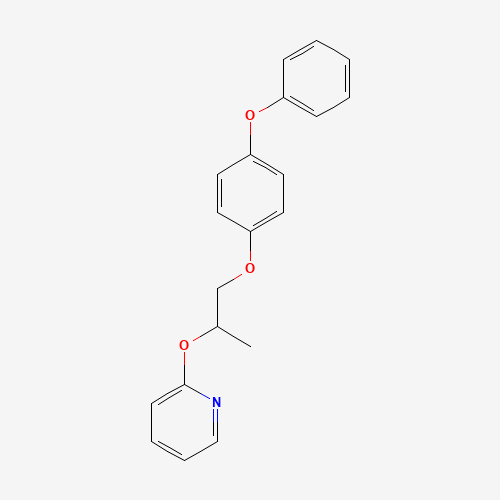
Pyriproxyfen is an aromatic ether that consists of propylene glycol having a 2-pyridyl group at the O-1 position and a 4-phenoxyphenyl group at the O-3 position. It has a role as a juvenile hormone mimic. It is a member of pyridines and an aromatic ether. It is functionally related to a 4-phenoxyphenol.
科学粮草官-词典编辑部,修订于:2026-07-06
Toxicity
ToxicityEPA Ecotoxicity
Pesticide Ecotoxicity Data from EPA: 35
Ecotoxicity Values
EC50; Species: Daphnia magna (Water Flea) age >13 day, mature organism; Conditions: freshwater, renewal, 20 °C; Concentration: 0.0557 ug/L for 5 days; Effect: population, change sex ratio /formulation/
Fate Summary
ATMOSPHERIC FATE: According to a model of gas/particle partitioning of semivolatile organic compounds in the atmosphere(1), pyriproxyfen, which has a vapor pressure of <9.8X10⁻⁸ mm Hg at 23 °C(2), will exist solely in the particulate phase in the ambient atmosphere. Particulate-phase pyriproxyfen may be removed from the air by wet and dry deposition(SRC). Pyriproxyfen does not contains chromophores that absorb at wavelengths >290 nm(3) and, therefore, is not expected to be susceptible to direct photolysis by sunlight(SRC). [
Soil Adsorption / Mobility
Using a structure estimation method based on molecular connectivity indices(1), the Koc of pyriproxyfen can be estimated to be 1.2X10+5(SRC). According to a classification scheme(2), this estimated Koc value suggests that pyriproxyfen is expected to be immobile in soil. In a field study, pyriproxyfen was shown to readily adsorb to organic matter(3). In leaching trials with four different soil types, over 50% of the pyriproxyfen remained in the upper 6 cm of a 30-cm soil column; there was no indication of rapid potential for downward migration(3).
Environmental Bioconcentration
An estimated BCF of 1620 was calculated in fish for pyriproxyfen(SRC), using a log Kow of 5.37(1) and a regression-derived equation(2). According to a classification scheme(3), this BCF suggests the potential for bioconcentration in aquatic organisms is very high, provided the compound is not metabolized by the organism(SRC).
Volatilization from Water / Soil
The Henry's Law constant for pyriproxyfen is estimated as 6.3X10⁻¹⁰ atm-cu m/mole(SRC) using a fragment constant estimation method(1). This Henry's Law constant indicates that pyriproxyfen is expected to be essentially nonvolatile from water and moist soil surfaces(2). Pyriproxyfen is not expected to volatilize from dry soil surfaces(SRC) based upon a vapor pressure of <9.8X10⁻⁸ mm Hg(3).
Environmental Abiotic Degradation
Pyriproxyfen is not expected to undergo hydrolysis in the environment due to the lack of functional groups that hydrolyze under environmental conditions(1). Pyriproxyfen does not contain chromophores that absorb at wavelengths >290 nm(1) and, therefore, is not expected to be susceptible to direct photolysis by sunlight(SRC).
Environmental Water Concentrations
SURFACE WATER: Pyriproxyfen was detected in surface water samples collected July 19, 2005 at 0.02 and 0.01 ug/L in a waste water reservoir and coastal sea water about 1 hour before low tide off the coast of Kirishima City, Japan; pyriproxyfen was not detected (detection limit 0.01 ug/L) in any other of the samples collected (18 reservoir, 36 coastal collected June 21, 2005 and 17 reservoir, 35 coastal collected July 19, 2005)(1). Pyriproxyfen was detected in surface water samples from lakes (Volvi, Doirani, Kerkini) located in Northern Greece; samples were collected fall/winter 2010 and spring/summer 2011(2).
Food Survey Values
Agricultural products monitored in Hyogo Prefecture, Japan from April 1995 to March 2000, found pyriproxyfen in 4 of 60 imported orange samples at concentrations of <0.05 ug/g, but was not detected in any of the other 227 imported and 478 domestic products sampled(1). Of 173 agricultural products analyzed in 2006 from Japan, two were reported to contain pyriproxyfen at 13 and 16 ng/g(2). Pyriproxyfen was detected in soya-based nutraceutical products at a maximum of 1.5 ug/kg(3).
Ecotoxicity Excerpts
/AQUATIC SPECIES/ ...A chronic full life-cycle test with Chironomus riparius from the first-instar larvae in the parental (P) generation until emergence in the subsequent F1 generation was conducted at different temperatures (16 and 24 °C), testing the effect of the insect growth regulator pyriproxyfen at 1, 3, 10, 30, and 100 ug/L. The emergence ratios were significantly affected by the interaction of temperature, chemical treatment, and generation, showing that, at lower temperatures, the negative effects of pyriproxyfen exposure were significantly greater in the F1 generation than in the P generation. The development rate showed that the effects of the interactions were significant in the F1 generation, underscoring the importance of extended exposure as a useful amendment to the ris...
ICSC Environmental Data
The substance is very toxic to aquatic organisms. Bioaccumulation of this chemical may occur in aquatic organisms. The substance may cause long-term effects in the aquatic environment. Avoid release to the environment in circumstances different to normal use.
Atmospheric Concentrations
Pyriproxyfen was detected (>6.5 pg/cu m) in at least one of 54 air particulate samples collected Apr-July 2009 from three stations of the atmospheric monitoring network of the Regional Valencia Government, Spain(1).
Artificial Pollution Sources
Pyriproxyfen's production may result in its release to the environment through various waste streams; its use as an insecticide(1) will result in its direct release to the environment(SRC).
Probable Routes of Human Exposure
Occupational exposure to pyriproxyfen may occur through inhalation and dermal contact with this compound at workplaces where pyriproxyfen is produced or used. Monitoring data indicate that the general population may be exposed to pyriproxyfen via inhalation of ambient air, ingestion of food containing insecticide residue, and dermal contact with consumer products containing pyriproxyfen. (SRC)
Other Environmental Concentrations
Pyriproxyfen is listed as an ingredient in about 50 inside the home, pesticide and pet care products(1). Pyriproxyfen had dissipation half-lives from plants of 58 days under field conditions and 518-918 days under cold storage conditions(2).
Environmental Fate / Exposure Summary
Pyriproxyfen's production may result in its release to the environment through various waste streams; its use as an insecticide will result in its direct release to the environment. If released to air, a vapor pressure of <9.8X10⁻⁸ mm Hg at 23 °C indicates pyriproxyfen will exist solely in the particulate phase in the atmosphere. Particulate-phase pyriproxyfen will be removed from the atmosphere by wet and dry deposition. Pyriproxyfen does not contain chromophores that absorb at wavelengths >290 nm and, therefore, is not expected to be susceptible to direct photolysis by sunlight. If released to soil, pyriproxyfen is expected to have no mobility based upon an estimated Koc of 1.2X10+5. Volatilization from moist soil surfaces is not expected to be an important fate process based upon an...
Symptoms
Ingestion Exposure: No acute symptoms expected.
Effect Level
collection=toxvaldb&kind=^EL$
Interactions
A number of pesticides are used in agricultural production with some having estrogenic activities, such as endocrine-disrupting chemicals that may affect wildlife and humans. This study aimed to detect the estrogenic effects of some mixed agricultural chemicals in agricultural production. The assay to measure estrogenic activity was evaluated by the cell proliferative activity of MtT/Se cells, which respond well to estrogen. To evaluate MtT/Se cells we went down to the molecular level of estrogen receptor (ER)-alpha and ER-beta expression. The proportion of ER-alpha to ER-beta was 3.55:1, as determined by semi-quantitative real-time PCR. These results showed that ER-alpha was dominant in MtT/Se cells on the transcriptional level, therefore implying that the estrogenic activity detected...
Lethal Dose
collection=toxvaldb&kind=^LD$
Toxicity Data
LC50 (rat) > 1,300 mg/m3/4h
Adverse Effects
Occupational hepatotoxin - Secondary hepatotoxins: the potential for toxic effect in the occupational setting is based on cases of poisoning by human ingestion or animal experimentation.
Exposure Routes
The substance can be absorbed into the body by ingestion and by inhalation of dust.
Toxicity Summary
IDENTIFICATION AND USE: Pyriproxyfen could be solid or liquid. Pyriproxyfen is a potent insect growth regulator affecting the hormonal balance in insects, thereby resulting in strong suppression of embryogenesis, metamorphosis, and adult formation. It is used to control agricultural, veterinary, and human health pests such as whiteflies and scale insects; flies, mosquitoes, and fleas. It is also used as veterinary medication. HUMAN EXPOSURE AND TOXICITY: The substance may have effects on the blood and liver. This may result in anemia, impaired functions and tissue lesions. Pyriproxyfen was reported to have some estrogenic activity in human ovarian carcinoma cells. In genotoxicity assays, an increase in unscheduled DNA synthesis was not induced both with and without activation in HeLa ce...
Lethal Concentration
collection=toxvaldb&kind=^LC$
RAIS Toxicity Values
Oral Chronic Reference Dose Reference: OPP
Human Toxicity Excerpts
/ALTERNATIVE and IN VITRO TESTS/ /This study/ evaluated the potential of pyriproxyfen to activate the ER by using an estrogen-responsive luciferase reporter gene in human ovarian carcinoma cells (E-CALUX assay system). Pyriproxyfen was reported to have some estrogenic activity with an EC10 of 2.9 x 10⁻⁵ M.
Acceptable Daily Intakes
EPA has established the Reference Dose (RfD) for pyriproxyfen, 2-[1-methyl-2-(4-phenoxyphenoxy)ethoxy]pyridine at 0.35 mg/kg/day. This RfD is based on a NOAEL of 35.1 mg/kg/day and an uncertainty factor (UF) of 100. The NOAEL was established from the combined chronic feeding/oncogenicity study in rats where the the LOAEL was 3,000 ppm, based on a 16.9% decr in body weight gain in females when compared to controls.
Carcinogen Classification
No indication of carcinogenicity to humans (not listed by IARC).
Non-Human Toxicity Values
LD50 Rabbit dermal >2,000 mg/kg
Reference and Risk Values
collection=toxvaldb&kind=^RRV$
Non-Human Toxicity Excerpts
/LABORATORY ANIMALS: Subchronic or Prechronic Exposure/ Groups of 21 male and 21 female Sprague-Dawley (SD) rats were fed diets containing pyriproxyfen at concentrations of 0, 80, 400, 2,000 and 10,000 ppm for 6 months. No death was found in any group. Alopecia in the neck and/or back, and soft feces were noticed in both sexes fed 10,000 ppm. A marked decrease in body weight gain was observed in both sexes fed 10,000 ppm throughout the treatment period, accompanying a decrease in food-consumption and an increase in water-intake during the initial stage of treatment. In terms of urinalysis, proteinuria, increases in K excretion, and, in number, yellowness or brownish-yellowness in appearance, were observed in both sexes fed 10,000 ppm. In females fed 10,000 ppm, increases in bilirubin, N...
Evidence for Carcinogenicity
Cancer Classification: Group E Evidence of Non-carcinogenicity for Humans
Antidote and Emergency Treatment
Advanced treatment: Consider orotracheal or nasotracheal intubation for airway control in the patient who is unconscious, has severe pulmonary edema, or is in severe respiratory distress. Positive-pressure ventilation techniques with a bag valve mask device may be beneficial. Consider drug therapy for pulmonary edema ... . Consider administering a beta agonist such as albuterol for severe bronchospasm ... . Monitor cardiac rhythm and treat arrhythmias as necessary ... . Start IV administration of D5W TKO /SRP: "To keep open", minimal flow rate/. Use 0.9% saline (NS) or lactated Ringer's (LR) if signs of hypovolemia are present. For hypotension with signs of hypovolemia, administer fluid cautiously. Watch for signs of fluid overload ... . Treat seizures with diazepam or lorazepam ... . U...
USGS Health-Based Screening Levels for Evaluating Water-Quality
Reference: Smith, C.D. and Nowell, L.H., 2024. Health-Based Screening Levels for evaluating water-quality data (3rd ed.). DOI:10.5066/F71C1TWP









