

 一键配货
一键配货
化合物详情
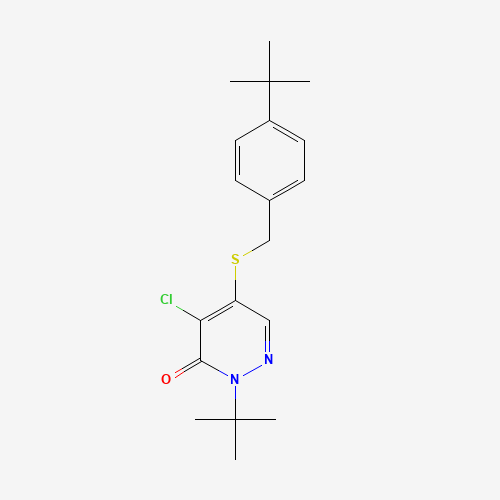
CAS96489-71-3
分子式C19H25ClN2OS
分子量364.93 g/mol g/mol
危化品
Pyridaben is an organochlorine insecticide, a pyridazinone and an organochlorine acaricide. It has a role as a mitochondrial NADH:ubiquinone reductase inhibitor.
科学粮草官-词典编辑部,修订于:2026-07-06
Toxicity
ToxicityEPA Ecotoxicity
Pesticide Ecotoxicity Data from EPA: 48
Ecotoxicity Values
LC50 Bluegill sunfish 1.8-3.3 ug/l (96 hr) /Conditions of bioassay not specified/.
Fate Summary
ATMOSPHERIC FATE: According to a model of gas/particle partitioning of semivolatile organic compounds in the atmosphere(1), pyridaben, which has an experimental vapor pressure of 1.18X10⁻⁶ mm Hg at 20 °C(3) is expected to exist in both the vapor and particulate phases in the ambient atmosphere(1). Vapor-phase pyridaben will be degraded in the atmosphere by reaction with photochemically-produced hydroxyl radicals(2); the half-life for this reaction in air is estimated to be 9.4 hours(SRC). The rate constant for the vapor-phase reaction of pyridaben with ozone has been estimated as 1.7X10⁻¹⁶ cu cm/molecule-sec at 25 °C(SRC) which was derived using a structure estimation method(2). This corresponds to an atmospheric half- life of about 7 days(SRC) at an atmospheric concentration of 7X10+11...
Soil Adsorption / Mobility
The Koc value for pyridaben is >5000(1) and according to a classification scheme(2), this Koc value suggests that pyridaben is expected to be immobile in soil.
Environmental Biodegradation
AEROBIC: Aerobic aquatic metabolism studies suggest that biodegradation is not an important route for removal of pyridaben(1).
Environmental Bioconcentration
An estimated BCF of 7500(SRC) was calculated for pyridaben, using an experimental water solubility of 0.012 mg/l(1) and a regression-derived equation(2). According to a classification scheme(3), this BCF suggests the potential for bioconcentration in aquatic organisms is very high(SRC). However, experimental data has shown that pyridaben has a low potential for biocentration in fish based on studies with rainbow trout and fathead minnow(4).
Volatilization from Water / Soil
The Henry's Law constant for pyridaben is estimated as 4.7X10⁻⁵ atm-cu m/mole(SRC) derived from its vapor pressure, 1.18X10⁻⁶ mm Hg(1), and water solubility, 0.012 mg/l(1). This estimated Henry's Law constant indicates that pyridaben may volatilize from water surfaces(2). Based on this Henry's Law constant, the volatilization half-life from a model river (1 m deep, flowing 1 m/sec, wind velocity of 3 m/sec)(3) is estimated as 28 hours(SRC). The volatilization half-life from a model lake (1 m deep, flowing 0.05 m/sec, wind velocity of 0.5 m/sec)(3) is estimated as 14 days(SRC). However, volatilization from water surfaces is expected to be attenuated by adsorption to suspended solids and sediment in the water column. The estimated volatilization half-life from a model pond is 60 years(SRC...
Environmental Abiotic Degradation
The rate constant for the vapor-phase reaction of pyridaben with photochemically-produced hydroxyl radicals has been estimated as 4.1X10⁻¹¹ cu cm/molecule-sec at 25 °C(SRC) using a structure estimation method(1). This corresponds to an atmospheric half-life of about 9.4 hours at an atmospheric concentration of 5X10+5 hydroxyl radicals per cu cm(1). The rate constant for the vapor-phase reaction of pyridaben with ozone has been estimated as 1.6X10⁻¹⁶ cu cm/molecule-sec at 25 °C(SRC) that was derived using a structure estimation method(1). This corresponds to an atmospheric half-life of about 7 days at an atmospheric concentration of 7X10+11 ozone molecules per cu cm(1). Hydrolysis is not expected to be an important route for removal of pyridaben in aquatic systems(2). It has been reporte...
Ecotoxicity Excerpts
/AQUATIC SPECIES/ Residual toxicities of avermectin b1 and pyridaben for 2- to 28-day exposure periods were assessed in laboratory and greenhouse trials for eight species of beneficial arthropods that are commercially produced for greenhouse pest management. In laboratory trials, Amblyseius degenerans (Berlese), Aphidius colemani (Viereck), Aphidoletes aphidimyza (Rondani), Dacnusa sibirica (Telenga), Encarsia formosa (Gahan), and Orius insidiosus (Say) showed high mortality (>85%) when exposed to 6-day residues of both acaricides. Lower toxicities were observed for pyridaben to the predatory mites Amblyseius cucumeris (Oudermans) and Phytoseiulus persimilis (Athias-Henroit), and for avermectin b1 to A. cucumeris after exposure to 6-day residues. In greenhouse trials, pyridaben showed s...
Artificial Pollution Sources
Pyridaben's production may result in its release to the environment through various waste streams; it's use as an insecticide(1) will result in its direct release to the environment(SRC).
Probable Routes of Human Exposure
Occupational exposure to pyridaben may occur through inhalation and dermal contact with this compound at workplaces where pyridaben is produced or used. (SRC)
Environmental Fate / Exposure Summary
Pyridaben's production may result in its release to the environment through various waste streams; it's use as an insecticide will result in its direct release to the environment. If released to air, a vapor pressure of 1.18X10⁻⁶ mm Hg at 20 °C indicates pyridaben will exist in both the vapor and particulate phases. Vapor-phase pyridaben will be degraded in the atmosphere by reaction with photochemically-produced hydroxyl radicals; the half-life for this reaction in air is estimated to be 9.4 hours. Particulate-phase pyridaben will be removed from the atmosphere by wet and dry deposition. If released to soil, pyridaben is expected to have no mobility based upon an estimated Koc of 3.4X10+5. Volatilization from moist soil surfaces is expected based upon an estimated Henry's Law constant...
Effect Level
collection=toxvaldb&kind=^EL$
Lethal Dose
collection=toxvaldb&kind=^LD$
Toxicity Data
LD50: 161 mg/kg (acute, rat) (L2092)
Effect Concentration
collection=toxvaldb&kind=^EC$
Lethal Concentration
collection=toxvaldb&kind=^LC$
RAIS Toxicity Values
Oral Chronic Reference Dose Reference: OPP
Acceptable Daily Intakes
An acute RfD of 0.50 mg/kg/day (NOAEL=50 mg/kg/day, UF=100) was selected for use in assessing acute dietary risk for the general population. This acute RfD is based upon the acute oral neurotoxicity study with rats in which the following effects were observed at the LOAEL of 100 mg/kg/day: clinical signs of toxicity, decreased food consumption, and decreased body weight gain. ...A chronic RfD of 0.005 mg/kg/day (NOAEL=0.50 mg/kg/day; UF=100) was selected for use in assessing chronic dietary risk. This chronic RfD is based on the chronic toxicity study in dogs, in which the following effects were observed at the LOAEL of 0.5 mg/kg/day: increased incidence of clinical signs in both sexes and decreased body weight gain in females. An additional uncertainty factor (3x, for not establishing...
Carcinogen Classification
No indication of carcinogenicity to humans (not listed by IARC).
Non-Human Toxicity Values
LD50 Mouse (female) oral 383 mg/kg
Reference and Risk Values
collection=toxvaldb&kind=^RRV$
Non-Human Toxicity Excerpts
/LABORATORY ANIMALS: Developmental or Reproductive Toxicity/ In a developmental toxicity study, Sprague-Dawley rats (22/group) from Charles River, U.K., received NC-129 (Pyridaben, 98.0% active ingredient (a.i.)) via gavage at dose levels of 0, 2.5, 5.7, 13.0, or 30.0 mg/kg/day from gestation day 6-15, inclusive. Natural mating was used. Maternal toxicity, observed at 13.0 and 30.0 mg/kg/day, consisted of decreased body weight/weight gain and food consumption during the dosing period. Based on these effects, the Maternal Toxicity LOEL is 13.0 mg/kg/day and the Maternal Toxicity NOAEL is 4.7 mg/kg/day (82% of 5.7 mg/kg/day based on concn analysis). Developmental toxicity NOAEL is 13.0 mg/kg/day based on observed decreased fetal body weight and increased incomplete ossification in selecte...
Antidote and Emergency Treatment
If inhaled: Remove victim to fresh air. Apply artificial respiration if indicated. If swallowed: Call a physician or Poison Control Center. Drink 1 or 2 glasses of water and induce vomiting by touching back of throat with finger. Do not induce vomiting or give anything by mouth to an unconscious person. If in eyes: Flush eyes with plenty of water. Call a physician if irritation persists. If on skin: Wash with plenty of soap and water. Get medical attention if irritation persists. /Pyridaben K/
USGS Health-Based Screening Levels for Evaluating Water-Quality
Reference: Smith, C.D. and Nowell, L.H., 2024. Health-Based Screening Levels for evaluating water-quality data (3rd ed.). DOI:10.5066/F71C1TWP