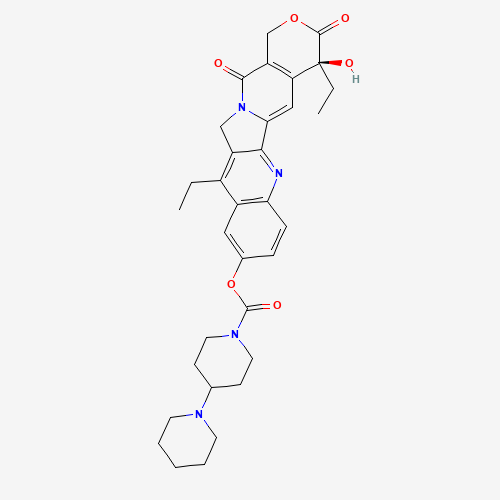
Interactions
Coadministration of atazanavir sulfate, a CYP3A4 and UGT1A1 inhibitor has the potential to increase systemic exposure to SN-38, the active metabolite of irinotecan. Physicians should take this into consideration when co-administering these drugs.
Adverse Effects
New regimens and administration schedules are under investigation to reduce the adverse effects that cause limitations on irinotecan use. Atropine sulfate has been administered with irinotecan to minimize the amount of irinotecan-induced diarrhea in patients. Loperamide administration with irinotecan has also been an effective medication to treat diarrhea.
Toxicity Summary
Among the most common dose-limiting toxicities of irinotecan, commonly shared with the DNA topoisomerase I inhibitor group of chemotherapeutic agents, is diarrhea. Diarrhea is most widely noted within 7 to 10 days after treatment and can be life-threatening. High-dose loperamide, a dopamine agonist that does not cross the blood-brain barrier, is effective against diarrhea caused by irinotecan. It allows the ability to increase doses during chemotherapy to levels that patients can tolerate.
Human Toxicity Excerpts
/SIGNS AND SYMPTOMS/ Deaths due to sepsis following severe neutropenia have been reported in patients treated with Camptosar.
Drug Induced Liver Injury
References: DOI:10.1016/j.drudis.2019.09.022
Non-Human Toxicity Excerpts
/LABORATORY ANIMALS: Developmental or Reproductive Toxicity/ Administration of 6 mg/kg/day intravenous irinotecan to rats (which in separate studies produced an irinotecan Cmax and AUC about 2 and 0.2 times, respectively, the corresponding values in patients administered 125 mg/sq m) and rabbits (about one-half the recommended human weekly starting dose on a mg/sq m basis) during the period of organogenesis, is embryotoxic as characterized by increased post-implantation loss and decreased numbers of live fetuses.
Populations at Special Risk
... The association of ABCC2 (MRP2) polymorphisms and haplotypes with irinotecan disposition and diarrhea /were examined/. A cohort of 167 Caucasian cancer patients who were previously assessed for irinotecan pharmacokinetics (90-min infusion given every 21 days), toxicity, and UGT1A1*28 genotype were genotyped for polymorphisms in ABCC2 using Pyrosequencing. Fifteen ABCC2 haplotypes were identified in the studied patients. The haplotype ABCC2*2 was associated with lower irinotecan clearance (28.3 versus 31.6 L/hr; P=0.020). In patients who did not carry a UGT1A1*28 allele, a significant reduction of severe diarrhea was noted in patients with the ABCC2*2 haplotype (10 versus 44%; odds ratio, 0.15; 95% confidence interval, 0.04-0.61; P=0.005). This effect was not observed in patients wit...
Antidote and Emergency Treatment
Enhanced elimination. Because of the rapid intracellular incorporation of most of these agents, dialysis and other extracorporeal removal procedures are generally not effective. /Antineoplastic agents/
Effects During Pregnancy and Lactation
◉ Effects on Lactation and Breastmilk



 一键配货
一键配货