

 一键配货
一键配货
化合物详情
CAS98105-99-8
分子式C20H17F2N3O3
分子量385.36 g/mol g/mol
非危品
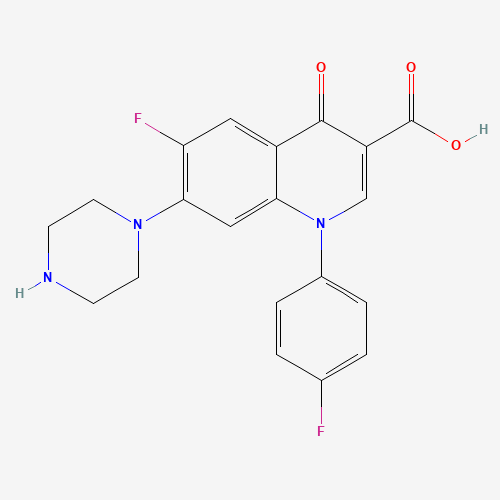
6-fluoro-1-(4-fluorophenyl)-4-oxo-7-(1-piperazinyl)-3-quinolinecarboxylic acid is a member of quinolines.
科学粮草官-词典编辑部,修订于:2026-07-06
Toxicity
ToxicityFate Summary
ATMOSPHERIC FATE: According to a model of gas/particle partitioning of semivolatile organic compounds in the atmosphere(1), sarafloxacin, which has an estimated vapor pressure of 1.6X10⁻¹⁴ mm Hg at 25 °C(SRC), determined from a fragment constant method(2), is expected to exist solely in the particulate phase in the ambient atmosphere. Particulate-phase sarafloxacin may be removed from the air by wet and dry deposition(SRC). Sarafloxacin contains chromophores that absorb at wavelengths >290 nm(3) and, therefore, may be susceptible to direct photolysis by sunlight(SRC).
Soil Adsorption / Mobility
Koc values of sarafloxacin have been reported as 55,000-155,000(1). According to a classification scheme(2), this Koc range suggests that sarafloxacin is expected to be immobile in soil.
Environmental Biodegradation
ANAEROBIC: Degradation half-lives of sarafloxacin were reported in marine sediment as 151 and >300 days in the 0-1 and 5-7 cm layers, respectively(1).
Environmental Bioconcentration
An estimated BCF of 3 was calculated in fish for sarafloxacin(SRC), using an estimated log Kow of 1.07(1) and a regression-derived equation(1). According to a classification scheme(2), this BCF suggests the potential for bioconcentration in aquatic organisms is low(SRC).
Volatilization from Water / Soil
The pKa values of the carboxy and amino moieties of sarafloxacin are 5.6 and 8.2, respectively(1), indicating that this compound will primarily exist as a zwitter ion and ions do not volatilize from water or moist soil surfaces(SRC). Sarafloxacin is not expected to volatilize from dry soil surfaces(SRC) based upon an estimated vapor pressure of 1.6X10⁻¹⁴ mm Hg(SRC), determined from a fragment constant method(2).
Environmental Abiotic Degradation
Sarafloxacin is not expected to undergo hydrolysis in the environment due to the lack of functional groups that hydrolyze under environmental conditions(1). Sarafloxacin contains chromophores that absorb at wavelengths >290 nm(1) and, therefore, may be susceptible to direct photolysis by sunlight(SRC). Sarafloxacin photodegraded rapidly in natural water systems(2). Aqueous photodegradation half-lives ranged from <1 hour at 1 cm depth in mid-summer to approximately 20 hours in mid-winter at 50 cm depth(3).
Environmental Water Concentrations
SURFACE WATER: In a survey conducted by the United States Geological Survey, sarafloxacin was not detected (0.02 ug/L reporting level) in 115 submitted water samples from a network of 139 US stream sampling sites across 30 states during 1999-2000(1). Sarafloxacin was not detected (detection limit 0.01 ng/L) in 143 surface water samples collected from 1994 to 2000 from US streams in the Great Lakes basin(2). Sarafloxacin was not detected (detection limit 0.01 ug/L) in samples upstream and down stream from 10 waste water treatment plants located around the US(3). Sarafloxacin was not detected (detection limit 0.01 ug/L) at 23 stream locations in 10 cities in Iowa(4). Sarafloxacin was not detected (detection limit 10 ng/L) at two sampling locations in the Assunpink Creek watershed area in...
Food Survey Values
Sarafloxacin was detected (detection limit <4 ug/kg) in some of the 16 honey samples tested(1). Sarafloxacin was not detected (detection limit <0.4 ug/kg) in honey samples imported into Canada(2). Sarafloxacin was not detected (detection limit 0.04-0.52 ug/kg) in 16 infant and young children powdered milk samples purchased from Spanish markets(3).
Effluent Concentrations
Sarafloxacin was not detected (detection limit 5.4 ng/L) in effluent samples from South Shore Water Reclamation Facility and Jones Island Water Reclamation Facility located in Milwaukee, Wisconsin(1). Sarafloxacin was not detected (detection limit 0.01 ug/L) in effluent samples from 10 waste water treatment plants located around the country (Arizona, Colorado, Georgia, Iowa, Kansas, Minnesota, Nevada, New Jersey, New York, South Dakota)(2). Sarafloxacin was not detected (detection limit 0.05 ug/L) in influent and effluent samples collected from seven wastewater treatment plants at locations in Wisconsin; samples were collected Oct 22, 2001 to May 9, 2002(3). Sarafloxacin was not detected (detection limit 44 ng/L) in effluent samples from a wastewater treatment plant in East Lansing, Mic...
Fish/Seafood Concentrations
Sarafloxacin was detected in fish liver, back fat, skin and bone 50 days after the end of medication at 4, 4, 114 and 27 ng/g, respectively, and 6, 6, 95 and 60 ng/g, respectively, 80 days after treatment(1). Sarafloxacin was not detected in muscle tissue at either the 50 or 80 day post treatment times(1).
Artificial Pollution Sources
Sarafloxacin's production and administration as an antibiotic in poultry(1) and fish(2) may result in its release to the environment through various waste streams(SRC). Sarafloxacin is authorized or allowed use in aquaculture in certain European countries and Chile(3), which may result in its direct release to the environment. (SRC)
Sediment/Soil Concentrations
SEDIMENT: Sarafloxacin was not detected (detection limit 5.4 ng/g) in sediment samples from five locations in Lake Michigan collected on two dates May 15, 2009 and April 9, 2010(1). Sarafloxacin was not detected in 40 sediment samples collected April to June 2010 from Puget Sound, Washington(2).
Probable Routes of Human Exposure
Occupational exposure to sarafloxacin may occur through dermal contact with this compound at workplaces where sarafloxacin is produced or used. Monitoring data indicate that the general population may be exposed via ingestion of fish raised on fish farms that use sarafloxacin and some foods. (SRC)
Environmental Fate / Exposure Summary
Sarafloxacin's production and administration as an antibiotic in poultry and fish may result in its release to the environment through various waste streams. Its use in aquaculture may result in its direct release to the environment. If released to air, an estimated vapor pressure of 1.6X10⁻¹⁴ mm Hg at 25 °C indicates sarafloxacin will exist solely in the particulate phase in the atmosphere. Particulate-phase sarafloxacin will be removed from the atmosphere by wet and dry deposition. Sarafloxacin contains chromophores that absorb at wavelengths >290 nm and, therefore, may be susceptible to direct photolysis by sunlight. If released to soil, sarafloxacin is expected to have no mobility based upon Koc values of 55,000-155,000. The pKa values of the carboxy and amino moieties of sarafloxac...
Toxicity Summary
IDENTIFICATION AND USE: Sarafloxacin is a fluoroquinolone antibacterial agent. It is used in veterinary medicine for the treatment and control of bacterial infections in poultry. Sarafloxacin is also used in aquaculture for the treatment in of furunculosis, vibriosis and enteric redmouth in Salmonidae. HUMAN EXPOSURE AND TOXICITY: The safety of single oral doses of sarafloxacin was studied in groups of healthy male volunteers. Six subjects received 100 mg sarafloxacin, six received 200 mg, five received 400 mg, and five received 800 mg. The adverse events reported most frequently were dizziness and asthenia. Emotional lability, somnolence, and hiccoughs were reported by those receiving the lowest dose. The safety of oral sarafloxacin administered for seven consecutive days was also stud...
Human Toxicity Excerpts
/HUMAN EXPOSURE STUDIES/ The safety of single oral doses of sarafloxacin was studied in groups of healthy male volunteers. Six subjects received 100 mg sarafloxacin, six received 200 mg, five received 400 mg, and five received 800 mg. The adverse events reported most frequently were dizziness and asthenia, although the increase in incidence was not dose-related. Emotional lability, somnolence, and hiccoughs were the only adverse events reported by those receiving the lowest dose. ...
Non-Human Toxicity Values
LD50 Mouse oral >8,000 mg/kg body weight
Non-Human Toxicity Excerpts
/LABORATORY ANIMALS: Subchronic or Prechronic Exposure/ ... Six groups of two young adult (age not stated) beagle dogs of each sex were given sarafloxacin in gelatin capsules at doses of 8, 20, 50, 125, 300, or 800 mg/kg bw per day for two weeks. Two positive control groups were included: in one, dogs received nalidixic acid in a gelatin capsule at a dose of 50 mg/kg bw per day, and in the other dogs received nalidixic acid at a dose of 125 mg/kg bw per day for two weeks. The negative control group received empty gelatin capsules. ... Clinical signs, body weight, food consumption, clinical pathology, and anatomical (gross and microscopic) pathology were evaluated. The treatment-related effects in the sarafloxacin-treated groups included lachrymation and emesis (at 8-125 mg/kg bw per day...
Antidote and Emergency Treatment
Emergency and supportive measures. 1. Maintain an open airway and assist ventilation if necessary. 2. Treat coma, seizures, hypotension, anaphylaxis, and hemolysis if they occur. 3. replace fluid losses resulting from gastroenteritis with IV crystalloids. 4. Maintain steady urine flow with fluids to alleviate crystalluria from overdoses of sulfonamides, ampicillin, or amoxicillin. /Antibacterial agents/